Which households are they for?

Households without ducting or an external opening

You should rule out vented appliances and choose between a standard condenser dryer and a heat pump model based on how often you dry laundry, your electricity consumption and the space available. Que Choisir distinguishes these technologies from models that require a connection to the outside.

Flat dwellers close to living areas

Indoor installation is still possible, but the stated noise level, dimensions, door opening and the model’s ventilation requirements are especially important when the appliance is near a living room or bedroom.

Households drying lots of laundry or delicate fabrics

Compare the capacity, fabric programmes and cycle times, rather than focusing solely on the energy class. The capacity should suit your usual loads and that of your washing machine.

What to check before buying

Heat pump

Consider this if: you dry laundry regularly without an external air outlet and want to limit electricity consumption.

Bear in mind: cycles can be longer; check the noise level, footprint, filters and water management.

Standard condenser dryer

Consider this if: you need an appliance without an external vent and generally prefer shorter cycles.

Compare: the energy label and consumption per 100 cycles, as this technology uses more energy than a heat pump according to Que Choisir.

Indoor clothes airer

Consider this if: you can dry laundry in a sufficiently large, well-ventilated room or one fitted with mechanical ventilation extraction.

Bear in mind: damp laundry increases indoor humidity; ADEME advises against concentrating it in a small, enclosed room.

Priority What to check Your needs
Installation without an external vent Choose a condenser or heat pump technology. Check the model’s manual for installation conditions, electrical connection requirements and condensate management. I need to install the appliance without an opening or duct leading outside.
Consumption and cycle time Compare the energy label, consumption in kWh/100 cycles and the duration of the Eco programme. Tumble dryers sold in the European Union have a regulated energy label. I want to reduce consumption without making cycles difficult to fit into my daily routine.
Space and noise Measure the recess, access route and door clearance. Compare the height, width, depth and stated sound level in dB(A). My tumble dryer will be close to a living area or installed in a limited space.
Capacity Check the rated capacity and compare it with your usual loads and the capacity of your washing machine. I would rather avoid running multiple cycles for large washes or using a drum that is too lightly loaded.
Maintenance and condensate water Identify accessible filters, the required maintenance tasks and whether the appliance has a water tank or drain hose. I want to know in advance whether I will need to empty a tank or whether a water drainage connection is possible.
Humidity when using an airer Choose a large, well-ventilated room or one fitted with mechanical ventilation extraction for air-drying laundry. If I dry laundry on an airer, I need to be able to limit humidity in the flat.

Mistakes to avoid

  • Confusing the absence of an external vent with an installation free from constraints

    A condenser dryer is suitable without external ducting, but it still has requirements relating to dimensions, access, electrical connection and water management, as specified by the manufacturer.

    Measure the space, door clearance and access to the water tank. Also check whether a drain hose can be connected and read the manual for the exact model reference.

  • Choosing based solely on drying speed

    A shorter cycle does not, by itself, tell you anything about consumption. Heat pump models use less energy than standard condenser dryers according to Que Choisir, but their cycles can be longer.

    Compare consumption per 100 cycles, the duration of the Eco programme and how often you actually dry laundry before making your choice.

  • Ignoring noise and dimensions

    A heat pump tumble dryer is still a deep appliance, and its noise may be noticeable in a flat. The Bosch, Electrolux and Beko models cited by their manufacturers are rated between 63 and 65 dB(A).

    Compare the exact dimensions and stated noise levels of the models, then allow enough space to load, unload and maintain the appliance.

  • Drying all your laundry in an enclosed room

    Laundry that is air-dried releases moisture into the home. ADEME recommends a large, well-ventilated room or one fitted with mechanical ventilation extraction.

    Keep the airer in a ventilated space; otherwise, compare a mechanical solution that is compatible with your installation.

Brand overview

Bosch

The French range includes 8 kg and 9 kg heat pump tumble dryers, with some models offering condensate management and condenser maintenance options.

  • According to Bosch, the WQG2450SFR offers a 9 kg capacity, 64 dB(A), a self-cleaning condenser and a water drain hose.
  • These features are specific to the WQG2450SFR: the WTH83V01FF, for example, is rated at 8 kg and 65 dB(A), without either of these two features.

Electrolux

This heat pump tumble dryer range includes 8 kg models designed for indoor condenser installation.

  • Electrolux states that the EW8HI4835FG offers an 8 kg capacity, 63 dB(A), energy class B and 85 kWh/100 cycles.
  • The dedicated programmes for delicate fabrics are manufacturer claims; compare the Eco cycle time and programmes for the specific model.

Beko

The range includes heat pump models with delayed start, filtration and a variety of programmes to compare based on the maintenance routine you prefer.

  • Beko states that the D3H18C01W has a double lint filter, a delayed end time of 0 to 24 hours and a noise level of 64 dB(A).
  • The C energy class and the stated duration of 174 minutes for the full-load cotton programme should be compared on a like-for-like basis with other models.

Miele

The T1 heat pump range includes configurations for stacked installation and features related to condensate water management.

  • According to Miele, the 8 kg TWC640WP includes a condensate water tank, an integrated drain kit and compatibility with stacked installation.
  • Check the consumption, noise and Eco cycle duration on the model’s label or product sheet before comparing it.

Joybuy products for this need

Joybuy condenser tumble dryer options for a home without an external air outlet, to be compared based on the space available, capacity, noise and condensate management.

Hotpoint CHD84MWBSEE 8 kg white heat pump tumble dryer

Hotpoint CHD84MWBSEE heat pump tumble dryer, 8 kg

A heat pump option for regular drying without an external vent.

8 kg capacity, energy class C, stated noise level of 64 dB, Easy Cleaning 2-in-1 filter, delayed start and the option to connect a drain hose.

Check the dimensions, door clearance, Eco cycle duration and installation requirements for your space.

Joybuy
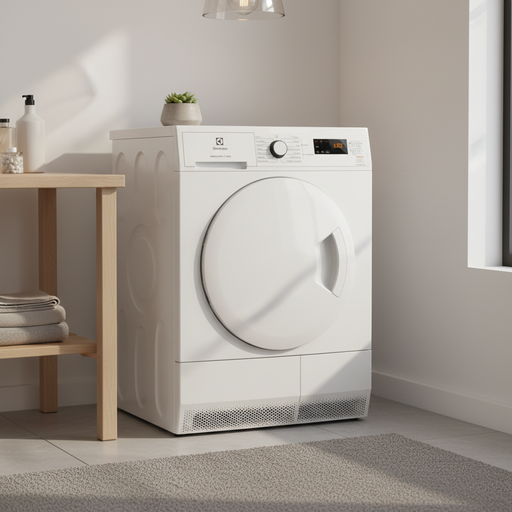
Electrolux EDH1018CD GentleCare 8 kg white condenser tumble dryer

Electrolux EDH1018CD GentleCare condenser tumble dryer, 8 kg

A condenser option worth considering for a home without external ducting.

8 kg capacity, stated dimensions of 60 × 65 × 85 cm, reversible door, water collection tank, OptiSense sensors and a stated noise level of 66 dB(A).

Energy class E is stated; compare the energy label, consumption, Eco cycle duration and installation requirements before buying.

Joybuy

Frequently asked questions

Can I install a tumble dryer without an external opening?

Yes, with a condenser tumble dryer, including a heat pump model: Que Choisir states that these appliances do not require a connection to the outside. However, check the electrical connection, condensate management and installation requirements in the manual for the exact model.

Is a heat pump suitable for every use?

It is particularly suitable for frequent drying when electricity consumption is an important consideration. Que Choisir states that it uses less energy than standard condenser technology, but cycles can be longer, so also compare the Eco cycle duration, noise and capacity.

Which elements of the energy label should I compare?

Compare the energy class, consumption in kWh/100 cycles, the duration of the Eco programme, acoustic noise and the condensation efficiency class where stated. An energy label is mandatory for domestic tumble dryers sold in the European Union.

Can an airer replace a tumble dryer in a flat?

Yes, if the laundry can dry in a large, well-ventilated room or one fitted with mechanical ventilation extraction. ADEME highlights that air-drying laundry is a significant source of indoor humidity, so avoid using a small, enclosed room.

Does the filter still need maintaining with a self-cleaning condenser?

Yes. A self-cleaning condenser can reduce some maintenance tasks, but the tasks specified in the manual are still necessary. In particular, lint filters must be maintained in accordance with the manufacturer’s instructions.