Households that often dry large loads
If you can set aside space for a dedicated appliance, compare heat pump tumble dryers by capacity, stated energy consumption and the maintenance required for the model you’re considering.


If you regularly dry large loads and have space for a dedicated appliance, consider a heat pump tumble dryer. According to UFC-Que Choisir, it doesn’t need an external vent. A washer-dryer is better suited to limited space, provided you’re happy with a lower drying capacity than washing capacity. Spinning your laundry and then air-drying it indoors avoids the need for an additional drying appliance, but you’ll need a suitable, well-ventilated room.
If you can set aside space for a dedicated appliance, compare heat pump tumble dryers by capacity, stated energy consumption and the maintenance required for the model you’re considering.
A washer-dryer combines both functions in one appliance. However, UFC-Que Choisir points out that its drying capacity is lower than its washing capacity. Check whether your loads can be dried without having to split them into inconveniently small batches.
Spinning your laundry and then air-drying it indoors requires enough space for your clothes. For this option, the recommendations of the Q-WASH project, supported by ADEME, favour a large, well-ventilated room or one with mechanical ventilation extraction.
Without an external vent, the space available is the first thing to consider when choosing between a dedicated appliance and a washer-dryer. Whether you can air-dry your laundry in a suitable room will then determine if indoor drying is a practical option.
Consider this if: you regularly dry laundry and have space for a dedicated appliance, but no external vent.
Bear in mind: it will take up extra space and require the maintenance set out in the manual. Also compare cycle times and the energy consumption of the specific model.
Consider this if: you already own one, for example. According to UFC-Que Choisir, this type of dryer condenses moisture without needing an external vent.
Check: its energy label and consumption before comparing it with a heat pump model.
Consider this if: you need one appliance to handle both washing and drying, particularly for smaller loads.
Bear in mind: its drying capacity is lower than its washing capacity. UFC-Que Choisir also recommends checking cycle times and water use during drying.
Consider this if: you don’t want to add a drying appliance and can use a suitable room for air-drying.
Bear in mind: drying depends on the space available and the room’s ventilation or extraction, in line with the recommendations of the Q-WASH project, supported by ADEME.
| Factor | What to check | Who this matters to |
|---|---|---|
| Electricity use for frequent drying | Compare the stated energy consumption and reference programme on the labels of the models you’re considering, as well as how easy it is to access the filter and water tank. | If I run drying cycles often, the energy used by each cycle is an important factor in my choice. Around 29% of consumers would put this electricity cost first. |
| Space for appliances | Measure the space, required depth, connections and door clearance. For a washer-dryer, check the washing and drying capacities separately. | When I only have room for one appliance, combining washing and drying matters more than being able to dry a large load. This lack of space would be the top priority for around 21% of consumers. |
| Drying capacity | Check the drying capacity in kg, not just the washing capacity, and look at the duration of programmes suited to your fabrics. | When I have large loads of laundry, I want to avoid splitting them across several cycles. Drying capacity would therefore be the main factor for around 29% of consumers. |
| Drying without an additional appliance | Check that you have room for an airer and can use a large, well-ventilated room or one with mechanical ventilation extraction. | If I prefer to air-dry my laundry after spinning it, I need a room where this is practical. Avoiding an additional tumble dryer would be the main priority for around 21% of consumers. |
A washer-dryer may not be able to dry the entire load it can wash in one go. UFC-Que Choisir distinguishes between these two capacities.
Compare both figures in kg and plan your laundry around the drying capacity.
If you need to split a load, you’ll have more laundry to handle and may need to run several drying cycles.
The old and new energy label scales for tumble dryers can’t be read as one continuous scale.
To compare two models, check which scale is used, the stated energy consumption and the programme it applies to.
Air-drying laundry indoors adds moisture to your home. The Q-WASH project, supported by ADEME, recommends using a large, well-ventilated room or one fitted with mechanical ventilation extraction.
Before choosing this option, check the space available and the room’s actual ventilation or extraction. This general recommendation is not an assessment of your home.
Features vary between models. LG says that the condition of the condenser and how often automatic cleaning runs can vary depending on the conditions of use.
Check the manual for the model you choose to find out how to maintain the filter, water tank and condenser, even if automatic cleaning is advertised.
Heat pump tumble dryers worth considering if condenser access and drying controls are important to you.
A range worth exploring for heat pump tumble dryers, particularly if you’re comparing condenser maintenance requirements.
Compare Miele heat pump tumble dryers first by capacity and the programmes you need for your laundry.
Washer-dryers to consider when you only have space for one appliance.
These models cover two ways to manage laundry without an external vent: heat pump tumble dryers if you have space for a dedicated appliance, and washing machines to use with an indoor airer in a suitable room. Check the dimensions and installation requirements for each model before choosing.
 Image unavailable
For drying laundry in a dedicated appliance without an external vent, if you have enough space.
Listed capacity of 8 kg; class C stated for this model. Compare the stated energy consumption and check the dimensions and programme times.
 Image unavailable
A dedicated appliance to consider if your home doesn’t have an external vent.
Listed capacity of 8 kg, class D stated and a double-layer lint filter specified for this model. Check the dimensions, stated energy consumption and programme times.
 Image unavailable
For drying laundry in a dedicated appliance without an external vent, provided you have a suitable space.
Confirm the capacity before buying: the title states 10 kg, while the main description lists 8 kg. Class D is stated. Also check the dimensions, stated energy consumption and programme times.
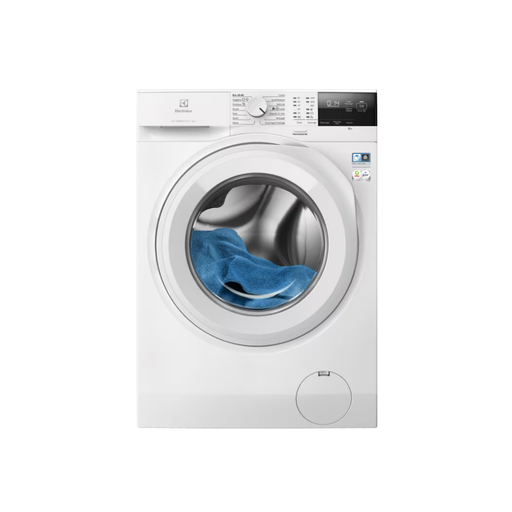 Image unavailable
For spinning your laundry before air-drying it in a suitable room, without adding a tumble dryer.
Washing capacity of 8 kg, maximum spin speed stated as 1,400 rpm and spin-drying efficiency class B. This model doesn’t dry laundry: you’ll need an airer and a well-ventilated room or one with mechanical ventilation extraction, in line with the recommendations of the Q-WASH project, supported by ADEME.
 Image unavailable
For washing and spinning laundry before air-drying it indoors, if you have a suitable room.
Washing capacity of 6 kg, maximum spin speed stated as 1,400 rpm and spin-drying efficiency class B. These figures don’t indicate a drying capacity: the laundry needs to be air-dried afterwards.
Yes. According to UFC-Que Choisir, condenser tumble dryers, including heat pump models, don’t need an external vent. Check the manual for the model’s clearance requirements, the room’s ventilation and how to drain or dispose of the condensed water.
Not necessarily: its drying capacity is lower than its washing capacity, as UFC-Que Choisir points out. Check both figures in kg for the model you’re considering and be prepared to remove some laundry if the wash load exceeds the drying limit.
Yes. Follow the manual’s instructions for the filter, water tank, alerts and condenser on the specific model. LG says that the condition of the condenser and how often automatic cleaning runs can vary depending on the environment and how damp the laundry is.
The Q-WASH project, supported by ADEME, recommends a large, well-ventilated room or one with a mechanical ventilation extract vent, preferably humidity-controlled. Make sure you can fit an airer without blocking the ventilation. This general advice is no substitute for assessing a damp problem in your home.