People without an external vent
If your home has neither a suitable external opening nor a vent, a vented tumble dryer won’t meet your needs. Look for a condenser model, then check its installation instructions.


If you don’t have an external vent or duct, consider condenser tumble dryers rather than vented models. According to Que Choisir, heat pump models generally use less electricity, while conventional condenser models usually dry clothes faster. In either case, check the instructions, the space and ventilation in the room, and how the condensed water is handled. Not having a vent doesn’t guarantee that moisture won’t build up on surfaces.
If your home has neither a suitable external opening nor a vent, a vented tumble dryer won’t meet your needs. Look for a condenser model, then check its installation instructions.
The type of appliance alone doesn’t determine whether a location is suitable. Electrolux warns that a room that’s too small can encourage condensation on surfaces. Check the space, ventilation and temperature range required for the model you’re considering.
If you use your tumble dryer frequently, compare the stated consumption in kWh/100 cycles, the capacity and the duration of the programme you’ll use. According to Que Choisir, heat pump models generally use less energy, but usually take longer to dry clothes than conventional condenser models.
First, make sure the appliance doesn’t need to vent air outside, then check its instructions against the room where you plan to install it. Once you’ve confirmed it’s suitable, compare energy use, cycle times and capacity.
Consider this if: you don’t have an external vent and use your tumble dryer frequently, provided the cycle times work for you.
The trade-off: according to Que Choisir, this technology generally uses less electricity, but usually takes longer to dry clothes than a conventional condenser model.
Consider this if: you don’t have an external vent and cycle time matters more to you than electricity use.
The trade-off: Que Choisir says these models generally dry clothes faster, but use more energy than heat pump models.
| Priority | What to check | What matters to me |
|---|---|---|
| Air venting | Check the appliance type on its product page and the requirements in its instructions. A vented model needs a usable external opening or duct. | My home has no external vent, so I need to rule out any appliance that requires air to be expelled outside. |
| Installation room | Check the available space, clearances, ventilation and temperature range specified for the model. Electrolux warns that a room that’s too small can lead to condensation. | I want to install the appliance without overlooking the moisture that could build up on walls or windows. |
| Energy use and cycle time | Compare the kWh/100 cycles on the same stated basis, along with the duration of the programme for the load in question. The technology alone won’t tell you the energy use or drying time of a specific model. | If I dry clothes often, I’m looking for a balance between electricity use and cycle times. |
| Capacity and water | Make sure the capacity in kg suits your usual loads. Check whether there’s a water tank and its specifications, or what’s required to connect the appliance directly to a drain. | My loads need to fit in the drum, and I need to be able to manage the condensed water every time I use it. |
Electrolux warns that a room that’s too small can encourage condensation on walls or windows, even when you’re using a condenser tumble dryer.
Before you buy, check the model’s instructions against the space available, the ventilation options and the room temperature.
According to Que Choisir, heat pump models generally use less energy than conventional condenser models, but usually take longer to dry clothes. This trade-off doesn’t tell you the figures for the model you’re considering.
Compare the kWh/100 cycles and the duration of a programme suited to your load, as well as the capacity and condensation efficiency class.
If the appliance has a tank, you’ll need to empty it. A hose or direct-drain kit can only be used if the model and installation allow it.
Decide how you’ll handle the water, then check the documentation for any accessories required and whether your plumbing connection is compatible.
A vented tumble dryer isn’t suitable for a home without a usable external opening or vent.
If you can’t confirm that you have a suitable outlet, look for a condenser model rather than trying to improvise a way to vent the air.
These examples can help you find useful information in French product listings. The specifications mentioned apply to the models listed, not to every product from each brand.
Product pages for some models give details of capacity, energy use and operating conditions, which you can check against your chosen location.
Bosch documentation lets you explore its heat pump models and the options available for managing water.
The published dimensions of a Whirlpool heat pump model can help you make an initial check that it will fit in your chosen space.
These condenser and heat pump models suit shoppers looking for a tumble dryer that doesn’t vent air outside. Their capacities and individual specifications can help you narrow down your options. Always check the instructions to make sure the appliance is suitable for your room.
 Image unavailable
Worth considering if you’re looking for an 8 kg heat pump model that doesn’t vent air outside. The title lists an energy class of C. Compare the kWh/100 cycles and check the instructions for ventilation and water management requirements.
 Image unavailable
Worth considering if you’re looking for an 8 kg condenser tumble dryer for a home without an external vent. The title mentions OptiSense and a propane refrigerant. Check the model’s documentation for installation requirements, energy use and water management.
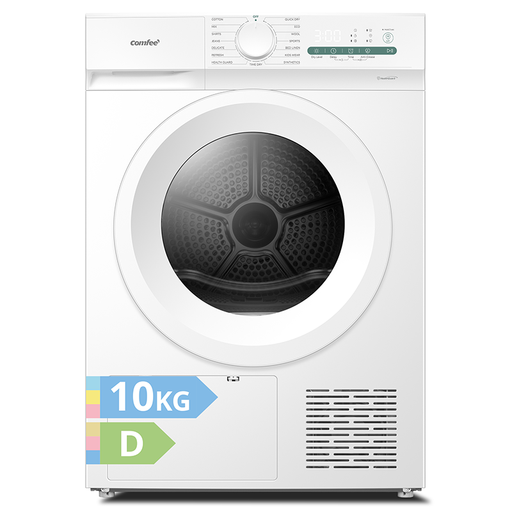 Image unavailable
Its stated 10 kg capacity is worth comparing with your usual laundry loads. The title lists an energy class of D and UV lighting. Check the kWh/100 cycles, room requirements and water collection options before choosing this model.
 Image unavailable
This heat pump model has a stated capacity of 8 kg, which you can compare with your laundry loads. The title lists an energy class of D and UV lighting. Check the energy label and instructions for details on energy use, installation and managing condensed water.
This technology is worth considering if your home has no way to vent air outside. You’ll still need to check the instructions, the available space and the room’s ventilation. Electrolux warns that a room that’s too small can encourage condensation on surfaces.
Collecting water from the laundry doesn’t necessarily prevent condensation in a room that’s too small or poorly ventilated. Electrolux recommends using the appliance in a room that’s spacious enough and well ventilated. Also check the installation requirements for your model.
How often you need to empty it depends on factors such as the model and the size of the load. If you’d prefer to use a direct drain instead of a tank, check that the tumble dryer’s instructions allow it and that your plumbing has a compatible connection.
It depends on how you use your tumble dryer. According to Que Choisir, heat pump models generally use less electricity, while conventional condenser models usually dry clothes faster. To compare two appliances, look at their capacity, kWh/100 cycles and the duration of the programmes you’re interested in.