Households that do laundry frequently
If you do laundry regularly, a dedicated appliance lets you dry your clothes without an external vent. Electricity use and the space required then become important factors.


Without an external vent, choose an appliance that collects water from your laundry rather than a vented tumble dryer. A heat pump tumble dryer is a good choice if you have space for a dedicated appliance and want to keep electricity use low. A standard condenser dryer is also worth considering, but compare cycle times; a washer-dryer is best suited to homes where there’s room for only one appliance. In every case, check the dimensions, how water is handled and the drying capacity of the model you choose.
If you do laundry regularly, a dedicated appliance lets you dry your clothes without an external vent. Electricity use and the space required then become important factors.
A washer-dryer combines both functions in one appliance. Its drying capacity is generally lower than its washing capacity, so check how much laundry you can dry in one go.
If you need to get through several loads, compare the programme times and capacities of the exact model, as well as the maintenance required for the tank and filters. The technology alone won’t tell you how long a full load takes.
Worth considering: if you have space for a dedicated appliance and want to keep electricity use down when drying frequently.
Bear in mind: check the programme times and maintenance requirements for each model. UFC-Que Choisir highlights this technology’s low electricity consumption.
Worth considering: if you want a dedicated appliance without an external vent and need cycle times that suit your routine.
Check: compare the energy label and programme time for each model. Don’t assume how much energy it uses or how quickly it dries based on the technology name alone.
Worth considering: if you have space for only one appliance to wash and dry your laundry.
Bear in mind: according to UFC-Que Choisir, drying capacity is generally lower than washing capacity, so one wash load may need to be dried in several batches.
| Factor | What to check | Who it matters to |
|---|---|---|
| Electricity use | Compare the energy label and Eco programme data for similar models. | When I’m doing several loads, I want to keep an eye on how much electricity each drying cycle uses. Around 42 % of consumers rank energy use as their main concern. |
| Space and installation | Measure the space and required clearances; if stacking appliances, check the instructions and make sure the stacking kit is compatible. | With space for just one appliance, I need to be able to wash and dry without adding a second appliance on the floor. Saving space is the top priority for around 33 % of consumers. |
| Drying time and capacity | Check the programme time for your load and the drying capacity, which differs from the washing capacity on a combined appliance. | If I need my laundry ready quickly or have several loads to dry, drying speed matters more. It’s the main concern for around 25 % of consumers. |
According to UFC-Que Choisir, a condenser tumble dryer collects the water removed from your laundry in a tank or drains it away. So, even without an external vent, you still need to consider how the water will be handled.
Check whether the model you’re considering has a tank, and consult its manual to see if direct drainage is possible and which connection is suitable.
A load that fits in the drum for washing may exceed the permitted drying capacity. For example, Electrolux lists the EW8W3816BI as having an 8 kg washing capacity and a 4 kg drying capacity.
Check the two capacities separately for the model you’re considering, and think about how much laundry you want to dry in one go.
Stacking frees up floor space, but it depends on the appliances and the stacking kit. Bosch states, for example, that its 00576101 kit requires a washing machine that is more than 55 cm deep.
Check both model numbers, any exclusions for the kit and the installation instructions before planning a stack.
The technology alone won’t tell you how much energy a particular model uses, how long its cycles take or what maintenance it requires.
Compare the specifications of models that will actually fit your space, then check their capacity, Eco programme and the maintenance tasks listed in the manual.
Beko offers standard condenser tumble dryers as well as heat pump models.
Bosch offers heat pump tumble dryers and stacking kits for certain appliance combinations.
Electrolux offers dedicated appliances, washer-dryers and a drainage kit for some condenser tumble dryers.
These models include heat pump tumble dryers, a condenser dryer whose exact technology needs confirming, and a washer-dryer for smaller spaces. Compare their capacity and installation requirements with the space you have available.
 Image unavailable
A dedicated appliance to consider if you have space for drying laundry without an external vent.
Listed capacity of 8 kg and energy rating C. Check the dimensions, programme times and drainage options in the model’s manual.
 Image unavailable
This dedicated tumble dryer is a good fit for homes without an external air vent.
Listed capacity of 8 kg and energy rating D. Check the programme time for your load, the dimensions and how water is collected.
 Image unavailable
This condenser model offers a dedicated drying appliance without an air vent.
Listed capacity of 8 kg. To see how it compares with other options, confirm the exact drying technology, cycle times and drainage options in the product documentation.
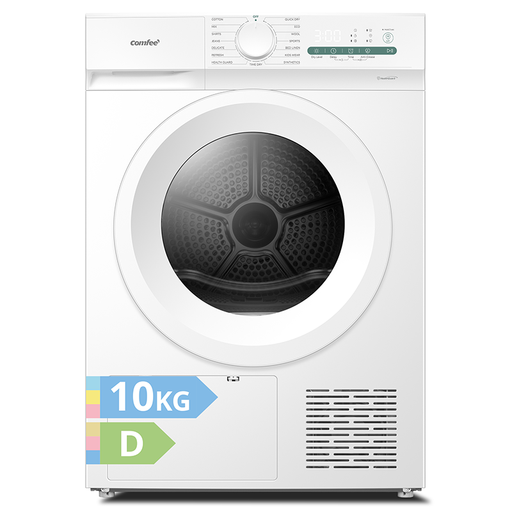 Image unavailable
A dedicated appliance to consider if you want to dry laundry without an external air vent.
Listed energy rating D. Confirm the drying capacity of this model before choosing it for your loads, then check the dimensions, cycles and how water is handled.
 Image unavailable
This combined appliance is a good option if you have space for only one appliance.
Listed capacities of 11 kg for washing and 6 kg for drying, so a full wash load may not be dryable in one go. Check the connections and the programme time that suits your needs.
No. According to UFC-Que Choisir, it collects the water removed from your laundry in a tank or drains it away. A vented tumble dryer, by contrast, expels moist air outside. However, always follow the installation requirements in the model’s manual.
No. This depends on the model and compatible accessories. For its E2YH01 kit, Electrolux recommends checking compatibility using the appliance’s PNC.
No. The two appliances must be suitable for stacking, and you’ll need a compatible kit. Bosch states that its 00576101 kit requires, among other things, a washing machine that is more than 55 cm deep. Also check which models are excluded and read the appliance manuals.
Because drying capacity is generally lower than washing capacity, as UFC-Que Choisir explains. For its EW8W3816BI, Electrolux lists 8 kg for washing and 4 kg for drying. This means you’ll need to reduce a full wash load before drying it.