If you don’t have an opening or usable duct to the outside, rule out vented tumble dryers. According to UFC-Que Choisir, condenser tumble dryers, with or without a heat pump, don’t need to be connected to an external vent. A separate appliance is a good option if you have the space and want a dedicated drying capacity. If you only have room for one appliance, compare washer-dryers, checking their washing and drying capacities, dimensions and cycle times separately.
Who are these options for?
Homes without an external vent
If you don’t have an opening or usable duct to release moist air, the type of appliance is the first thing to consider. UFC-Que Choisir distinguishes between vented models and condenser models, which don’t need to be connected to the outside. Next, check the installation requirements for the model you’ve chosen.
Households with frequent laundry loads
If you often dry large loads, compare the drying capacity and programme times of separate appliances. The energy consumption listed for each model also matters if you’ll be using it regularly.
Smaller homes with room for just one appliance
A washer-dryer combines both functions in one appliance. It could be a good space-saving option if its drying capacity, actual dimensions and cycle time suit your laundry needs. UFC-Que Choisir points out that drying capacity may be lower than washing capacity.
What sets these appliances apart?
First, check whether the appliance can be installed in your room. Then weigh up the space available, energy consumption and how much laundry you need to dry per cycle.
| What to consider |
What to check |
Who should consider it? |
| Installation without an external vent |
Make sure it’s a condenser model, with or without a heat pump, then check the manual for ventilation and connection requirements. |
If you don’t have an opening or usable duct, you’ll want to avoid choosing a vented tumble dryer that you can’t connect. Around 36% of consumers put installation compatibility first. |
| Electricity consumption |
Compare the energy label and specifications for the exact models, taking into account the programmes and load sizes listed. |
If you dry laundry regularly, you’ll want to check how much electricity an appliance uses rather than choosing based on the technology alone. Around 29% of consumers prioritise energy consumption. |
| Space available |
Measure the space and delivery access routes. For a washer-dryer, compare its washing and drying capacities. |
If you only have room for one appliance to wash and dry your laundry, you’ll want both functions in one without finding out that your usual load is too large to dry. Around 21% of consumers put lack of space first. |
| Capacity and cycle time |
Check the drying capacity and the programme time for the fabrics and load size you have in mind. |
If you do several loads in a row, you’ll want to dry a suitable amount of laundry without tying up the machine for too long. Around 14% of consumers prioritise capacity and cycle time. |
What you shouldn’t overlook
-
Assuming ‘no external vent’ means ‘no installation requirements’
A condenser model doesn’t need a duct to the outside, but it still needs to fit in the space available and meet the ventilation and connection requirements in its manual.
Measure the appliance and access routes, then check the installation manual before you order.
-
Looking only at the washing capacity of a two-in-one appliance
According to UFC-Que Choisir, a washer-dryer may be able to dry less laundry than it can wash. This means you may not be able to dry a whole washed load straight away.
Choose based on how much laundry you need to dry at once, and compare the stated washing and drying capacities.
If your load is larger than the drying capacity, you’ll need to remove some laundry before drying or split it across several cycles.
-
Choosing a heat pump without checking programme times
The technology alone won’t tell you how long a cycle suited to your laundry will take. UFC-Que Choisir takes drying time into account in its assessment process.
If you need to do several loads in a row, check the stated times for the programmes and load sizes you’ll use.
-
Assuming direct drainage is always possible
A kit may let you drain the condensate without emptying the tank, but Bosch advises checking that it’s compatible with the tumble dryer in question.
Before planning this connection, check the exact appliance model, kit compatibility and included accessories.
Brands to know when comparing ranges
Bosch
Bosch offers condenser and heat pump tumble dryers in France.
- Bosch lists capacities from 7 to 9 kg across its tumble dryer range.
- If you want to connect the condensate outlet to a drain, check that the Bosch kit is compatible with your chosen model.
Beko
Beko offers ranges of condenser and heat pump tumble dryers.
- Some models in the range are listed with direct condensate drainage.
- For the model you choose, check its dimensions, noise level and how the condensed water is handled.
Electrolux
Electrolux offers washer-dryers with their washing and drying capacities listed separately.
- Electrolux product pages list washing/drying capacities of 8/5 kg for model EW7IW2856BG and 8/4 kg for model EWW8416DB.
- Choose based on the amount of laundry you need to dry, not just the stated washing capacity.
Tumble dryers available on Joybuy
These separate condenser models, some of them with heat pump technology, are worth considering if you’re looking to dry laundry without an external vent. Compare their capacities and check the installation manual for the model you’re interested in.
 Image unavailable
Hotpoint CHD84MWBSEE, heat pump, 8 kg
A separate tumble dryer to consider if you have a dedicated space but no external air vent. The product title lists an 8 kg capacity. Check the dimensions and installation requirements for this model. If you want to connect the condensate outlet to a drain, also confirm that the accessories are compatible.
View on Joybuy
 Image unavailable
Comfee CD08EHP05W-HR, heat pump, 8 kg
This separate model is worth comparing if you’re looking for a tumble dryer that doesn’t need an external air vent. Its product title lists an 8 kg capacity and energy rating D. Check the manual for its dimensions and installation requirements, then compare its energy information and programme times for the loads you plan to dry.
View on Joybuy
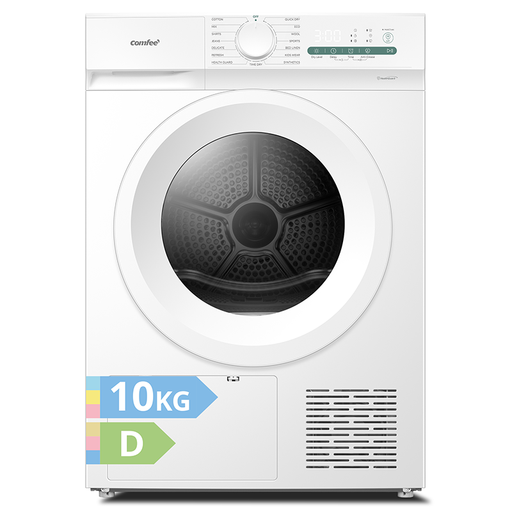 Image unavailable
Comfee CD10EHP05W-HR, heat pump, stated capacity 10 kg
This separate heat pump tumble dryer could suit you if you’re looking for a model without an external vent. Before choosing it for a particular load size, confirm the capacity of this model: the product information lists both 8 kg and 10 kg. Also check its installation manual and energy label.
View on Joybuy
 Image unavailable
Electrolux EDH1018CD GentleCare, condenser, 8 kg
This condenser tumble dryer is another option for a space without an external air vent. Its product title lists an 8 kg capacity. Check the manual for the space needed around the appliance and its ventilation requirements, then compare its energy information with other models you’re considering.
View on Joybuy
Frequently asked questions
Can you install a tumble dryer without an external vent?
Yes. Choose a condenser tumble dryer, with or without a heat pump: UFC-Que Choisir explains that these appliances don’t need to be connected to the outside. A vented model, on the other hand, needs a usable opening or duct. In all cases, follow the installation instructions for your model.
Does a condenser tumble dryer need to be connected to a drain?
No. The condensate can collect in a tank that you empty. Direct drainage is possible with some configurations, but check that the model and any kit you need are compatible before planning this connection.
Can a washer-dryer dry a whole washing load?
Not if the load exceeds its stated drying capacity. For example, Electrolux product pages list washing capacities of 8 kg for models EW7IW2856BG and EWW8416DB, but drying capacities of 5 kg and 4 kg respectively. Compare both capacities for the model you choose before planning to wash and dry a full load without removing any laundry.
How do you compare the energy consumption of two appliances?
Check the energy label and product information for each model, taking into account the programmes and capacities the figures refer to. The European Commission describes the public part of EPREL as a tool that lets consumers compare energy information for the models registered there.


