Households planning a cooking island
An integrated extractor lets you create an island without an overhead extractor hood. However, you’ll need to allow enough space beneath the worktop for the hob and its installation.


A venting hob is a good choice for an island if you want an unobstructed view above the cooking area, provided your worktop, cabinetry and ventilation can accommodate the model you choose. If you’re replacing an existing hob, an induction hob with a separate extractor hood may be a better option if the cut-out or the space beneath the worktop won’t allow for an integrated extractor. Whether you choose extraction or recirculation will then depend on what your kitchen can accommodate and how you’ll maintain the filters.
An integrated extractor lets you create an island without an overhead extractor hood. However, you’ll need to allow enough space beneath the worktop for the hob and its installation.
Recirculation can avoid the need to install ducting to the outside, if the model supports this mode. Check which kit is required, the air path and access to the filters.
Before choosing a venting hob, compare its cut-out and the space it takes up beneath the worktop with your current installation. UFC-Que Choisir notes that models measuring 70 to 80 cm wide are better suited to a first-time installation than to a replacement.
Consider this if: you can confirm that an external vent, a duct route and enough space beneath the worktop are all suitable for the model you’ve chosen.
Things to allow for: extraction also requires an adequate air supply, particularly if you have a combustion appliance.
Consider this if: an external vent isn’t practical and the model explicitly supports recirculation.
Things to allow for: an odour filter, possibly a compatible kit, and access for maintenance.
Consider this if: your existing cut-out or cabinetry can’t accommodate the venting hob you want, and a separate extractor hood suits your kitchen.
The trade-off: the extractor hood needs its own space above or near the cooking area.
| Priority | What to check | My needs |
|---|---|---|
| Fitting | Compare the cut-out, cabinet width and available height beneath the worktop with the diagram for the exact model. Also check the drawers and the route for the extractor components. | I’m replacing an existing hob: I want to know whether the new installation will fit the worktop and cabinetry without blocking my drawers. |
| Ventilation | Check which mode the hob supports. For extraction, have the external vent, duct and air supply checked; for recirculation, check the kit, filters and air path. | I want my island to remain free of an overhead extractor hood, but I need to choose a ventilation mode that works in my kitchen. |
| Filters | Identify the grease filters and, for recirculation, the odour filter. Check which parts are included, the maintenance instructions and whether you’ll be able to access the filters once the hob is installed. | I want to maintain the filters without having to dismantle the cabinetry. |
| Cooking and extraction | Compare results obtained using the same installation mode, then compare noise levels using similar speeds and measurement methods. Check that the cooking zones suit your pans. | When I use large pans, the cooking zones matter just as much as the extraction. A single airflow figure doesn’t tell me what I need to know about both. |
A venting hob may need a different cut-out and more space beneath the worktop. UFC-Que Choisir notes that models measuring 70 to 80 cm wide are better suited to a first-time installation than to a replacement.
Measure the worktop, cabinet and drawers, then compare them with the fitting diagram for the exact model before you order.
You may need to alter the worktop, cabinetry, drawers or plinth.
Recirculation requires an odour filter that’s compatible with the model; the installation kit may be sold separately from the hob.
Check the kit reference, what it contains, the filter type and whether you’ll be able to access it after installation. For the CIARRA ONE hob featured below, the Joybuy France listing states that CBEHKIT installation accessories are sold separately.
UFC-Que Choisir’s testing protocol explains that grease capture can vary considerably between extraction and recirculation. An airflow figure on its own also won’t tell you how noisy an appliance is under comparable conditions.
Compare measurements taken using the same method and in the mode you plan to use. Check the conditions that apply to the noise figures.
An installation that vents air outside removes air from the room. Electrolux warns that without replacement air, extraction can affect the operation of a stove.
Before work begins, have your existing ventilation and any relevant combustion appliances checked, then follow the installation instructions for your chosen model.
These brand examples can help you identify the documents and accessories to compare; they don’t guarantee that a particular model will be compatible with your kitchen.
Bosch offers separate accessories for installing venting hobs in recirculation or extraction mode.
Electrolux publishes product details for venting hobs, along with installation documents.
The NikolaTesla range includes venting hobs, with fitting requirements that vary between models.
Siemens provides detailed dimensions for some inductionAir venting hobs.
This hob combines induction cooking with an integrated extractor for a kitchen without an overhead extractor hood. Check its installation documents to see whether it suits your cabinetry and planned ventilation mode.
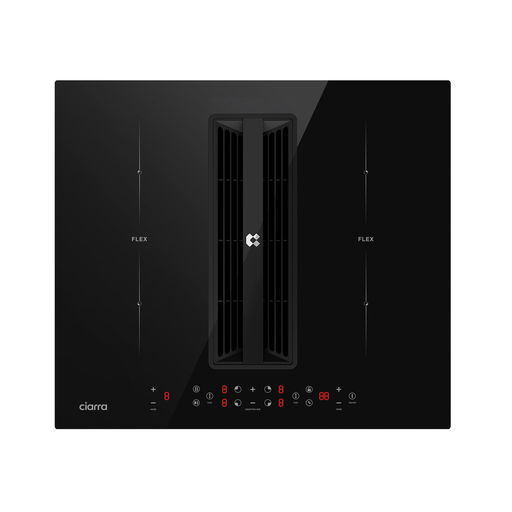 Image unavailable
This induction hob with an integrated extractor lets you cook without an overhead extractor hood. Its product title lists four cooking zones, Boost and Flex functions, and Plasma⁺. The Joybuy France listing states that CBEHKIT installation accessories are sold separately. Before choosing this model, check what the kit contains, which ventilation mode you plan to use and the clearance required beneath the worktop.
Not necessarily. UFC-Que Choisir notes that venting models measuring 70 to 80 cm wide are better suited to a first-time installation than to a replacement. Compare your existing cut-out, cabinetry, drawers and the space beneath the worktop with the diagram for the model you’re considering.
Consider extraction if an external vent, duct and suitable air supply can all be confirmed. If an external vent isn’t practical, check that the hob supports recirculation and find out which odour filter and any additional kit you’ll need, as well as the maintenance requirements.
Extraction removes air from the room. Electrolux warns that without replacement air, it can affect the operation of a stove. Have the ventilation and any relevant combustion appliances checked before work begins.
Follow the instructions for the model you’ve installed: requirements vary depending on the filters and ventilation mode. For recirculation, check whether the odour filter needs replacing or can be regenerated, and make sure you can access it after installation.
Compare the modes separately and take the test conditions into account. UFC-Que Choisir explains in its testing protocol that grease-capture efficiency can vary considerably depending on the installation mode. A measurement taken in one mode therefore doesn’t, on its own, describe performance in the other configuration.