People following a vegan diet
The ingredients matter more than the packaging. Nutella France says its classic recipe contains skimmed milk powder, while the brand describes Nutella Plant-Based as suitable for vegan diets.


When shopping for vegan products, check the recipe and allergens first, then choose the packaging. A squeezy bottle doesn’t mean a spread is suitable for a vegan diet. Nutella describes its Plant-Based version as suitable for vegan diets, but Carrefour France lists it in a 350 g jar. If easy, direct serving is your priority, check the ingredients of the bottle you’re considering before choosing it.
The ingredients matter more than the packaging. Nutella France says its classic recipe contains skimmed milk powder, while the brand describes Nutella Plant-Based as suitable for vegan diets.
A squeezy bottle can be handy when you want to add spread to toast or pancakes without using a spoon. However, you still need to check the recipe in the bottle itself: the packaging tells you nothing about its ingredients.
Ingredients, allergens and nutritional values answer different questions. A ‘lactose-free’, ‘organic’ or ‘palm oil-free’ claim doesn’t, on its own, confirm that a recipe is vegan.
When choosing a spread as part of your vegan shop, start by checking whether the recipe is suitable. Then compare the format and the information that matters for how you’ll use it.
| What to check | Look for | Who it’s for |
|---|---|---|
| Vegan suitability | An explicit vegan claim and the full ingredients list; allergens shown on the label. | If you avoid ingredients of animal origin, what matters is evidence from the recipe, not the shape of the container. Around 36% of consumers would make this their top priority. |
| Serving from a bottle | Clear identification as a squeezy bottle; the ingredients of the product inside it. | If I’m serving spread straight onto toast or a pancake, I’d rather not use a spoon. Ease of serving would be the top priority for around 29% of consumers. |
| Nutritional comparison | Nutritional values per 100 g, particularly sugars and saturated fatty acids; the Nutri-Score, if shown on the packaging. | If I’m comparing different recipes or jar sizes, the values per 100 g give me a common basis. Around 21% of consumers would prioritise this comparison. |
| Local availability | The exact format and availability from your chosen shop or delivery service. | Before finishing my shop, I want to know whether my retailer stocks the recipe and packaging I’m looking for. This would be the top priority for around 14% of consumers. |
According to the European Commission, front-of-pack nutrition labelling remains voluntary under current EU rules. So, if there’s no Nutri-Score, that doesn’t mean the nutritional declaration is missing.
Read the nutritional values per 100 g and use Nutri-Score as an additional guide when it’s displayed. Don’t use it to decide whether a product is vegan.
Convenient packaging doesn’t guarantee that a product is free from ingredients of animal origin. Nutella France, for example, confirms that classic Nutella contains skimmed milk powder.
Check the ingredients and allergens for the exact version, then decide whether its packaging suits the way you like to serve it.
‘Lactose-free’, ‘organic’ and ‘palm oil-free’ describe different characteristics. None of these claims, on its own, confirms that a product is free from all ingredients of animal origin.
Look for an explicit vegan claim and check the full ingredients list rather than relying on a single claim on the front of the pack.
The brand distinguishes between classic Nutella and Nutella Plant-Based, which it describes as suitable for vegetarian and vegan diets.
Funkie offers a cocoa and hazelnut recipe made with plant-based ingredients. A separate Joybuy France listing describes its praline spread in a 200 g jar.
The brand offers, among other products, a chocolate and hazelnut spread described as lactose-free and gluten-free.
These two spreads are worth comparing if you’re looking for plant-based recipes or products described as vegan, provided you’re happy with a jar rather than a squeezy bottle. Check the label of the version you choose, especially the ingredients, allergens and nutritional values.
 Image unavailable
Worth considering if you’d like to explore a plant-based recipe in a jar rather than choosing a squeezy format first. The Joybuy France listing describes a spread with no dairy products, made with ingredients including red bean purée (28,2 %) and roasted hazelnuts (21 %). It contains hazelnuts, so check the label if this allergen is relevant to you. Also check the full ingredients list if you’re looking for an explicit vegan claim.
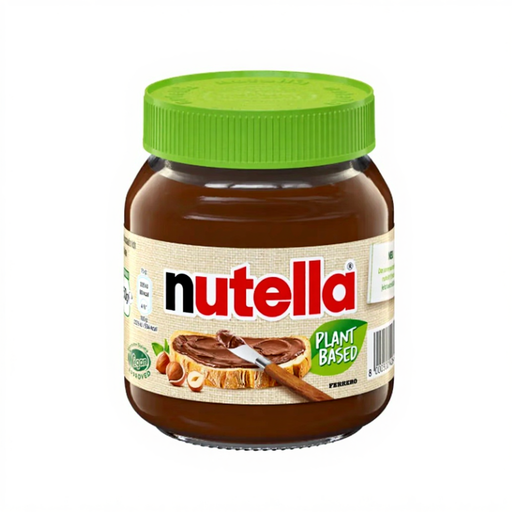 Image unavailable
Worth considering if an explicitly vegan version matters more to you than serving from a bottle. Nutella describes Plant-Based as suitable for vegetarian and vegan diets; Carrefour France lists it in a 350 g jar. This packaging doesn’t let you dispense the spread directly like a squeezy bottle. Check the label of the product you choose for its ingredients, allergens and nutritional values.
No. According to the European Commission, front-of-pack nutrition labelling is voluntary under current EU rules. However, as Your Europe explains, a nutritional declaration is among the required details for the relevant prepacked foods. Where displayed, Nutri-Score doesn’t replace the ingredients list or nutritional values.
Check the exact version, its ingredients list, allergens and nutritional values, then make sure the packaging suits how you plan to use it. Check the label again when your order arrives so you have the information for the product you received.
No. Nutella France says the classic recipe contains skimmed milk powder. Nutella Plant-Based is a separate version that the brand describes as suitable for vegetarian and vegan diets.
No. This claim relates to lactose and doesn’t, on its own, tell you whether other ingredients of animal origin are present. For the recipe you’re considering, look for an explicit vegan claim and check the full ingredients list.