If you require vegan certification, choose a soy drink whose carton carries a label that explicitly identifies it as “vegan”: a “vegan” claim on a product listing alone does not prove that it has been certified by a third party. To compare drinks that meet your requirements, check the ingredients, sugars and nutritional information on the packaging.
Which option is right for you?
For shoppers who require vegan certification
If certification is essential to your purchase, look for the logo on the carton and check its category. The V-Label distinguishes between “vegetarian” and “vegan” products; the ingredients alone are no substitute for this check.
For shoppers looking for an unflavoured recipe
For cereal, hot drinks or cooking, compare the ingredients and sugar content per 100 ml. The unflavoured options from Bio Village, Bjorg and Sojasun differ, so choose the specific product rather than relying on the word “unflavoured” alone.
For shoppers comparing nutritional values
If protein, calcium, vitamins or sugars are important to you, check the nutritional information for each product per 100 ml. Check vegan status and allergens separately.
What should you check in store?
At your local shop, start with the factor that matters most to your purchase: a vegan label, the recipe, organic status and origin, or nutritional values. Then check the carton of the specific product you’ve chosen.
| Criteria |
What to check |
Who is it for? |
| Vegan certification |
The logo on the carton and its “vegan” category, distinct from “vegetarian”. |
I want to see an identifiable certification before putting the carton in my basket, not just a plant-based recipe. Around 31% of shoppers put this proof at the top of their list. |
| Recipe and sugars |
The ingredients list and the “of which sugars” line per 100 ml. |
For my cereal or cooking, I prefer to make my choice by checking the ingredients and sugar content. This is a priority for around 25% of shoppers. |
| Organic status and origin |
Organic claims and the origin of the soya shown on the specific product. |
When shopping locally, I first check whether the soya and its origin meet my criteria. Around 25% of shoppers prioritise organic status or origin. |
| Nutritional values and intended use |
Values per 100 ml, any added calcium or vitamins, and how you plan to use it. |
Before choosing a drink for breakfast or cooking, I compare the values shown for the different recipes. This comes first for around 19% of shoppers. |
Common mix-ups to avoid
-
Assuming “plant-based”, “vegetarian” and “vegan” mean certified
The V-Label distinguishes between vegetarian and vegan categories. A “vegan” description on a product listing is not enough to establish that the carton carries third-party certification.
If certification is essential to you, check the logo and the “vegan” category on the packaging.
-
Assuming organic means vegan-certified
An organic recipe and vegan certification relate to two different criteria. The Bio Village listing describes a recipe made with organic soya juice, but the ingredients alone do not establish that it carries a vegan label.
Check the organic claim, ingredients and the label you’re looking for separately.
-
Looking only at the claims on the front of the pack
Soy drinks can differ in their added ingredients and nutritional values. Soya is also an allergen to look out for in the ingredients list.
Read the ingredients and allergen information, then compare sugars and other values on the same basis: per 100 ml. The DGCCRF reminds shoppers that allergenic ingredients must be highlighted.
-
Confusing everyday soy drink with infant formula
The labelling on the Bio Village drink reviewed states that it is not suitable as a replacement for breast milk or infant formula for babies under one year old.
Do not use a regular soy drink as a substitute for a formula intended for infants.
Brands to consider based on your criteria
ALDI
A retailer to consider if you’re looking for the V-Label on a soy drink.
- ALDI says it uses the V-Label and distinguishes between its vegetarian and vegan categories.
- In store, check that the carton you choose carries the “vegan” category itself.
Carrefour Bon Appétit !
A soy drink described as “vegan” on its Carrefour listing.
- The listing states that it contains 97% soya juice and gives details of the ingredients in this product.
- This product description alone does not confirm that the carton carries a vegan label; the recipe also contains sugar.
Bio Village / E.Leclerc
An unflavoured option to consider if the ingredients and origin of the soya matter to you.
- According to E.Leclerc, the drink reviewed lists organic soya juice as its only ingredient, uses soya from France and contains 0.7 g of sugars per 100 ml.
- These features do not prove vegan certification: check the label on the product you buy.
Alpro
An option to compare if protein and added calcium or vitamins are important to you.
- The Auchan listing for Alpro Soya High Protein shows 5 g of protein and 120 mg of calcium per 100 ml.
- The listing classifies it as “Vegetarian”: this does not confirm vegan certification.
Sojasun
An unflavoured soy drink to consider for cereal or cooking.
- Sojasun describes its unflavoured recipe as made with soya juice and lists 4.7 g of protein per 100 ml.
- The ingredients and nutritional values shown do not remove the need to check the packaging for a vegan label.
Soy drinks available on Joybuy
This individually portioned soy drink may suit you if a “vegan-friendly” claim meets your buying criteria. If you require vegan certification, check the label and its category on the packaging before choosing it.
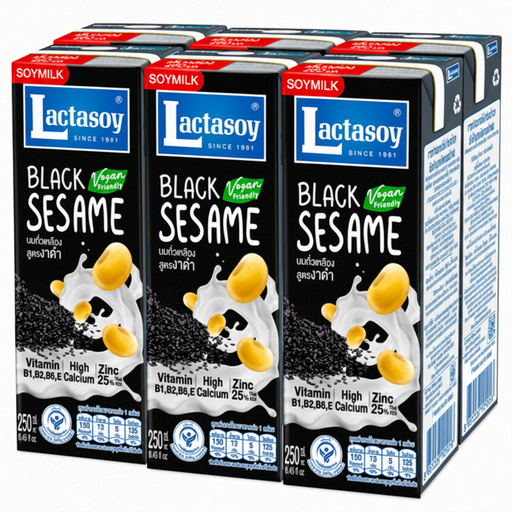 Image unavailable
Lactasoy black sesame soy drink, 6 × 250 ml
This pack contains six 250 ml servings, making it handy for taking a drink with you.
The listing describes the drink as “vegan-friendly”; if you require vegan certification, check the label and its category on the packaging. Also check the ingredients and allergens, including soya and sesame.
View on Joybuy
Frequently asked questions
How can you tell if a soy drink is vegan-certified?
Look for a certification logo on the carton and check that it identifies the “vegan” category. The V-Label distinguishes this category from “vegetarian”; a “vegan” claim on a product listing does not, by itself, prove that the product carries this label.
Is an organic soy drink automatically vegan-certified?
No. Organic status and vegan certification are two separate claims. Even if a drink’s ingredients suit you, check the packaging separately for the label you require.
Which allergen should you look for in a soy drink?
Check the ingredients list for soya, as well as any other allergens declared for the recipe you choose. The DGCCRF reminds shoppers that allergenic ingredients must be highlighted on the labelling of pre-packed foods.
Can a regular soy drink replace infant formula?
Do not use a regular soy drink as a substitute for formula intended for infants. The labelling on the Bio Village product reviewed states that it is not suitable as a replacement for breast milk or infant formula for babies under one year old.


