Vegans who are mindful of allergens
You’re looking for a recipe with no animal-derived ingredients. If you’re allergic to milk proteins, check the warnings too: vegan certification doesn’t rule out a ‘may contain milk’ statement.


When choosing a praline spread as part of a vegan food shop, check its plant-based ingredients and sugar content separately: the claim ‘no added sugars’ guarantees neither. If you also require a ‘sugar-free’ claim, Regulation (EC) No 1924/2006 sets a maximum of 0.5 g of sugars per 100 g. Check the ‘of which sugars’ line and, if you have a milk allergy, read the warnings on the packaging.
You’re looking for a recipe with no animal-derived ingredients. If you’re allergic to milk proteins, check the warnings too: vegan certification doesn’t rule out a ‘may contain milk’ statement.
You want to tell this claim apart from ‘no added sugars’. Regulation (EC) No 1924/2006 sets a maximum of 0.5 g of sugars per 100 g or 100 ml for a ‘sugar-free’ claim.
You’re looking for a hazelnut and cocoa or praline flavour in store, without assuming that a vegan recipe is also ‘sugar-free’, or that a spread with no added sugars is free from milk.
If both vegan and ‘sugar-free’ are essential, check each claim on the exact product you’re considering: ‘no added sugars’ is no substitute for either of these checks.
| Criteria | What to check | Who is it for? |
|---|---|---|
| Vegan ingredients and allergens | Check the vegan claim, ingredients and milk warnings, especially if you have an allergy. | If I avoid animal ingredients, I also need to distinguish this from the risk of traces of milk. This is a priority for around 29% of consumers. |
| ‘Sugar-free’ claim | Compare the wording of the claim with the ‘of which sugars’ line per 100 g against the 0.5 g limit set by Regulation (EC) No 1924/2006. | I’m looking for a spread that meets the ‘sugar-free’ claim, not simply a recipe with no added sugar. Around 36% of consumers prioritise this distinction. |
| Vegan and no added sugars | Check both claims, then the sugar content and storage instructions after opening. | To find a vegan recipe with no added sugars, I’m happy to consider something different from classic praline. This is a priority for around 21% of consumers. |
| Flavour and in-store shopping | Confirm the exact flavour and product available at the store or through your chosen collection option. | When doing my usual food shop, I first look for a praline-like flavour that I can find in my store. Around 14% of consumers prioritise this convenience. |
These claims refer to different criteria. Under Regulation (EC) No 1924/2006, ‘sugar-free’ means no more than 0.5 g of sugars per 100 g or 100 ml. Auchan lists 8.5 g per 100 g for the Lucien Georgelin ‘no added sugars’ spread mentioned here.
Read the claim and the ‘of which sugars’ line on the packaging of the product you choose.
Plant-based ingredients don’t set a limit on sugar content: Nutella France lists 45.4 g of sugars per 100 g for Nutella Plant-Based, which it describes as vegan-certified.
Check the vegan status and nutrition information per 100 g separately.
A spread with no added sugars may still contain milk. Auchan’s product listing for Gerblé hazelnut and cocoa spread includes skimmed milk, whey and maltitol.
Check the ingredients and allergens for the exact product, especially if you avoid milk.
The details below apply to the specific products named, not to every product from each brand.
Nutella France describes Nutella Plant-Based as a vegan-certified cocoa and hazelnut spread, sold in a 350 g jar.
Rigoni di Asiago describes Nocciolata L’Intense as an organic cocoa and hazelnut spread with no milk.
Nutripure describes Pure Pâte à Tartiner Bio as a vegan recipe with no added sugar, made with ingredients including red kidney beans, hazelnuts and cocoa.
Lucien Georgelin’s hazelnut spread with no added sugars is an example of a product whose ingredients you should check if you’re doing a vegan food shop.
Gerblé’s hazelnut and cocoa spread with no added sugars is an example of a recipe to distinguish from a vegan option.
This cocoa and hazelnut spread is described as vegan and is made for spreading on toast. Its sugar content sets it apart from spreads that meet the ‘sugar-free’ claim.
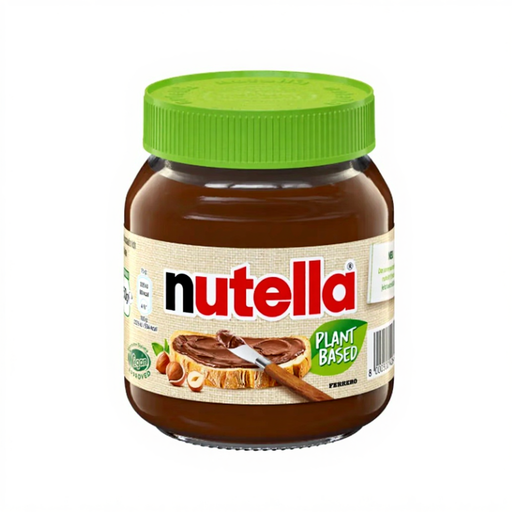 Image unavailable
Worth considering if you’re looking for a cocoa and hazelnut spread described as vegan-certified. The jar contains 350 g. Nutella France lists 45.4 g of sugars per 100 g and says it may contain milk, which is important to bear in mind if you’re allergic to milk proteins.
No. According to the French Ministry of the Economy, displaying Nutri-Score is voluntary. The DGCCRF states that nutrition information is compulsory for most pre-packed foods. You can take a displayed Nutri-Score into account, but it doesn’t tell you on its own whether a spread meets your vegan or sugar-related criteria.
No. Regulation (EC) No 1924/2006 reserves the ‘sugar-free’ claim for products containing no more than 0.5 g of sugars per 100 g or 100 ml. A spread with no added sugars can still contain sugars: Auchan lists 8.5 g per 100 g for the Lucien Georgelin product mentioned here.
Not necessarily. Nutella France describes Nutella Plant-Based as vegan-certified, but says it may contain milk and isn’t suitable for people allergic to milk proteins. Check the warnings on the product you buy.
Check that the product is available at your selected store, then check its ingredients, allergens and ‘of which sugars’ line per 100 g. It’s also worth confirming the cocoa and hazelnut or praline flavour and the product’s availability before placing your order.
Follow the instructions for the product you’ve bought, as they can vary by recipe. Nutripure recommends refrigerating Pure Pâte à Tartiner Bio after opening and eating it within 7 to 10 days.