Anyone stocking a vegan pantry
You’re looking for peas you can store at room temperature and want to be able to check the ingredients before using them.


To stock a vegan pantry, choose peas in a tin, jar or carton after checking the ingredients for the exact product, then pick a pack size that suits the portions you need. Peas and carrots can also work if the recipe suits your needs: check the added ingredients, drained weight and storage instructions rather than relying on the product name alone.
You’re looking for peas you can store at room temperature and want to be able to check the ingredients before using them.
You’d rather season your recipes yourself than start with a product that already contains added salt.
You’re comparing usable quantities so you can open a pack that suits your planned meals and the storage instructions once opened.
First, distinguish plain peas from mixed recipes, then choose a quantity that suits your meals. Compare salt and other added ingredients for the specific product, not the brand as a whole.
| Priority | What to check | Who is it for? |
|---|---|---|
| Vegan ingredients | Read the full ingredients list and check the allergens listed, especially for a mix or seasoned recipe. | I want to check what’s in the product before adding it to a vegan dish, rather than relying on its name; around 30% of consumers would prioritise this check. |
| Storage and portions | Check that it can be stored at room temperature, then compare the net drained weight and the instructions for after opening. | I’m looking for something I can store outside the freezer and a quantity my household can use without ending up with lots of leftovers; around 40% of consumers would put pack size first. |
| Salt and other considerations | Compare salt per 100 g in the nutritional information and look for sugar or flavourings in the ingredients; check organic or origin claims if they matter to you. | I prefer to know what’s been added so I can season dishes myself and choose according to my sourcing preferences; around 30% of consumers would make this their main concern. |
A mix contains other vegetables and may also include sugar, salt or flavourings, depending on the recipe. So it won’t necessarily work in the same way as an ingredient you season yourself.
Check the ingredients before choosing a ready-made side dish to go with your meal.
The liquid in the pack is included in the total weight, but not in the weight of the drained vegetables. A pack that’s too large for your planned meals will also leave you with more to store once opened.
Compare the net drained weight and read the storage instructions for the packaging you choose.
‘No preservatives’ doesn’t mean ‘no salt’, ‘no sugar’ or ‘no flavourings’: ingredients vary from one product to another.
Check the full ingredients list and nutritional information per 100 g, especially the ‘salt’ line.
According to Anses, a swollen or deformed tin, or an unusual smell when opened, may indicate a risk. DGCCRF also lists rust as a possible sign of deterioration.
Do not eat the contents of a tin showing these signs.
These examples show how ingredients and pack sizes can vary; always check the specific product you’re thinking of buying.
One tinned peas product lists a drained net weight of 560 g.
A 400 g organic peas product offers another pack size to compare.
E.Leclerc’s Marque Repère range includes plain peas and a peas and carrots mix.
This range includes both plain peas and peas and carrots mixes.
One peas and carrots product is for anyone looking for a mix rather than plain peas.
This Joybuy product is a peas and carrots mix in brine. Consider it if you’re after this kind of side dish rather than plain peas to cook with.
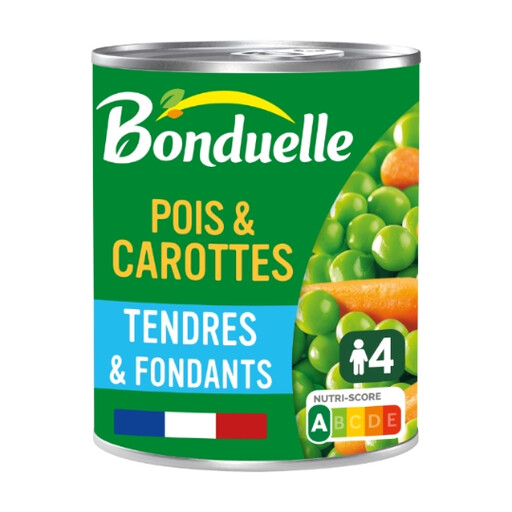 Image unavailable
Worth considering if your recipe calls for peas with carrots rather than plain peas.
The stated pack size is 530 g. Check the drained net weight, ingredients list and instructions for after opening on the product you choose.
No, you can’t tell from the product name alone. Check the ingredients for the specific product, especially if it’s a seasoned mix; allergen information on the label is not the same as vegan certification.
A best-before date indicates when the product is at its best, while a use-by date indicates when it should be eaten by. The French Ministry of the Economy distinguishes between these two dates: check which one appears on your product, along with its storage instructions.
Follow the instructions on the packaging you’ve opened, as they vary by product. One Bonduelle tin checked says to store it at a maximum of 4 °C and eat the contents within 48 hours of opening; this timeframe doesn’t automatically apply to other products.
Do not eat the contents of a tin showing signs of deterioration. Anses advises against using tins that are swollen or deformed, or that give off an unusual smell when opened; DGCCRF also warns about rust.
No, these claims relate to other characteristics of the product. To check whether the recipe suits your vegan shop, look at the ingredients list for the specific product separately.