
Livraison le jour même ou le lendemain

Qualité garantie

Débloquez vos offres de bienvenue: Livraison GRATUITE | Jusqu'à -80 % | 30 jours d'essai gratuits à JoyPlus
Téléchargez l'application
Veal cat food is appealing thanks to its mild flavour and reputation as a meat-rich recipe. But an attractive photo, the word “natural” or a long list of vitamins is not enough to assess a product. For an adult cat living in France, the key points are whether it is a complete food, its actual composition, its format and its storage requirements.
The words “with veal” do not necessarily mean that the recipe contains a high proportion of this meat. Some compositions list just 4% veal, within a broader category such as “meat and animal derivatives”. It is therefore better to check the detailed ingredients list, shown in descending order, rather than relying on the product name.
Grain-free cat food may suit certain preferences, but this claim alone says nothing about the recipe’s nutritional balance. Check that the packaging clearly states “complete food for adult cats”. Complementary wet food should not make up the entire daily ration unless this has been recommended by an animal health professional.
Large tins are convenient in households where several meals are served each day. Once opened, however, their contents must be refrigerated and eaten quickly. Conversely, 85 g cat food pouches or 125 g portions reduce leftovers but create more packaging. The ideal format therefore depends on your cat’s weight, appetite and your routine.
For wet food for adult cats intended to be served regularly, look for the words “complete food”. Then examine the analytical constituents: crude protein, fat, ash, fibre and moisture. Wet food often contains between 75 and 80% water, which contributes to daily hydration but does not replace a bowl of fresh water.
Protein content should be compared while taking the moisture level into account. Two recipes showing the same percentage are not necessarily equivalent if they contain different amounts of water. The feeding guide provided by the manufacturer is a starting point and should be adjusted according to your cat’s weight, activity level and body condition.
If you are looking for meat-rich cat food, check the precise percentages. The MJAMJAM veal and herring recipe lists 50% veal, 20% herring and 29% meat broth. Other products combine veal with insect protein. The brand presents this option as hypoallergenic, but it is not a guarantee against an individual allergy.
For hypoallergenic cat food, also check how many animal protein sources are included. A recipe described as “single-protein” may be easier to use when managing a food sensitivity. The veal and herring recipe is, by definition, a combination of two animal proteins.
The MJAMJAM recipes featured below state that they contain no cereals or added sugar. The PURINA ONE recipe, on the other hand, lists sugars among its ingredients. This is worth considering if you are looking for wet cat food that meets specific criteria.
Vitamins, taurine and minerals should appear in the list of nutritional additives. Taurine is included in the selected recipes, with levels varying between products. This information enables you to compare products objectively, without turning a nutritional feature into a medical claim.
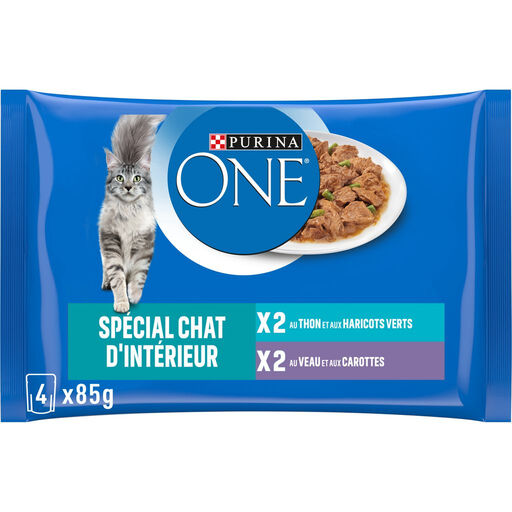
Why this choice suits this profile: The individual 85 g pouches are easy to portion and fit effortlessly into a daily routine, particularly if your cat alternates between wet and dry food.
The product information clearly states that this is a complete food for adult cats. It also details the composition: the veal recipe contains 4% veal and sugars, two points to consider before buying.
4 × 85 g format, 79% moisture, 12% crude protein and taurine listed at 580 mg/kg.
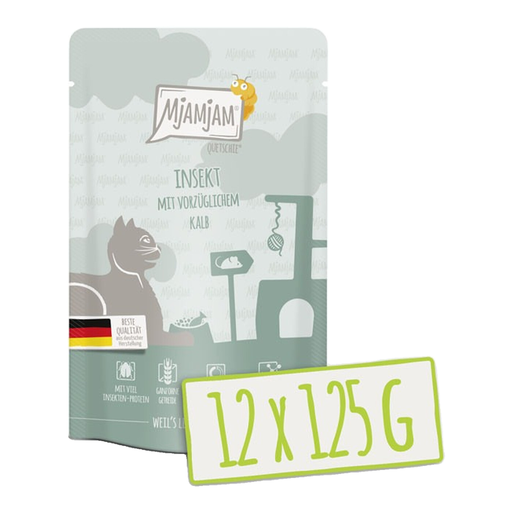
Why this choice suits this profile: This product is aimed at households looking for a recipe made with veal and insects, without cereals, sugar, preservatives or artificial flavourings, according to the information provided.
The percentages are clearly specified: 36.5% veal, 32% insects and 30.5% meat broth. The composition therefore makes it easy to verify the significant proportion of animal-derived ingredients.
12 × 125 g pack, complete food, 5.5% fat and 93 kcal per 100 g, according to the product information.
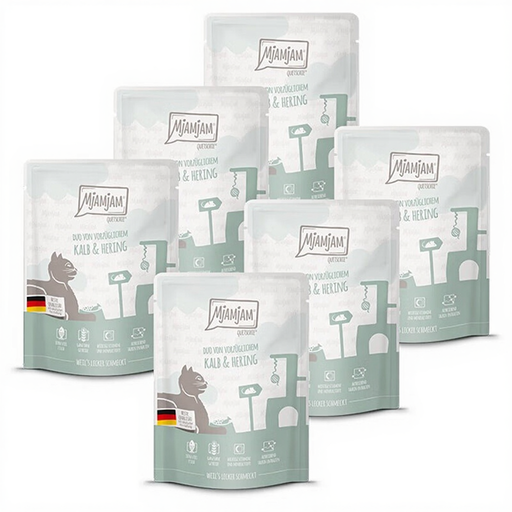
Why this choice suits this profile: The 1.8 kg multipack is suitable for households that serve wet food regularly and want to space out their purchases.
The recipe specifies 50% veal and 20% herring, with no cereals or sugar according to the product information. Each opened portion must nevertheless be refrigerated and eaten within 24 hours.
6 × 300 g multipack, complete food for adult cats, 10.5% crude protein and 8.5% fat.
We have put together a complete, real-time updated selection of products that meet these strict criteria as well as European safety regulations.
Serve the food at room temperature, unless the packaging states otherwise. Served straight from the fridge, it may be less appealing to some cats. Follow the feeding guide recommended by the manufacturer and make any dietary change gradually, over several days.
After opening, refrigerate the product in a sealed container if necessary. The MJAMJAM products featured here recommend eating them within 24 hours. Always leave a bowl of fresh water available and never give your cat a product if its packaging is damaged or its appearance or smell seems unusual.
It can certainly form part of an adult cat’s diet if it is labelled as a complete food and its composition meets the cat’s nutritional needs. Veal does not, however, guarantee that your cat will accept or tolerate the product well. Introduce any new recipe gradually and monitor your cat’s appetite and digestion.
The 85 g or 125 g pouches make it easier to portion food for a cat that eats small meals and help limit leftovers. A 200 g, 300 g or 400 g tin may be more convenient for several meals or multiple cats, provided you can store its contents properly after opening.
Start by checking the ingredients list and whether the food is complete. A grain-free recipe is not necessarily suitable for a particular sensitivity. If you suspect an allergy or your cat has persistent digestive problems, ask a vet for advice before making a long-term change to its diet.