
Livraison le jour même ou le lendemain

Qualité garantie

Débloquez vos offres de bienvenue: Livraison GRATUITE | Jusqu'à -80 % | 30 jours d'essai gratuits à JoyPlus
Téléchargez l'application
Vacuum storage bags significantly reduce the volume of clothing, duvets and blankets, while making wardrobe organisation easier. However, not all models are interchangeable. A small bag that is ideal for a suitcase will not be sufficient for a double duvet, while an XXL size can quickly become difficult to move or fit into a small home.
Before placing your order, it is best to avoid these three common mistakes:
Whether you are storing out-of-season clothing, household linen or belongings during a move, your choice should therefore be based on three factors: the dimensions, the sealing system and how you intend to use it.
Small vacuum storage bags for clothes are suitable for shirts, jumpers, trousers and accessories. Sizes of around 40 × 50 cm or 40 × 60 cm fit easily into a suitcase or travel bag.
For duvets, pillows and blankets, it is better to choose wider compression bags for duvets. An L-sized model measuring 80 × 100 cm can hold a double duvet, depending on its thickness. An XXL vacuum storage bag measuring 65 × 45 × 27 cm is better suited to bulky textiles, particularly if it needs to remain stable under a bed or in a storage chest.
Always check the external dimensions rather than relying solely on the stated capacity. Several medium-sized bags are often easier to handle and store than one large, overloaded model.
Models in this category are generally made from polyethylene (PE), polyamide (PA), PET or a blend of nylon and polyethylene. These materials create a barrier against dust and limit exposure to moisture, provided that the bag is properly sealed.
A thick outer layer and a double zip reduce the risk of punctures and leaks. However, no plastic bag can withstand direct contact with sharp objects, unprotected metal fasteners or a heat source. For long-term storage, only store clean, completely dry laundry to help prevent odours and condensation.
Reusable vacuum storage bags are particularly useful if you regularly switch between winter and summer clothing. Their lifespan depends in particular on how you handle the zip and valve, as well as on avoiding punctures.
A bag compatible with a standard vacuum cleaner fitted with a hose will work perfectly well at home. This solution avoids having to buy an additional accessory, but is less convenient when travelling.
A portable vacuum pump makes storage easier in a suitcase, student accommodation or during a house move. Cordless electric models are quick and easy to use, while a manual pump is lightweight and does not rely on a battery. Some travel bags can even be compressed simply by rolling them, with no vacuum cleaner or pump required.
After compression, check that the bag does not re-inflate. If it does, the problem may be caused by a poorly closed zip, an incorrectly positioned valve, fabric caught in the seal or a small tear.
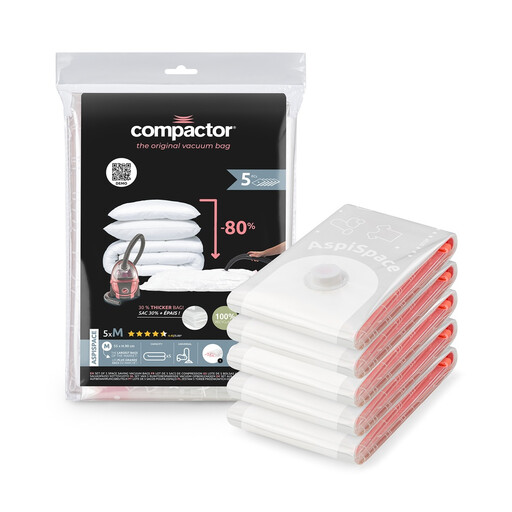
Why this choice suits this profile: This pack of five medium-sized bags is ideal for getting started with sorting seasonal clothing, cushions or a single duvet.
The medium size reduces the risk of only half-filling an oversized bag. The valve is advertised as compatible with standard vacuum cleaners fitted with a hose.
Pack of 5 ; dimensions: 55 × 90 cm ; transparent material lets you identify the contents without opening the bag.
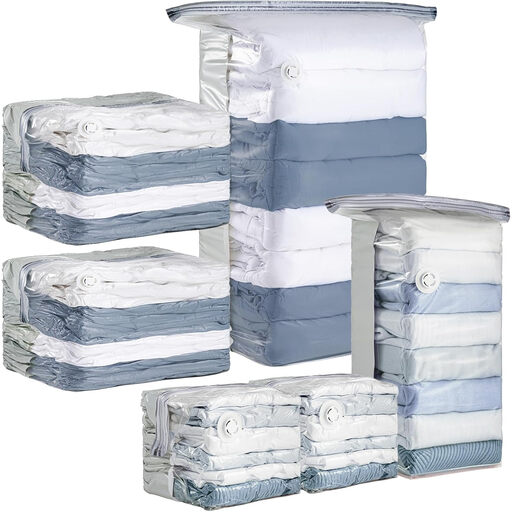
Why this choice suits this profile: Its cube-shaped, freestanding design is ideal for households storing several duvets, blankets or quilts and wanting to fill the bag without it collapsing.
The square structure remains upright while you fill it. The double zip and supplied clip make it easy to check that it is securely closed before starting the vacuuming process.
Pack of 6 bags ; 3 jumbo sizes and 3 medium sizes ; PA/PE material described as airtight and water-resistant.
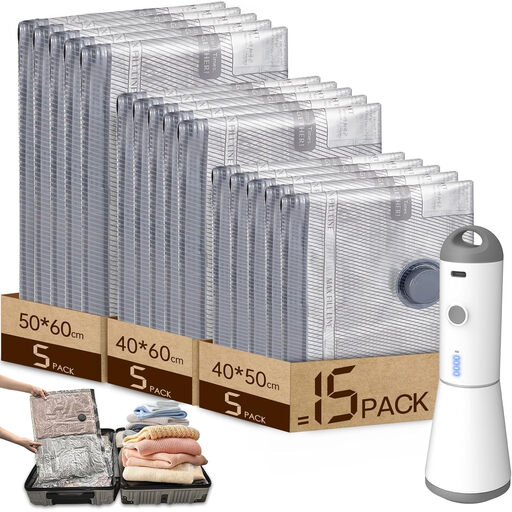
Why this choice suits this profile: This set is designed for families, frequent travellers and people in the middle of a house move who need several sizes and a dedicated pump.
The cordless pump means you do not need a vacuum cleaner. The three sizes make it easier to sort clothing, bed linen and travel items.
15 bags: 5 small, 5 medium and 5 large ; cordless pump included ; double-zip closure.
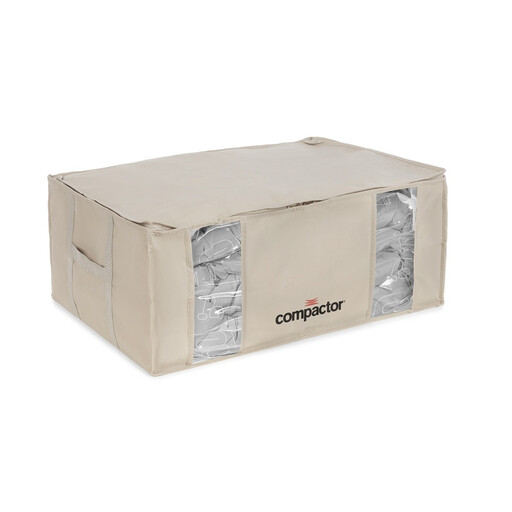
Why this choice suits this profile: Measuring 65 × 45 × 27 cm, this model is designed to store several double duvets and pillows in a dedicated space.
Its capacity is suited to a specific need: storing bed linen and thick textiles. This avoids mixing a multitude of small items in a bag that is difficult to organise.
XXL size ; valve compatible with a vacuum cleaner fitted with a hose ; airtight closure described as limiting exposure to dust and moisture.
We have selected a complete, real-time updated range of products that meet these demanding criteria while complying with European safety regulations.
These precautions are particularly important when vacuum storing clothing and household linen for several months. These bags are not designed for storing food. Keep them out of reach of children due to the risk of suffocation.
No, not always. Many models have a universal valve compatible with a vacuum cleaner fitted with a hose, but always check the product details. Travel bags that compress by rolling work without any appliance, while some sets include a manual or electric pump.
It depends on the textile, how thoroughly it has dried and the quality of the closure. To prevent unpleasant odours, wash and dry the duvet completely before storing it. Delicate textiles should be removed periodically, and the manufacturer’s recommendations should be followed: prolonged compression can affect the loft of some fillings.
A properly sealed closure limits contact with dust and moisture in the air. Some manufacturers also claim protection against moths and other pests, but this does not remove the need to store textiles in a clean, dry and properly ventilated place. Always inspect laundry before storing it, and never seal away a textile that is still damp.