
Livraison le jour même ou le lendemain

Qualité garantie

Débloquez vos offres de bienvenue: Livraison GRATUITE | Jusqu'à -80 % | 30 jours d'essai gratuits à JoyPlus
Téléchargez l'application
Vacuum storage bags significantly reduce the volume of textiles, freeing up space in a wardrobe, under a bed or in a suitcase. But not every model is suitable for the same purposes. A bag that is perfect for a few jumpers may not be suitable for a thick duvet or a suit on a hanger.
Before placing your order, it is best to avoid three common pitfalls:
Here are the criteria to consider when choosing vacuum bags for clothes, models designed for bedding or more specialised storage solutions.
The dimensions matter more than the number of bags in the pack. For folded clothes and accessories, medium-sized bags are generally easier to handle. For coats, jackets and suits, hanging vacuum bags make use of the wardrobe’s height without requiring clothes to be folded.
For bedding, always check the dimensions specified by the manufacturer:
A freestanding cube bag can be practical for under-bed storage, moving house or storing items in the garage. Its stable base makes filling easier, even when you are doing it on your own.
The models featured here are mainly made from a polyamide (PA) and polyethylene (PE) blend, or PE/PET depending on the reference. This flexible, transparent structure makes it easy to identify the contents. Some Compactor bags are advertised as being made from 0.085 mm recyclable PE/PET, while several TAILI models focus on a PA+PE design intended for repeated use.
Pay particular attention to:
The terms ‘waterproof’ or ‘airtight’ describe the product’s design, but you should still check the closure after every use. A puncture caused by a sharp object can make the bag unusable, regardless of the quality of its valve.
Vacuum bags with a pump may come with a manual or cordless pump. Other models work with a standard vacuum cleaner fitted with a hose. Before ordering, check which equipment you have at home.
Models with a pump included are particularly suitable for:
For regular household use, a valve compatible with a standard vacuum cleaner may be more convenient. Also check for a cap, flap or closure system that maintains the airtight seal after the air has been removed.
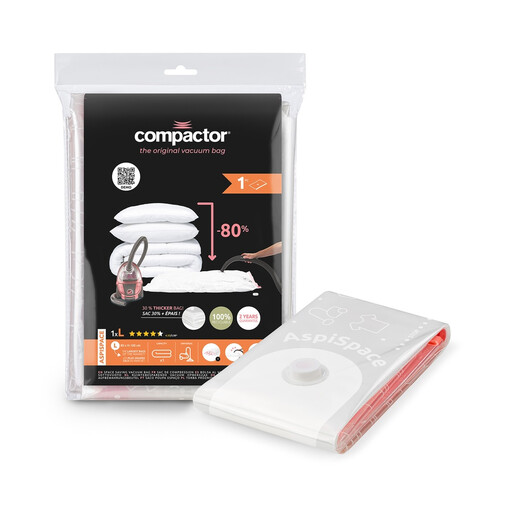
Why this choice suits this profile: its 80 × 100 cm size is suitable for storing a double duvet, cushions or winter clothes. Compatibility with a vacuum cleaner fitted with a hose makes it easy to use for the first time.
The dimensions are clearly stated and the bag has a zipped closure with a slider, as well as a universal anti-leak valve, according to the manufacturer.
80 × 100 cm L size, transparent bag, printed instructions and nylon/polyethylene material, as stated in the product listing.
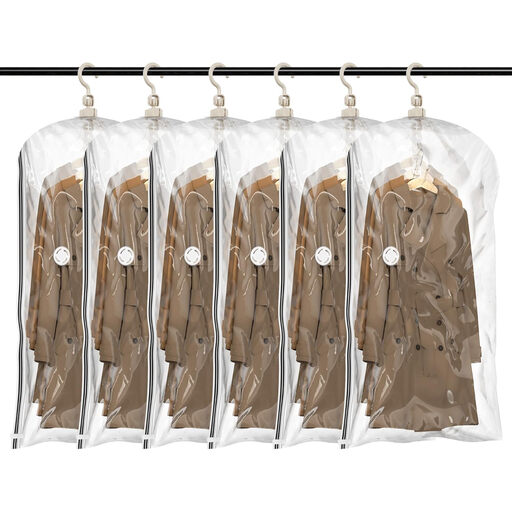
Why this choice suits this profile: this solution focuses on vertical organisation for suits, jackets and coats. Its jumbo dimensions of 135 × 70 × 38 cm and five rings help organise a family wardrobe.
The hanging system prevents formal clothes from being folded. The colour-changing zip makes it easy to check the closure visually before vacuuming.
Six jumbo bags, five 360° rotating rings and a valve advertised as compatible with all vacuum cleaners.
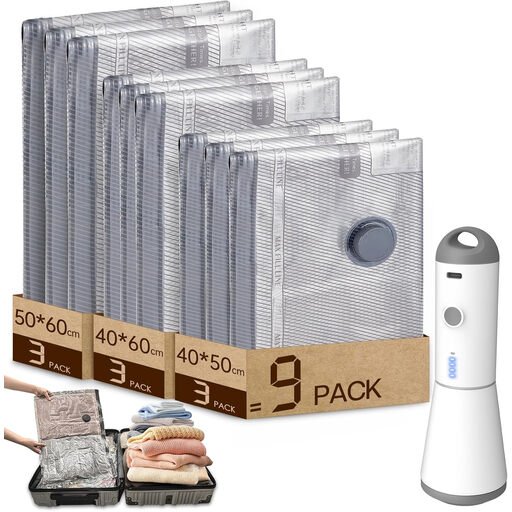
Why this choice suits this profile: its nine sizes and cordless pump are suitable for moving house, frequent travel and storing several rooms’ worth of items.
The included pump means you do not have to rely on a vacuum cleaner. The three sizes — 40 × 50, 40 × 60 and 50 × 60 cm — reduce the risk of choosing a bag that is too large for a suitcase.
Cordless pump included, double zip and nine reusable bags advertised as being made from polyamide and polyethylene.
We have put together a complete, real-time updated list of products that fully meet these strict selection criteria and European safety regulations.
To preserve storage bags for laundry, a few precautions are essential:
Compression is convenient for blankets, duvets, coats and seasonal clothing. However, it does not replace a storage method suited to each material. For delicate textiles, follow the washing and storage instructions on the label.
No. Many models are designed to work with a vacuum cleaner fitted with a hose, but the connectors may vary. Check the valve compatibility in the product listing. A manual or cordless pump is a good solution if you would rather not use a vacuum cleaner.
The length of time depends on the bag material, the condition of the textile and the storage conditions. For long-term storage, keep the bags in a dry environment, avoid overfilling them and check the closure regularly. Delicate items may need to be stored without compression.
Manufacturers often state that their bags are resistant to water, dust or moisture. This does not mean that the bags can be submerged or that they replace protection against leaks or heavy condensation. Textiles must be completely dry before vacuum sealing.