
Livraison le jour même ou le lendemain

Qualité garantie

Débloquez vos offres de bienvenue: Livraison GRATUITE | Jusqu'à -80 % | 30 jours d'essai gratuits à JoyPlus
Téléchargez l'application
Vacuum storage bags can free up a considerable amount of space in a wardrobe, under the bed or even in the car. But choosing the right model is essential. Leaking seals, plastic that is too fragile and a size unsuitable for a bulky duvet are just some of the potential drawbacks. To avoid disappointment, it is worth looking beyond the simple promise of “space-saving storage”.
Here are the criteria to consider before buying a compression bag for clothes, a duvet storage bag or an additional solution, such as an under-bed storage box.
A claim such as “up to 80% less volume” depends largely on the type of textile, its thickness and the amount of air removed. A thick duvet will not take up the same amount of space as a pile of thin jumpers. The bag dimensions and the items it can actually hold are therefore much more useful indicators.
For a double duvet, a size of around 80 × 100 cm may be suitable, depending on its thickness. Particularly bulky items may require an XL model, such as an 80 × 130 cm bag.
A bag can look sturdy yet quickly lose its effectiveness if the leak-proof valve or zip does not close properly. A slider makes sealing easier and reduces the risk of handling errors. You should also check compatibility with your vacuum cleaner: some models require a machine fitted with a flexible hose and a universal valve.
Vacuum storage bags are designed for textiles. They are not a substitute for a rigid box for items that could puncture the plastic, and they are not suitable for storing food. Avoid sharp corners, metal buckles and filling the bag to the brim.
For underwear, socks, scarves and ties, a fabric drawer organiser will often be more practical. It gives you daily access to the contents without having to open and vacuum the bag again.
Measure the available space before ordering, particularly under the bed. An extra-flat solution measuring 15 to 18 cm high will slide more easily under a bed frame than an overly thick bag. Also remember to check the distance between the bed legs and the space needed to pull the bag towards you.
In a wardrobe, a medium-sized compression bag can hold coats, jumpers or seasonal laundry. For a student or someone living in a small home, several medium-sized bags may sometimes be easier to stack and handle than one XXL model.
Nylon, polyethylene, PET and PEVA do not offer exactly the same characteristics. A transparent bag makes it easy to identify its contents at a glance. PEVA is generally valued for its water resistance, while a thicker design will withstand repeated handling more effectively.
In all cases, store only clean, completely dry textiles. Even when airtight, a bag should not be kept in a very damp room. Protection against dust and moisture also depends on the storage conditions.
Before removing the air:
For long-term storage, place the bag in a dry location away from heat and objects that could puncture it.
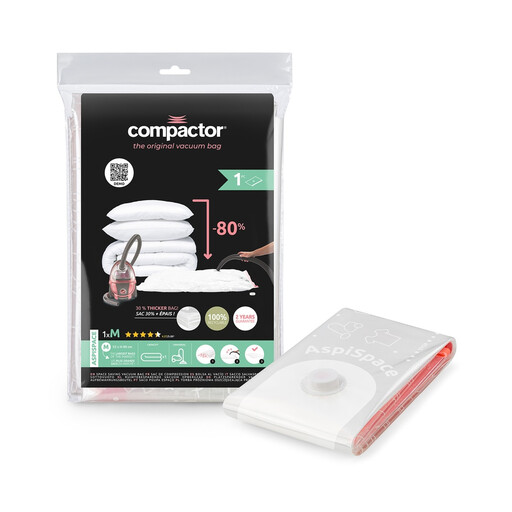
Why this choice suits this profile : Measuring 90 × 55 cm and with a stated capacity of 70 L, it is suitable for seasonal clothes, jumpers and coats in a wardrobe or small home.
Its medium size reduces the risk of overfilling, while the universal valve and zip closure make vacuum sealing easier.
Its nylon/polyethylene material is stated to be 30 % thicker, with compression of up to 80 % depending on the contents.
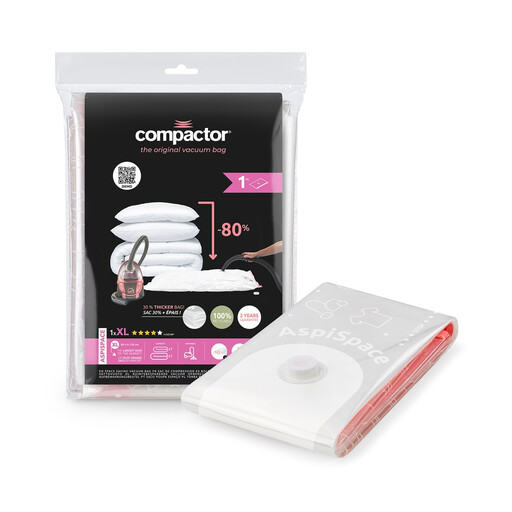
Why this choice suits this profile : This large size is designed for households storing duvets, blankets and bulky winter clothes.
Its dimensions are clearly stated, so you can compare them with those of your bedding before buying instead of relying on a vague space-saving promise.
Universal leak-proof valve, zip with slider and stated capacity for both a double duvet and a single duvet.
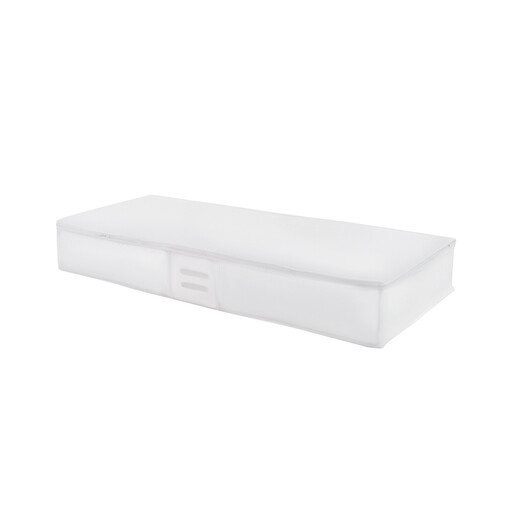
Why this choice suits this profile : Its extra-flat 100 × 48 × 15 cm design is suitable for storage under a bed or on a shelf, without requiring a vacuum cleaner.
It is suitable for homes where access to a power socket or vacuum cleaner is limited, while avoiding the problem of choosing a bag that is too tall to fit under the bed.
0.1 mm PEVA material, water-resistant design and stated protection against dust, dirt and moisture.
We have put together a complete, real-time updated selection of products that meet these demanding criteria while complying with European safety regulations.
Storing seasonal laundry is more effective when it is organised by category. Label each bag according to its contents: “duvets”, “coats”, “winter laundry” or “ski clothing”. An under-bed storage box with a transparent window can complement the bags for items you need more regularly.
For small accessories, fabric drawer organisers make it easy to separate underwear and socks. Bamboo storage boxes, such as the Osaka models, are better suited to accessories, cosmetics or stationery than to bulky textiles. This system means you do not have to open a large bag just to find one small item.
It depends on the valve. Models fitted with a universal valve are generally designed to work with a vacuum cleaner equipped with a flexible hose. Even so, check the shape of the connector before filling the bag.
The length of time depends on the material, the condition of the bag and the storage conditions. To minimise unpleasant odours and permanent creases, store only clean, dry textiles, check the seal regularly and keep the bag in a cool, dry place.
They form a barrier against dust and can limit exposure to moisture, depending on the quality of their seal and material. However, they are not a substitute for a dry storage area. Avoid cellars, garages and rooms prone to condensation, especially for long-term storage.