
Livraison le jour même ou le lendemain

Qualité garantie

Débloquez vos offres de bienvenue: Livraison GRATUITE | Jusqu'à -80 % | 30 jours d'essai gratuits à JoyPlus
Téléchargez l'application
Vacuum storage bags can free up a considerable amount of space in a wardrobe, under a bed or in a suitcase. However, you need to choose a model suited to your textiles and how you intend to use it. If it is too small, it will not fill properly; if it is too large, it will quickly become heavy and difficult to handle.
Before buying vacuum compression bags, it is worth keeping three common pitfalls in mind.
Claims such as ‘up to 75 or 80% more space’ generally apply under very specific conditions and depend on the textile’s original volume. A very bulky duvet may indeed lose a large proportion of its volume, whereas a garment that is already compact will take up considerably less additional space.
The amount you can actually store also varies according to the material, filling and effectiveness of the suction. It is therefore better to compare the bag dimensions, stated capacity and types of laundry it is suitable for, rather than focusing on a marketing figure.
A bag may appear robust yet quickly lose its compression if the zip is unreliable or the valve allows air to pass through. Vacuum bags for clothes intended for seasonal storage should have a properly airtight seal and a valve compatible with the compression system being used.
Also check whether the bag requires a hand pump, cordless pump or household vacuum cleaner. This saves you from having to buy an additional accessory later — and discovering that it is not compatible.
An overfilled bag will not close properly, and its seams will be placed under excessive pressure. Clothes with metal fasteners, buckles or sharp features may also puncture the plastic.
For vacuum bags for duvets and bags intended for bed linen, leave some space around the closure and protect any items that could catch against the wall of the bag.
The size should match the volume and shape of what you want to store:
To organise a wardrobe effectively, several medium-sized bags are often more practical than one XXL model. This allows you to separate belongings by season, person or type of textile.
Bags are generally made from PE, PET, PA or a blend of polyamide and polyethylene. These materials need to withstand twisting, handling and everyday friction. Some product descriptions state a thickness of 0.085 mm, while others specify a material thickness of 55 microns.
These figures alone do not make it possible to predict how long a bag will last. However, they provide a more objective basis for comparing different models. For regular use, a reusable design, double seal and leak-proof valve are genuine advantages.
Four systems are common:
Compression obviously does not replace washing and thoroughly drying your laundry. Before sealing a bag, make sure the textiles are clean and completely dry to prevent unpleasant odours and condensation.
The models below are grouped according to their size, accessories and the uses mentioned in their product descriptions.
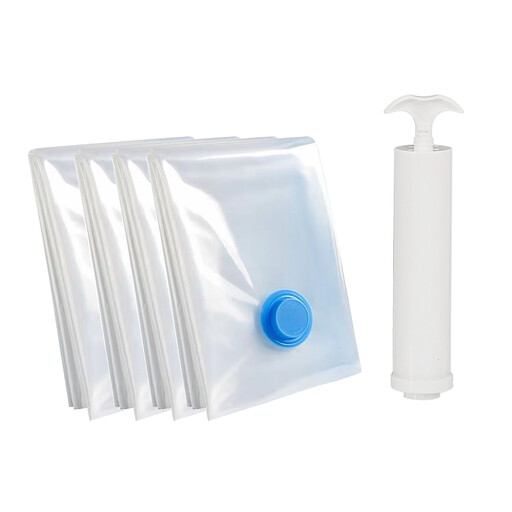
Why this choice suits this profile : this pack of five medium-sized bags, supplied with a hand pump, lets you try vacuum storage without investing in electrical equipment.
The pump is included, while the medium size reduces the risk of filling an oversized bag right to the top.
Pack of five bags, hand pump included and a size suitable for both clothes and household linen.
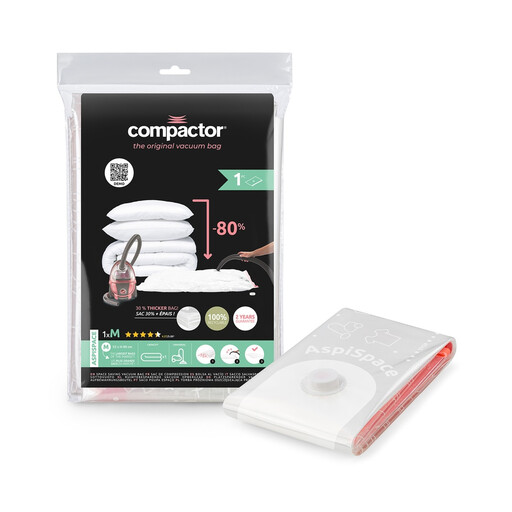
Why this choice suits this profile : this transparent 70-litre bag is ideal for neatly organising clothes, coats and duvets in a wardrobe.
The product description states that the material is 30% thicker than the standard version in the collection, and that it has a secure zip closure.
90 × 55 cm size, a valve compatible with a standard vacuum cleaner and a stated two-year guarantee.
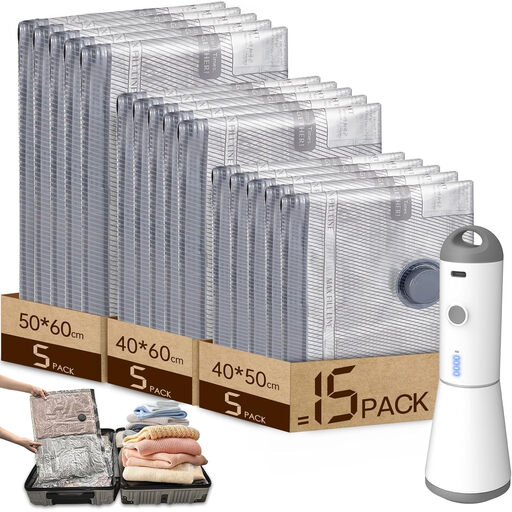
Why this choice suits this profile : this pack of fifteen bags in three sizes meets the needs of a family, a house move or regular travel.
The three sizes prevent you from having to use an unnecessarily large bag, while the dedicated pump means you do not need a vacuum cleaner.
Fifteen bags, cordless pump included, double seal and sizes ranging from 40 × 50 cm to 50 × 60 cm.
We have put together a complete, real-time updated list of products that meet these demanding selection criteria and European safety regulations.
A few simple precautions are all you need to protect the seal and valve:
Vacuum bags are not designed for food storage. They must also be kept out of children’s reach: a sealed plastic bag presents a suffocation risk.
No. Most household models work with a vacuum cleaner fitted with a hose, but the shape of the valve may vary. Models supplied with a pump offer a simpler and more predictable solution. For vacuum travel bags, the roll-up system generally means you do not need any appliance.
It depends on the condition of the bag, how airtight the closure is and the type of textile. For long-term storage, check the valve and closure regularly. Clothes must be clean and completely dry before being packed away. Delicate or highly structured items may sometimes be better stored without compression to prevent permanent creasing.
Many models are designed to be used several times, particularly those made from recyclable PA/PE or PE/PET. However, their lifespan depends on how they are handled and stored, as well as whether they remain free from punctures. Clean them with a soft, slightly damp cloth, then allow them to dry completely before folding them.