
Livraison le jour même ou le lendemain

Qualité garantie

Débloquez vos offres de bienvenue: Livraison GRATUITE | Jusqu'à -80 % | 30 jours d'essai gratuits à JoyPlus
Téléchargez l'application
Vacuum storage bags dramatically reduce the bulk of seasonal clothing, blankets and duvets in a wardrobe, under a bed or during a house move. However, not all models are created equal depending on how you plan to use them. A bag that’s too small is difficult to fill, a flimsy seal can let air back in, and an ill-suited pump makes the whole thing impractical.
Before you place an order, here are the most common pitfalls to avoid and the criteria that really matter in a British home – whether it’s a flat, a family house or for life on the go.
Listings often promise a volume reduction of up to 75 or 80%. Yet this figure depends on the fabric, its loft and how full the bag is. A thick duvet doesn’t behave the same way as a stack of T-shirts or towels.
So always check the flat dimensions, the capacity and the recommended type of contents. A vacuum bag intended for a duvet needs to be wide and long enough so the seal isn’t put under strain.
Compression relies on two key elements: the zip seal and the valve. A poorly closed zip or a valve that’s incompatible with your vacuum cleaner can prevent the air from being properly removed.
For regular use, a vacuum compression bag should have a reliable seal, a slider or closure clip, and a valve that works with the equipment you have at home.
A multi-pack isn’t necessarily more practical. Identical sizes are fine for storing a batch of clothes, but much less so when you’re mixing bed linen, pillows and blankets.
To organise a wardrobe flexibly, it’s often better to choose an assortment of sizes. For travel, smaller bags that are easy to roll will generally be simpler to slip into a suitcase.
The dimensions given usually refer to the bag when laid flat. Leave a margin around the seal and avoid filling the bag right to the edge. Here are some rough guidelines:
Before vacuuming, lay a large bag on a clear, flat surface. If you’re storing it under a bed, also check the final height of the bag once compressed.
The models in this selection are mainly made from polyethylene, polyamide or nylon, sometimes combined with PET. These materials form a soft, transparent casing that makes it easy to see the contents without opening the bag.
The stated thickness, when given, is a useful indicator, but it doesn’t replace a few common-sense precautions. Metal zips, buckles and rigid corners can puncture the plastic. Place any sharp items towards the centre and avoid overloading the bag.
Reusable vacuum bags should be emptied, cleaned with a soft cloth and thoroughly dried before being stored away. They are not intended for food preservation.
Three common methods are available:
Some travel bags can also be rolled to expel the air without a vacuum cleaner. This is convenient on the move, but doesn’t necessarily replace a full vacuum for long-term storage.
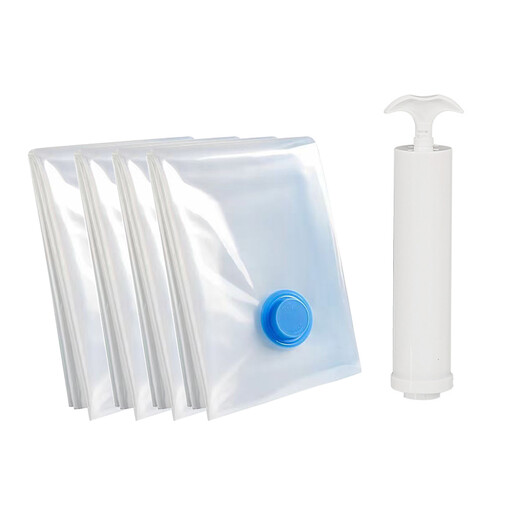
Why this choice suits this profile: With five bags and a manual pump, this pack lets you get started without investing in extra electrical equipment. It works well for both seasonal clothes and bed linen.
The pack reduces the risk of running out of bags during your first storage session, while the manual pump means you don’t have to rely on a particular vacuum cleaner model.
A pack of 5 large bags with a manual pump included, suitable for household linen and seasonal clothing.
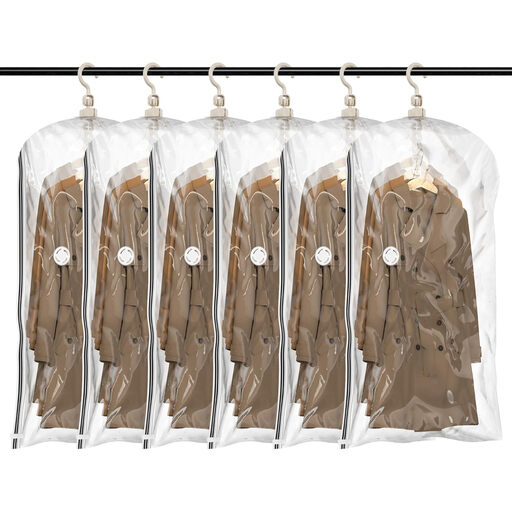
Why this choice suits this profile: These six hanging bags, measuring 135 × 70 × 38 cm, are designed for jackets, suits and clothes you want to keep easily accessible in a wardrobe.
The hanging system avoids squashing clothes into a bag on the floor. The colour-changing seal lets you check at a glance that it’s properly closed.
A five-ring hook, 360° rotation and a valve compatible with a vacuum cleaner, according to the product listing.
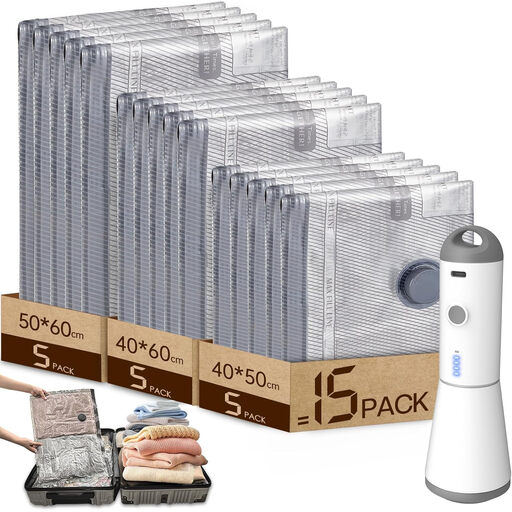
Why this choice suits this profile: Its fifteen bags in three sizes, paired with a cordless pump, are ideal for house moves, families and travellers who switch between clothes, bed linen and small items.
The three sizes prevent wasting space by using a large bag for small items. With the dedicated pump, there’s no need to hunt for a compatible hose when you’re on the move.
Five bags of 50 × 60 cm, five of 40 × 60 cm and five of 40 × 50 cm, with a cordless pump included.
We’ve put together a comprehensive, real-time selection of products that meet these strict criteria as well as European safety regulations.
Protection against moisture and dust depends on the integrity of the bag and its seal. These products are not a substitute for a dry, ventilated space, especially in a cellar or garage subject to large temperature fluctuations.
Not necessarily. Many models work with a vacuum cleaner that has a hose, but the diameter and shape of the valve can vary. Check the compatibility information on the product listing. Bags with a manual or electric pump offer a more self-contained solution.
It depends on the fabric, the level of compression and the storage conditions. For seasonal storage, open the bag when the time comes, air the duvet and check its condition before reusing it. Avoid compressing very delicate items or those filled with feathers for long periods without following the manufacturer’s care instructions.
Yes, as long as you choose a size that fits your suitcase. Small bags, roll-up models and kits with a cordless pump are the easiest to use on the go. For air travel, bear in mind the total weight once the textiles are compressed: saving space doesn’t make them any lighter.