
Livraison le jour même ou le lendemain

Qualité garantie

Débloquez vos offres de bienvenue: Livraison GRATUITE | Jusqu'à -80 % | 30 jours d'essai gratuits à JoyPlus
Téléchargez l'application
Vacuum storage bags dramatically reduce the volume of clothes, duvets and blankets when your wardrobes, cellar or under-bed space starts to fill up. But not all models are created equal, and they aren’t all suited to the same jobs. A poorly sized bag, an unreliable seal or a fiddly pump can quickly turn a bargain into an accessory left at the back of a cupboard.
Before comparing vacuum compression bags, it’s worth checking a few essential points.
Product listings sometimes claim a volume reduction of “up to 75%” or “up to 80%”. These figures apply under specific conditions and vary depending on the fabric, its thickness and the suction power. A very fluffy duvet won’t behave the same way as a jumper or a pair of trousers.
The amount of laundry you put in the bag also matters. If you overfill it, the bag won’t seal properly and is more likely to lose its vacuum quickly.
An XXL bag isn’t necessarily the most practical. In a wardrobe, a very large model can become awkward to handle. If you plan to slide it under a bed, check the height of the bag once compressed, as well as the actual width available.
For vacuum bags for clothes, medium sizes are often easier to stack and move around. Larger models are better suited to vacuum bags for duvets, thick blankets and household linen.
A valve that works with a vacuum cleaner isn’t everything. The zip seal must lock properly, and the material needs to withstand repeated handling. Buttons, metal fasteners and other sharp-edged items can eventually puncture the bag.
Reusable vacuum storage bags must be emptied, cleaned and thoroughly dried before each new use. They are not intended for food storage and should be kept out of reach of children.
Start by measuring your folded textiles, then compare their dimensions with the usable surface area of the bag. Here are some benchmarks for common sizes:
To organise a wardrobe efficiently, having several sizes allows you to separate clothes by season or by family member. A mixed pack of different sizes is often more useful than a set made up entirely of large bags.
Blends of polyamide or nylon and polyethylene are common in this category. They offer a flexible, transparent casing that’s suitable for compression. Some COMPACTOR models claim a thickness of 0.085 mm and use recyclable PE/PET material.
Check for a double zip seal, a locking slider and an anti-leak valve. These features alone don’t guarantee the same lifespan in every situation, but they do make sealing easier and reduce the risk of user error.
Vacuum bags that come with a pump have the advantage of being self-contained. Cordless pump models are handy during a house move, in student accommodation or when travelling. For regular use at home, a universal valve compatible with a vacuum cleaner may be enough.
For vacuum storage bags for travel, roll-up models are often the simplest. They don’t need any appliance or power socket. Their compression level is generally more modest, but they are lighter and less bulky.
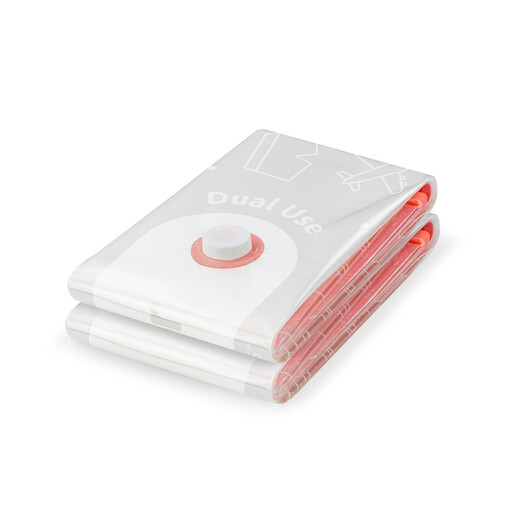
Why this choice suits this profile: This pack of two 40 × 60 cm bags lets you get started without spending much, especially for storing clothes, pillows or small seasonal textiles.
The small size reduces the risk of overfilling the bag and lets you try this storage method before moving on to a larger pack.
Two transparent bags with a zip seal and a valve compatible with a household vacuum cleaner.
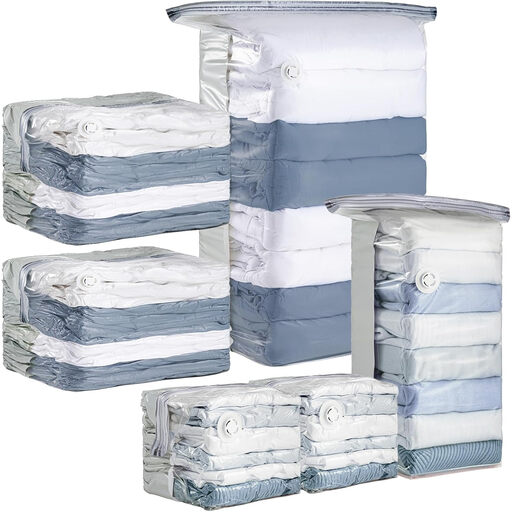
Why this choice suits this profile: The self-standing cube format is ideal for large items of laundry and makes filling easier in households that need to store significant volumes.
The cube shape and wider base make loading simpler than with a very wide flat bag, which is often hard to fill evenly.
A pack of six self-standing bags in PA/PE materials, with a valve compatible with a standard vacuum cleaner.
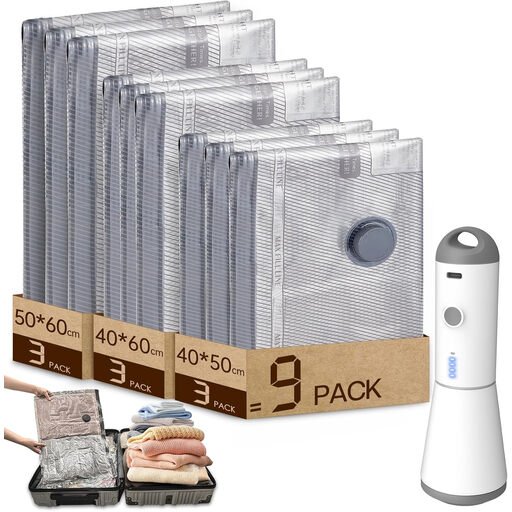
Why this choice suits this profile: Its cordless pump and three different sizes cater to travellers, families and anyone who regularly reorganises their laundry.
The dedicated pump means you don’t have to rely on a vacuum cleaner, while the three sizes reduce the risk of using a bag that’s too big or too small.
Nine bags, a rechargeable cordless pump and a double seal, available in 40 × 50, 40 × 60 and 50 × 60 cm sizes.
We’ve put together a complete, real-time updated selection of products that meet these criteria and European safety standards.
To keep your textiles in good condition:
These precautions help protect your laundry from moisture and dust, but they don’t replace proper ventilation in your home. For long-term storage, open the bags regularly to check the condition of the textiles and make sure there’s no musty smell.
Models with a universal valve are designed to work with a vacuum cleaner that has a hose. Still, check the shape of the nozzle and the manufacturer’s recommendations. A manual or cordless pump will be more convenient if you don’t have a vacuum cleaner to hand.
It depends on the quality of the seal, the condition of the bag and the storage conditions. For delicate fabrics, avoid compressing them for too long and regularly check for any moisture. Reusable bags should be cleaned and thoroughly dried between uses.
They provide an effective barrier against dust and limit exposure to moisture when the seal is properly closed. However, they don’t replace a dry space and don’t guarantee absolute protection against pests. Wash and dry clothes carefully, then inspect them before storing.