
Livraison le jour même ou le lendemain

Qualité garantie

Débloquez vos offres de bienvenue: Livraison GRATUITE | Jusqu'à -80 % | 30 jours d'essai gratuits à JoyPlus
Téléchargez l'application
Vacuum storage bags for clothes can dramatically reduce clutter in your wardrobe, under your bed, or inside your suitcase. They're also handy for storing duvets, blankets, pillows and seasonal clothing. But not all models are created equal, and not every one will suit your needs.
A seal that lets air in, the wrong size, or a flimsy film can quickly turn a great idea into a disappointing purchase. Here are the key factors to consider before choosing a vacuum storage bag that's right for your home, your travels, or a house move.
A promise of volume reduction of up to 75 or 80% doesn't mean all textiles will compress to the same degree. A thick duvet, a padded coat and woollen jumpers all behave differently.
The result depends largely on how much you put in the bag, the thickness of the items, and how effectively the air is removed. So it's better to look at the usable dimensions, capacity and compatible pump type rather than just comparing the advertised percentages.
A compression bag for clothes needs an airtight seal, a suitable valve and a film that's strong enough. Some models compress when you roll them by hand, while others require a vacuum cleaner or an electric pump.
Before ordering, check exactly what's included in the pack: a portable vacuum pump may be supplied, but it's not always the case. At home, a model compatible with your vacuum cleaner hose will often be the most practical. In a suitcase, a cordless pump will generally be easier to use.
Even the best seal or most efficient valve won't survive a tear in the film. Coat hanger hooks, belt buckles, shoes and other sharp objects can cause a slow leak. Fold your clothes carefully, protect any protruding items, and avoid overfilling the bag beyond the recommended capacity.
The size should match the volume and shape of your items:
For a vacuum bag for a duvet, measure your duvet once folded before ordering. Even a large bag shouldn't be filled to the brim: air needs to be able to reach the valve. For vacuum storage of bedding, cube-shaped models or those with straps can also make handling easier after compression.
A double zip seal with a slider lets you see at a glance that the bag is properly closed and helps you seal it evenly along the entire length. An anti-leak valve or a well-protected flap reduces the risk of air seeping back in after vacuuming.
Bags that work with a vacuum cleaner usually need a compatible hose. Models with a built-in or supplied pump are easier to use in a student room, a small flat or a hotel room.
Polyethylene, polyamide and PET are commonly used to make these bags. A thicker, more durable film is worthwhile if you'll be handling them frequently, but it doesn't make the bag indestructible.
To extend the life of reusable vacuum bags, empty them completely, wipe them with a soft cloth and let them dry before folding. Store them away from sunlight, excessive humidity and sharp objects. Protection against moisture and dust also depends on how airtight the seal really is and the condition of the film.
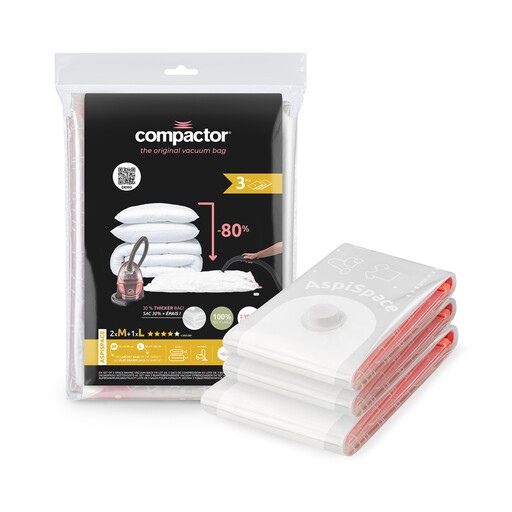
Why this suits this profile: this pack combines two M sizes and one L size. A practical combination for starting to organise several types of textiles without buying multiple packs.
The different sizes reduce the risk of overfilling, while compatibility with a standard vacuum cleaner means you don't have to buy a dedicated pump.
A pack of 3 bags, a universal valve, a zip seal with slider, and intended use for clothes, pillows and duvets.
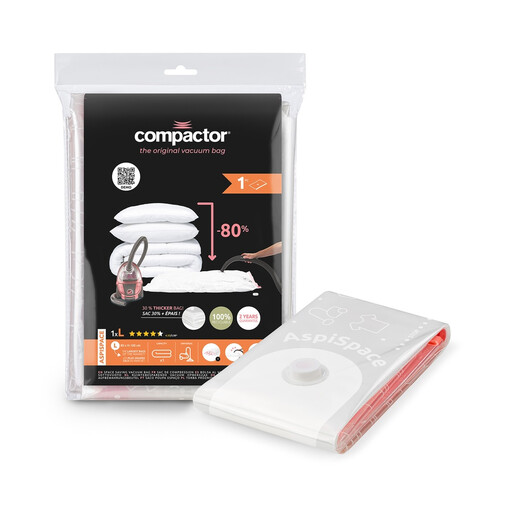
Why this suits this profile: its 80 × 100 cm size is designed for bulky items and lets you organise your bedding methodically.
The size is clearly stated and instructions are printed on the bag, making first-time use straightforward and error-free.
Dimensions of 80 × 100 cm, a universal anti-leak valve and a nylon/polyethylene material, according to the manufacturer's specifications.
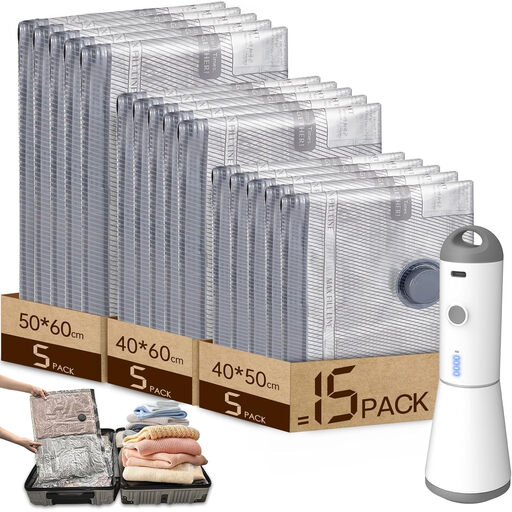
Why this suits this profile: its three sizes and cordless pump are ideal for families, house moves and anyone who regularly stores their laundry.
The supplied pump means you don't need a vacuum cleaner, while the S, M and L sizes reduce the risk of choosing the wrong dimensions.
15 reusable bags, a double seal, a cordless pump and air extraction claimed in around 30 seconds.
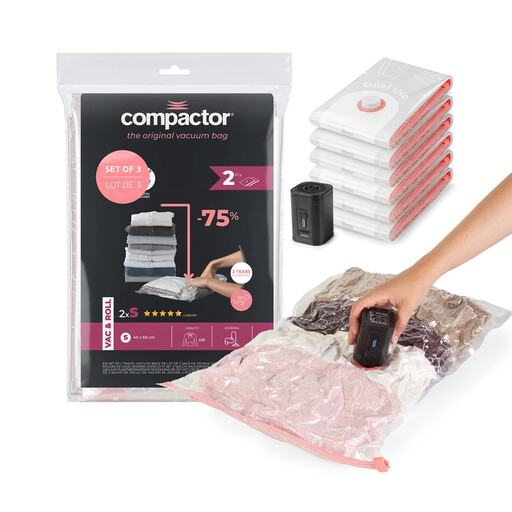
Why this suits this profile: the six S-size bags at 40 × 60 cm are ideal for lightweight clothing, rucksacks and suitcases.
The bag can be used with a vacuum cleaner or compressed by rolling it by hand – a handy backup option when you're travelling.
Six bags, an electric pump, S size and the option to expel air without a vacuum cleaner.
We've put together a comprehensive, real-time updated list of products that fully meet these strict selection criteria and European safety regulations.
Vacuum bags are not a substitute for breathable covers for all textiles. For delicate items, certain natural materials and clothes that need ventilation, follow the recommendations on their care labels.
Yes, as long as the bag has a valve compatible with your vacuum cleaner's hose. However, check the connector diameter and whether an adaptor is needed. When travelling, a manual pump or a portable vacuum pump will often be more practical.
It depends on the material, the condition of the bag and the storage conditions. For seasonal clothing, check the seal regularly and make sure the film has no punctures. Textiles must be clean and dry before packing to minimise odours and marks from residual moisture.
Many models are designed to be used several times. Their lifespan depends on how often they're handled, the strength of the film and how well they're looked after. Clean the bag with a soft cloth, let it dry completely and avoid any contact with sharp objects.