
Livraison le jour même ou le lendemain

Qualité garantie

Débloquez vos offres de bienvenue: Livraison GRATUITE | Jusqu'à -80 % | 30 jours d'essai gratuits à JoyPlus
Téléchargez l'application
Vacuum storage bags can free up precious space in a wardrobe, under a bed or at the bottom of a suitcase. But you need to pick the right model. A bag that’s too small for a duvet, a seal that lets air back in or an incompatible pump can quickly turn a good idea into a disappointing purchase.
Before comparing offers, it’s worth looking beyond the promises of reduced volume. Here are the main pitfalls to avoid, the criteria to check and a selection suited to different uses.
The dimensions given usually refer to the bag when fully unfolded. Once filled, the available space depends on the thickness of the textiles and the margin needed to close the zip properly. A 40 × 60 cm bag will work better for folded clothes, jumpers or T-shirts than for a double duvet.
For bulky bedding, go for a vacuum bag for duvets in size L, XL or XXL. Also think about shape: a cube-shaped model is often easier to stack in a wardrobe or chest.
Claims of “up to 75 or 80%” vary depending on the type of textile, its loft and how much you put in the bag. A down duvet doesn’t compress the same way as a coat or a lightweight blanket.
The volume reduction also depends on how airtight the seal is. A poorly closed zip, a badly positioned valve or an overfilled bag can let air seep back in over time.
Some vacuum bags for clothes work with a vacuum cleaner fitted with a hose. Others are simply emptied by rolling them by hand. Models with an electric or manual pump are particularly handy when you’re on the move.
Before ordering, check compatibility with your equipment and see if an adaptor is included. A built-in or included pump can be very practical for travel, but it also adds an accessory that needs charging or maintenance.
To keep a wardrobe well organised, transparent bags let you see the contents without opening them. Coloured models or those with an outer cover can be more discreet in a living space.
Bags are usually made from polyethylene (PE), polyethylene terephthalate (PET), polyamide (PA) or a blend of these materials. Their durability depends on the overall design: film thickness, quality of the welds, strength of the zip and reliability of the valve.
Some COMPACTOR models, for example, claim a recyclable PE/PET material of 0.085 mm, while TAILI bags combine PA and PE. This information is useful for comparing technical specs, but it doesn’t guarantee the same lifespan in all conditions.
A reusable vacuum bag needs to be handled with care. Avoid sharp objects, unprotected metal fastenings and filling it to the brim. Also be careful with the term “recyclable”: it doesn’t necessarily mean the bag will be accepted by all local recycling schemes.
Go for a double zip, a closure clip or a slider that’s supplied. The valve should remain easy to access once the bag is filled and be compatible with your vacuum cleaner or pump.
An airtight seal limits the exposure of textiles to dust and ambient humidity. However, it doesn’t replace storage in a dry place. Avoid damp cellars, the risk of leaks and large temperature fluctuations. These bags are not designed for food storage.
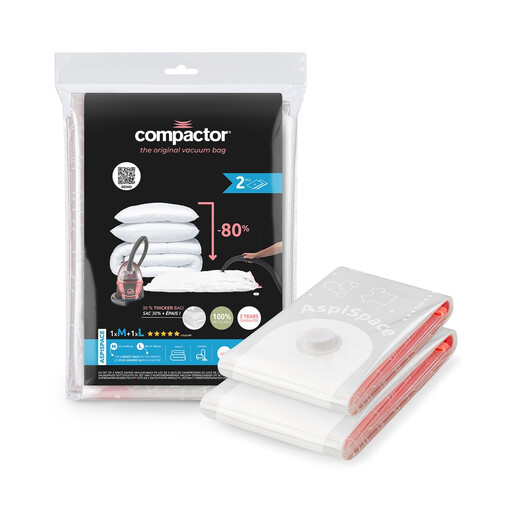
Why this choice suits this profile: This assortment of two sizes lets you start with clothes, bedding or a small duvet without investing in a large pack.
The M and L sizes reduce the risk of choosing a bag that’s too big or too small. The zip closure and valve are designed for use with a standard vacuum cleaner.
Two sizes, a claimed recyclable PE/PET material of 0.085 mm and a transparent design.
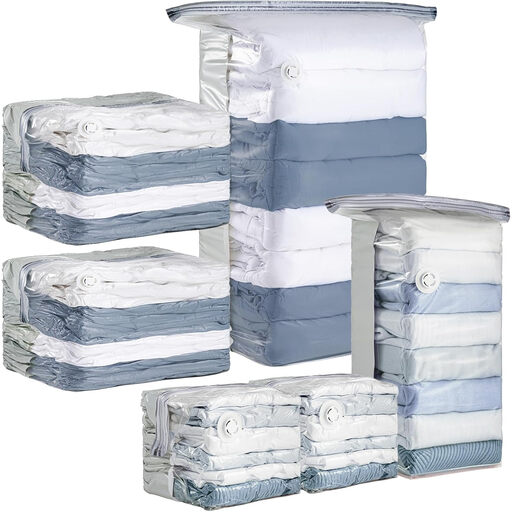
Why this choice suits this profile: Its self-supporting cube shape is ideal for households that regularly store several duvets, blankets or batches of laundry.
The wider base makes filling easier and reduces the risk of overloading a flat bag. The clip accompanies the double zip closure.
Pack of six cube-shaped bags, claimed dimensions of 78.7 × 101.6 × 38.1 cm (31 × 40 × 15 inches), and a valve compatible with a standard vacuum cleaner.
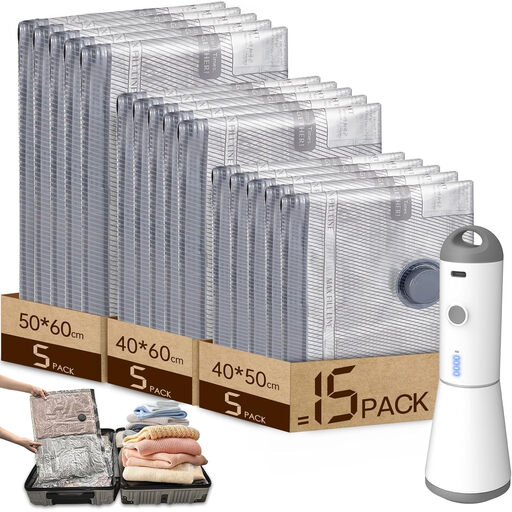
Why this choice suits this profile: With fifteen bags across three sizes, this pack meets the needs of a house move, a family or frequent travellers.
The cordless pump means you don’t need to find a vacuum cleaner when you’re about to leave. The three sizes also reduce the risk of using a large bag for small items.
Fifteen bags, cordless pump, sizes 40 × 50 cm, 40 × 60 cm and 50 × 60 cm, with double zip closure.
We’ve put together a comprehensive, real-time list of products that fully meet these strict selection criteria and European safety regulations.
Vacuum bags for clothes are not a permanent storage solution for all textiles. Wool, leather and certain structured garments may need to stay hung up or be folded without prolonged compression. Always check the care instructions on the labels.
It depends on the textile, the humidity level and the condition of the bag. For seasonal storage, check the seal regularly for airtightness and look for any condensation. Items must be clean and dry before being compressed.
Not necessarily. Many models work with a vacuum cleaner fitted with a hose. Bags that come with a pump, electric or manual, are more practical for a suitcase, a student room or a home without a vacuum cleaner.
A properly sealed closure forms a barrier against dust and limits exposure to ambient humidity. However, it doesn’t protect against immersion, leaks or a very damp room. For bedding stored over a long period, choose a ventilated, dry location.