
Livraison le jour même ou le lendemain

Qualité garantie

Débloquez vos offres de bienvenue: Livraison GRATUITE | Jusqu'à -80 % | 30 jours d'essai gratuits à JoyPlus
Téléchargez l'application
Vacuum storage bags are popular for their ability to quickly reduce the volume of textiles. But a poorly chosen model can soon disappoint: a seal that lets air back in, a valve that doesn't fit your vacuum cleaner, or a bag that's too small for a duvet. Whether you're organising a wardrobe, freeing up space under a bed, or preparing for a house move, a few simple criteria can help you avoid unnecessary purchases.
Some adverts promise a volume reduction of "up to 80%". Yet this figure depends on the type of textile, its fluffiness and how full the bag is. A thick duvet and a neatly folded jumper won't behave the same way.
So check the actual dimensions, the stated capacity and the intended use: clothing, pillows, coats or a vacuum bag for a duvet.
A vacuum bag that reinflates after a few hours loses most of its usefulness. The points to examine are the slider, the sealing gasket and the anti-leak valve. Even when described as universal, the valve must be compatible with your vacuum cleaner's hose.
For travel, a bag with its own pump or a roll-up system can be more practical than a model that needs a power socket.
Once sealed, a compression vacuum bag limits exposure to dust, ambient humidity and moths, according to the manufacturer's instructions. However, it does not replace the need for storage in a dry room. Textiles must be clean and completely dry before vacuum packing: otherwise, odours or traces of dampness can appear.
The format should match your textiles, without filling the bag so much that it puts the seal under strain.
A vacuum bag that is too large and only half full can be less manageable. Conversely, a model that is too small may strain the seal and create pronounced creases.
Recyclable PE/PET is commonly used for textile storage bags. PET contributes to the film's rigidity, while polyethylene gives it flexibility. A stated thickness, for example 85 µm, provides a useful comparison point between models, although durability also depends on the welds and overall design.
Avoid placing items with sharp edges or unprotected metal fastenings inside. Even a tiny puncture can stop the bag from holding its vacuum.
Bags fitted with a valve are generally designed to work with a vacuum cleaner that has a hose. Other models can be rolled by hand to expel the air, a solution better suited to travel.
Before ordering, check:
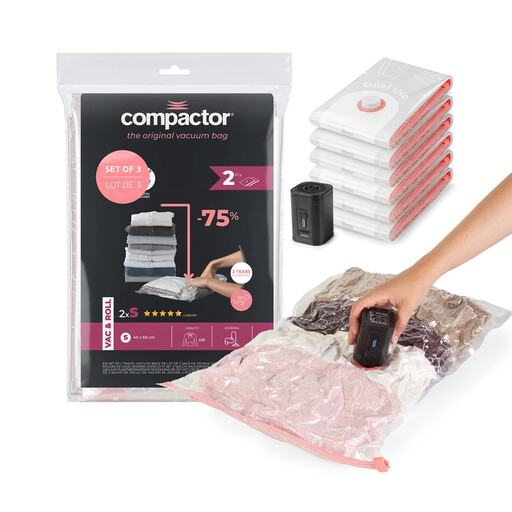
Why this profile suits it: This pack is ideal for starting to organise a suitcase, drawers or small piles of clothes. The six 40 × 60 cm bags come with an electric pump.
The included pump means you don't have to rely on a vacuum cleaner hose when travelling. The compact size also reduces the risk of overfilling the bags.
Six 40 × 60 cm bags, electric pump included, can be used with a vacuum cleaner or by rolling.
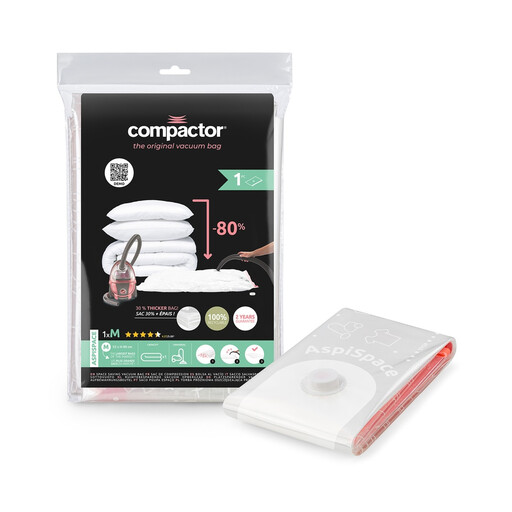
Why this profile suits it: With its dimensions of 90 × 55 cm, this model is suitable for households that regularly store coats, jumpers and seasonal clothing in a wardrobe or under a bed.
The product page states it is made from material 30% thicker than the standard version, plus it has a secure zip closure. These are concrete details, more useful than a simple compression promise.
90 × 55 cm format, stated capacity of 70 l, reinforced valve and a two-year warranty indicated by the manufacturer.
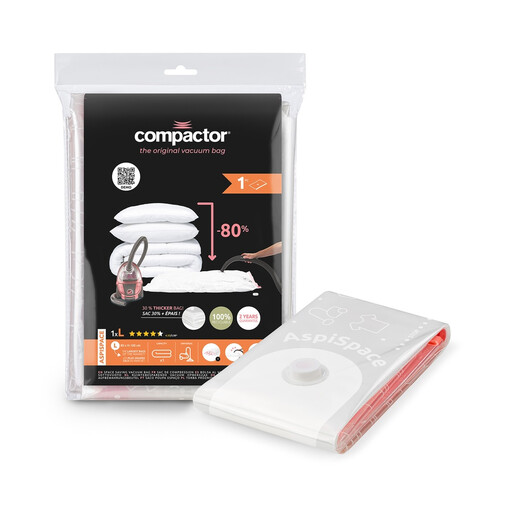
Why this profile suits it: Its dimensions of 80 × 100 cm are suitable for double duvets, pillows and the bulkiest winter clothing.
The universal anti-leak valve and the slider closure target the two main causes of air loss. It is still essential to protect the bag from sharp objects.
80 × 100 cm format, designed for a double duvet, compatible with a vacuum cleaner that has a hose.
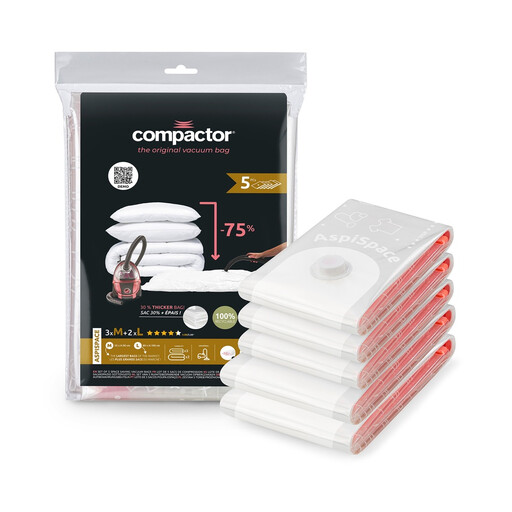
Why this profile suits it: This pack brings together three M bags (55 × 90 cm) and two L bags (80 × 100 cm) to sort clothes, pillows and bed linen.
The two sizes prevent you from using a large bag for a small pile of clothes and make it easier to achieve a better-balanced fill.
Five bags in total, stated recyclable PE/PET materials, transparent design and compatibility with standard vacuum cleaners.
We've put together an updated selection of products to organise and seal your bags according to your needs.
To extend the life of a reusable vacuum bag, simply follow these steps:
Excessive compression can permanently crease some delicate fabrics. For padded coats and duvets, also check the care instructions on the label.
The duration depends on the quality of the seal, the condition of the valve, how full the bag is and the storage conditions. Inspect the bag after a few days, then regularly. A slight regain in volume may indicate a poorly closed zip or a puncture.
Vacuum bags with a valve are generally designed for a vacuum cleaner with a hose, but the diameter and shape of the valve can vary. Check the product page before buying. Roll-up models or those with a pump offer an alternative when you don't have a vacuum cleaner to hand.
No. A vacuum bag for a duvet must be wide enough to hold the duvet without straining the zip. Large formats, such as 80 × 100 cm, are generally better suited to bulky duvets; however, measure the duvet once folded before ordering.