
Livraison le jour même ou le lendemain

Qualité garantie

Débloquez vos offres de bienvenue: Livraison GRATUITE | Jusqu'à -80 % | 30 jours d'essai gratuits à JoyPlus
Téléchargez l'application
Vacuum storage bags can free up precious space in a wardrobe, under a bed, or in a suitcase. But not all of them meet the same needs. A model suited to lightweight clothing won’t necessarily work for a thick duvet, while a non-suction storage bag can be more practical for suits or regularly used laundry.
Before buying, three mistakes often crop up: relying solely on the claimed volume reduction, overlooking the closure system, and choosing a size that’s too large. Here are the criteria to consider when selecting vacuum bags for clothes, compression bags for duvets, or storage bags for household linen that are truly right for your needs.
A bag may be marketed as offering “space-saving” without including a valve for sucking out the air. Standard zip-up bags mainly protect against dust and make organising easier, but they don’t necessarily reduce the volume of their contents.
For effective compression, check for a suction valve, a double-zip closure, or a compatible pump. A PEVA bag with a zip will be more suited to a need for organisation and light protection.
Even if correctly filled, a poorly sealed bag will quickly lose its compression. Textiles can also put excessive pressure on the seams if the bag is overloaded or if sharp objects are inside.
A double zip, a closure clip, or a valve with a stopper are all features to check before buying. Also, stick to the recommended volume and leave enough margin around the closure.
A large bag isn’t automatically more practical. Once filled, it can become heavy to move or may not fit under your bed. For seasonal storage, first measure the available space: height under the bed, width of a shelf, or dimensions of a chest.
Medium sizes generally work well for folded clothes. Large models and cube-shaped bags are better suited to bulky duvets, blankets, and pillows.
Reusable vacuum bags are often made from a combination of polyamide and polyethylene, while standard storage bags can be made from PEVA, vinyl, or non-woven polypropylene. The product page should specify the material used as well as any care instructions.
For repeated use, look for:
These features don’t make the bag indestructible. Always keep textiles away from sharp objects, heat sources, and persistent dampness.
Compare the bag’s dimensions with those of the items you want to store. Small or medium-sized storage bags for clothes and bedding are easier to sort by category: jumpers, coats, bed linen, or baby clothes.
For a duvet, check the stated capacity and the bag’s shape. A cube-shaped bag can stand upright and slide into a cupboard, while a flat bag will be better suited under a bed. Some bags indicate a capacity in litres or an approximate volume: use these as a guide, without exceeding the recommended load.
A portable vacuum pump is handy for a suitcase, a student room, or a home where no vacuum cleaner is easily accessible. Models without a pump may be compatible with a household vacuum cleaner fitted with a hose.
Before storing your textiles, make sure they are clean and completely dry. Place them in without compressing them to the point of straining the zip, close it gradually, then suck out the air. For long-term storage, check the condition of the closure from time to time and air the items when the season changes.
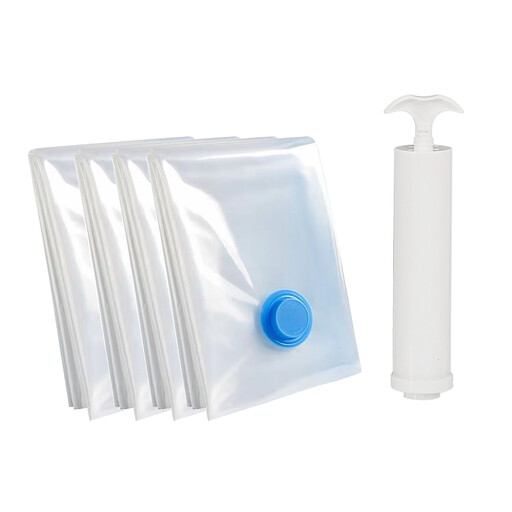
Why this choice suits this profile: This pack of five bags with a hand pump lets you get started gradually, especially for storing seasonal clothes and folded laundry.
The medium size reduces the risk of overfilling a bag beyond its capacity, and the pump is included.
A pack of five medium-sized bags, complete with a hand pump.
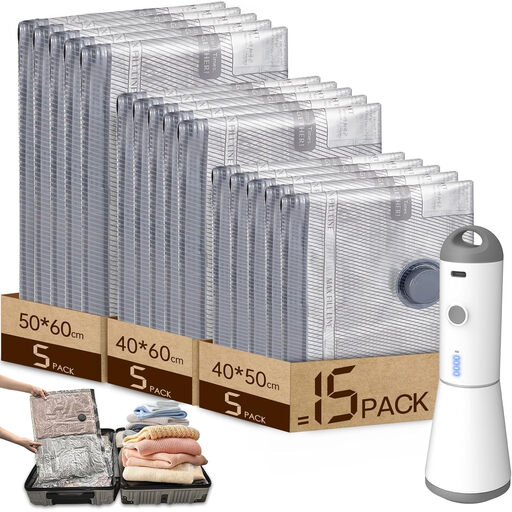
Why this choice suits this profile: The fifteen bags, split across three sizes, and the cordless pump are ideal for a household looking to organise several categories of textiles.
The three different sizes prevent you from trying to fit very different items into a single overloaded bag.
A cordless pump, a double closure, and sizes of 40 × 50, 40 × 60, and 50 × 60 cm.
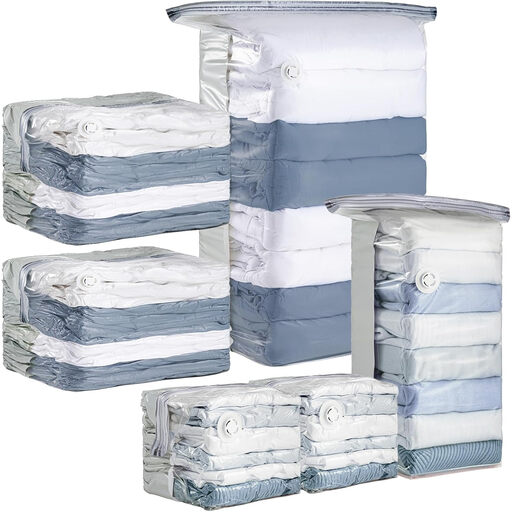
Why this choice suits this profile: The cube shape and jumbo and medium sizes are designed for storing duvets, blankets, and bedding during a house move or a change of season.
The wider base and closure clip make filling easier and allow you to check the zip is properly sealed before suction.
Six cube-shaped bags, a valve compatible with a standard vacuum cleaner, and a stated capacity of 7.3 kg per bag.
We’ve put together a comprehensive list, updated in real time, of products that meet these demanding selection criteria and European safety regulations.
Compression bags are not a substitute for a properly ventilated room. If your home is damp, choose a dry space and check the condition of the textiles regularly.
No. Some bags require a dedicated pump, while others have a valve compatible with a household vacuum cleaner and its hose. Check the product page before buying and look at the shape of the valve.
It depends on the material, the quality of the closure, and the storage conditions. For seasonal storage, only place clean, dry textiles in the bag, then inspect it regularly. If the compression is lost or a smell appears, open the bag, air the items, and check the seal.
Yes. Small sizes and vacuum bags for clothes help organise a suitcase and reduce bulk. On the downside, compression makes the contents denser and therefore potentially heavier. Check your luggage weight limits and choose a model with a portable pump if no vacuum cleaner is available at your destination.