
当日/次日达

品质保障

开启新人专享福利: 全场免邮 | 低至 2 折 | 免费试用 30 天 JoyPlus 会员
下载 Joybuy
A full wardrobe does not necessarily mean you need to buy additional furniture. Vacuum storage bags for clothes reduce the volume of sweaters, jackets, duvets and other seasonal textiles, whether stored under a bed or packed in a suitcase. However, the quality of the seal, the dimensions and the ease of use can vary considerably from one model to another.
Before choosing a set, it is best to avoid three common pitfalls: a claimed volume reduction without clearly stated conditions, a valve that is incompatible with the pump you own, and a bag that is too thin to withstand repeated use. Here are the key points to examine, along with a selection suited to different needs.
A compression bag for clothes may look exceptionally spacious in a product photo. In practice, its capacity depends primarily on the thickness of the items you place inside. Coats, knitwear and jeans naturally take up more room than T-shirts.
An overfilled bag is difficult to seal and puts excessive pressure on the zip. Take the time to check the flat dimensions, then leave a few centimetres of clearance around the closure. This precaution makes it easier to achieve an airtight seal and reduces the risk of deformation.
The closure plays an essential role. A poorly aligned zip can let air back in, while an awkward valve slows down extraction. Reusable vacuum bags should therefore have a sufficiently robust closure to withstand repeated opening and closing.
Also check whether the pump is included. A cordless vacuum pump means you do not have to bring out the vacuum cleaner every time, particularly when storing clothes in a student bedroom, a small apartment or a holiday rental.
Compression limits exposure to dust and can help protect textiles from ambient moisture, provided the bag is properly sealed. However, it does not replace storage in a dry, clean place with a stable temperature.
Clothes must be clean and completely dry before being packed. Storing a textile while it is still damp can lead to unpleasant odours and damage the fibres, even inside a hermetically sealed bag.
An assortment of several sizes is often more practical than a set consisting of one large format. Small bags are suitable for underwear, T-shirts and children's clothing. Medium sizes accommodate sweaters and trousers, while larger models can hold lightweight jackets or household linens.
A set of 9 vacuum bags in several dimensions makes it easier to organise a wardrobe: three bags for each clothing category, for example. This prevents summer and winter textiles from being mixed together in a container that is difficult to handle.
Product specifications often mention a combination of polyamide and polyethylene. These materials are commonly used to create a flexible outer layer that resists tearing. Also review the care instructions: dry or lightly damp cleaning of the pump, thorough drying of the bags and no sharp objects inside.
The term “reusable” does not mean that the bag will last indefinitely. To preserve it, avoid sharply folding it around the valve and do not overfill it. Pack items without protruding edges, exposed metal buckles or unprotected shoes.
A pump integrated into or supplied with the set simplifies everyday use. Cordless models are particularly convenient for storage under a bed or in a suitcase, since they do not require a nearby power outlet. Depending on the product specifications, some devices claim to extract the air in around 30 seconds; the actual time depends on how full the bag is, the position of the valve and the available power.
For regular use, check battery compatibility, the charging method and how easily the pump can be stored. A compact model can stay in the cupboard with the bags rather than disappearing at the back of a drawer between seasons.
The products below do not all serve the same purpose. Vacuum bags reduce volume, while a wardrobe or foldable boxes organise clothing without compressing it.
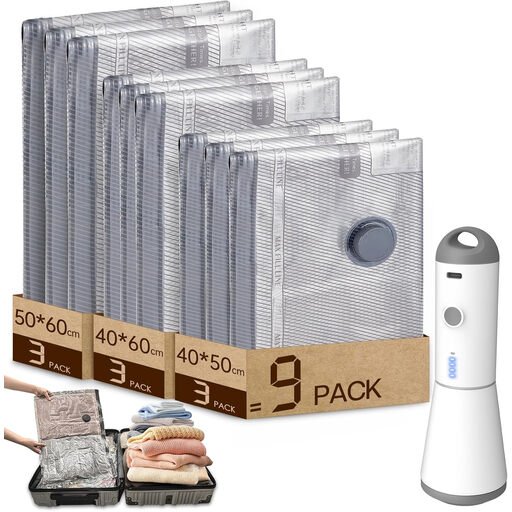
Why this choice suits this profile: A versatile set for organising a wardrobe, under-bed storage or luggage from day one.
The cordless pump is included, and the nine bags come in three sizes: 40 × 50 cm, 40 × 60 cm and 50 × 60 cm. This variety means you do not have to use an oversized bag.
Double-zip closure, included pump powered by a lithium-polymer battery, and a stated total set weight of 810 g.
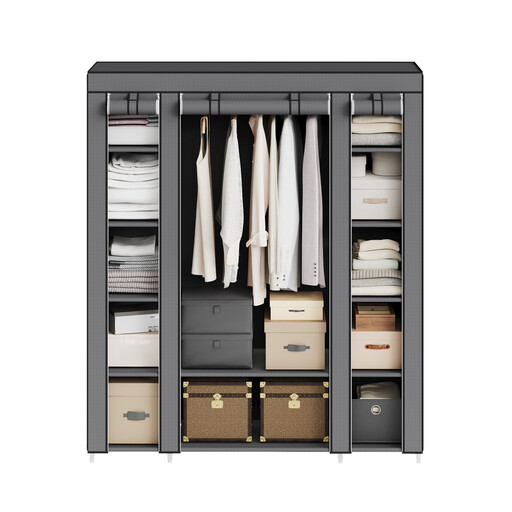
Why this choice suits this profile: For organising a wardrobe without compressing every garment, this unit provides a practical and accessible overview.
The cover protects clothes from dust, while the compartments keep items separate without relying on a valve or pump.
Dimensions of 45 × 150 × 175 cm, twelve storage compartments and a stated static load capacity of 5 kg per shelf.
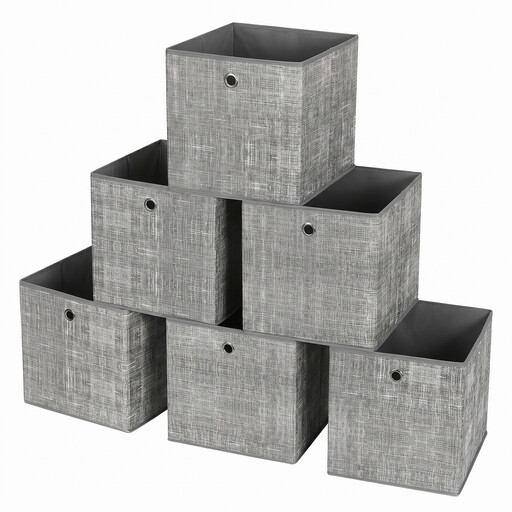
Why this choice suits this profile: These boxes complement vacuum bags for regularly worn clothes, accessories, linens or children's belongings.
The 30 × 30 × 30 cm dimensions are clearly specified. The boxes fold flat when not in use and require no vacuuming.
Set of six boxes, made with cardboard and 80 g/m² non-woven fabric, with a stated static capacity of up to 5 kg per box.
To compare other formats, including a portable wardrobe or higher-capacity boxes, also browse the clothing storage and wardrobes selection.
For knitwear and garments that need to retain their shape, a box or wardrobe may be preferable to prolonged compression. Vacuum bags are better suited to flexible textiles and seasonal items.
Explore a regularly updated selection of solutions for organising your clothes, wardrobe and storage spaces.
Yes, provided they are compatible with the space available in your suitcase and the pump remains sufficiently compact. However, check the total weight, the dimensions after compression and the carrier’s rules regarding baggage.
The duration depends on the textile, the condition of the bag and its storage location. For seasonal storage, regularly check for moisture, unpleasant odours or loss of air. Delicate garments may require less compressed storage.
Its running cost depends primarily on recharging the battery. A pump included in the set avoids the need to purchase a separate device. To minimise handling, group items by category and only start vacuuming once the bag has been properly filled and sealed.