
Same-day & Next-day Delivery

Quality Guaranteed

Unlock Your Welcome Offers: FREE Delivery | Up to 80% OFF | Free 30-day JoyPlus trial
Download the APP
Overflowing closets, a winter duvet hogging an entire shelf, a suitcase that refuses to close the night before a trip… It's a familiar story. Lack of space is a daily headache. On paper, the vacuum storage bag seems like a miracle solution: a quick pass with the vacuum, and just like that, bulky textiles are compressed to optimise every last square inch.
In the real world, however, the experience often ends in disappointment: a bag that reinflates after three days, plastic that tears at the slightest touch, or a zipper that fails miserably. Before you invest, let's review the common pitfalls so you can make the right choice and finally reclaim space in your closets.
The market is flooded with options, but they are far from equal in quality. Here are the three most common problems that will turn your purchase into a useless gadget.
To ensure you don't make a mistake, here are the technical points to examine closely. This is what separates a reliable product from a mere marketing promise.
The longevity of a garment compression bag depends primarily on its materials. Entry-level models often use simple polyethylene (PE). For true durability, look for dual-material compositions like Polyamide + Polyethylene (PA+PE). Polyamide offers far better flexibility and puncture resistance. The film's thickness, sometimes indicated in microns (?m), is another good indicator: the thicker it is, the tougher it is.
A good valve is designed to block any air from re-entering once suction is complete. So-called "universal" valves, compatible with most canister vacuum nozzles, are a real everyday convenience. As for the closure, a double-zip system provides an extra layer of security. An ergonomic slider included with the bag makes the process much easier and ensures both sides of the zip are perfectly sealed.
It all depends on your use case:
Rather than searching for a one-size-fits-all bag that doesn't exist, it's better to choose a solution tailored to a specific need.
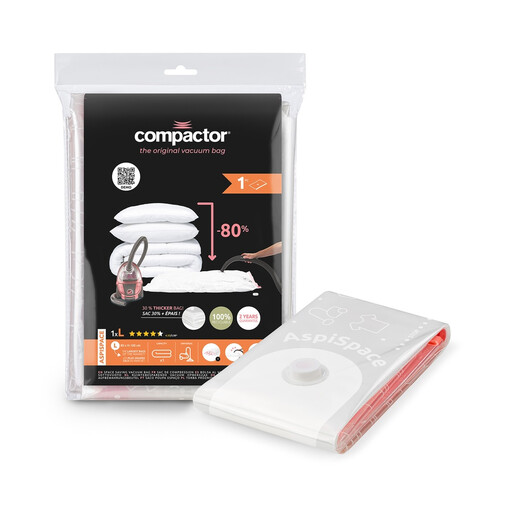
The use case: Storing a bulky winter duvet or ski jackets. No need to buy a whole set when a single bag will do. It's the simple, effective solution.
Its nylon and polyethylene (PA+PE) composition makes it much more durable than entry-level plastics, eliminating the risk of punctures.
The universal non-return valve, compatible with any vacuum cleaner, ensures easy, long-lasting compression.
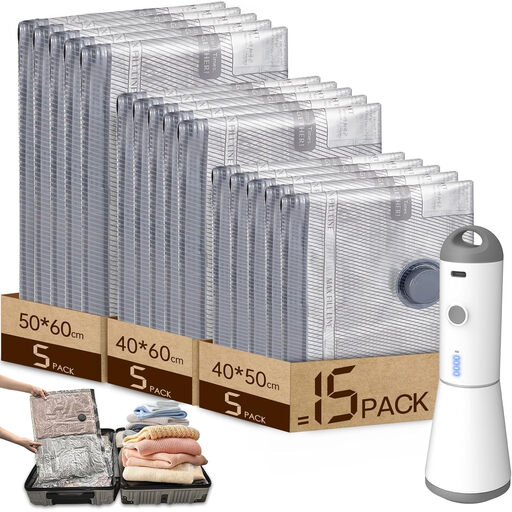
The use case: For long-term travellers or moving house, autonomy is key. This complete kit with a cordless electric pump lets you repack your suitcase anywhere, without needing a vacuum cleaner.
The combination of a double-zip closure, a specific valve, and a dedicated pump creates a closed ecosystem that drastically reduces the risk of leaks.
The portable cordless pump is the real game-changer in this set, offering complete freedom to compress and re-compress your luggage on the go.
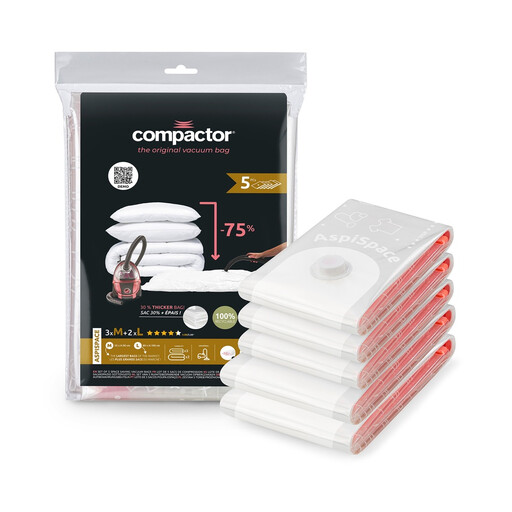
The use case: Managing seasonal wardrobe changes for the whole family, storing duvets and pillows for guests… An assortment of sizes quickly becomes essential. This set provides the necessary flexibility.
With its different sizes (M and L), this set avoids the headache of a single bag that's often too big or too small, allowing you to truly optimise storage volume.
The brand's reputation and its recyclable PE/PET construction are marks of quality for repeated use, season after season.
Discover our full selection of products that meet our criteria for quality and durability.
A high-quality, properly sealed, and unpunctured model should hold its compression for several months. A very slight reinflation over 6 to 12 months is acceptable. However, if the bag reinflates in a matter of days or weeks, it's a sign of a leak (from the valve or closure).
Yes, absolutely. They are designed for it. Their lifespan will depend on the quality of the plastic (the PA+PE blend is the most durable) and the care you take with them. Avoid overfilling them or folding them at sharp angles to maximise their longevity.
For most textiles, the risk is zero. However, you should be cautious with delicate natural fibres (feathers, high-quality down, leather, virgin wool) over very long periods. Prolonged extreme compression can eventually break the fibres and damage the "loft" of a duvet. For these delicate items, aim for moderate compression (a 50% volume reduction) rather than maximum compression.