
Livraison le jour même ou le lendemain

Qualité garantie

Débloquez vos offres de bienvenue: Livraison GRATUITE | Jusqu'à -80 % | 30 jours d'essai gratuits à JoyPlus
Téléchargez l'application
Every time the seasons change, your cupboards overflow: thick duvets, coats, blankets and bed linen take up shelf space even though they’re not in use all year round. A vacuum storage bag can help reduce clutter in a wardrobe, under a bed or in a suitcase – provided you choose a model that suits your textiles and how you plan to use it.
Before you place an order, three common mistakes keep cropping up.
The bag’s size should mainly take into account the thickness and nature of the items, not just the number of garments stated. For storing seasonal clothing, small to medium sizes generally work well for jumpers, jackets and other less bulky textiles. Larger models are better suited to a vacuum storage bag for duvets, blankets and bulky bed linen.
Here are a few useful guidelines:
Always check the dimensions given in centimetres. A bag measuring 80 × 100 cm doesn’t offer the same capacity as a 80 × 130 cm model, even if both are labelled “L” or “XL”.
A vacuum bag with a manual or cordless pump is handy if you don’t have a vacuum cleaner to hand. Models with a universal valve are generally compatible with a vacuum cleaner that has a flexible hose, but it’s best to check this before you buy.
A cordless pump makes it easier to organise storage in a bedroom, cellar or during a house move. However, you’ll need to remember to recharge it and keep it away from moisture. For occasional use at home, the vacuum cleaner is often the simplest solution.
A vacuum bag for clothes should have a zip that closes easily along its entire length. Models with a double zip and slider make it easier to see the closure, especially when the bag is well filled.
The most commonly used materials are polyethylene, polyamide, PET and PEVA. Bags made from recyclable PE or PET can be used repeatedly, while PEVA is mainly used for non-compressed protective covers. The term “reusable” doesn’t mean you can skip a few precautions: avoid sharp objects, don’t overload the bag, and clean it before letting it dry completely and folding it away.
An airtight seal limits exposure to dust and moisture. However, it doesn’t replace storage in a dry, well-ventilated place, especially if the textiles weren’t completely dry when you packed them.
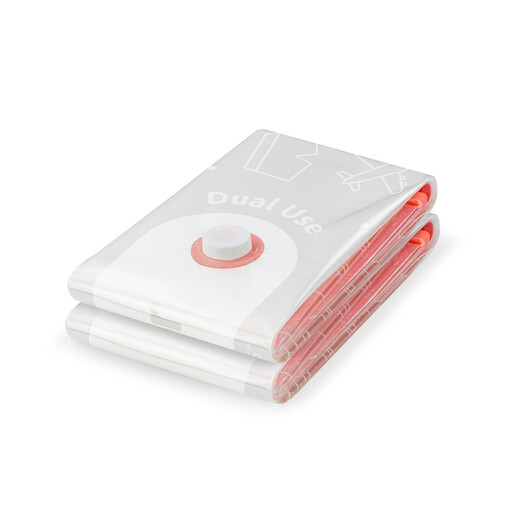
Why this choice suits this profile: This pack of two 40 × 60 cm bags lets you start gradually. It’s suitable for clothes, pillows and small household linen items. The valve is designed to work with a standard vacuum cleaner fitted with a flexible hose.
Its compact size reduces the risk of overfilling and makes it easy to check the seal before moving on to a larger capacity.
Two transparent bags, a zip closure and a valve compatible with your vacuum cleaner: the contents stay visible without having to open the cover.
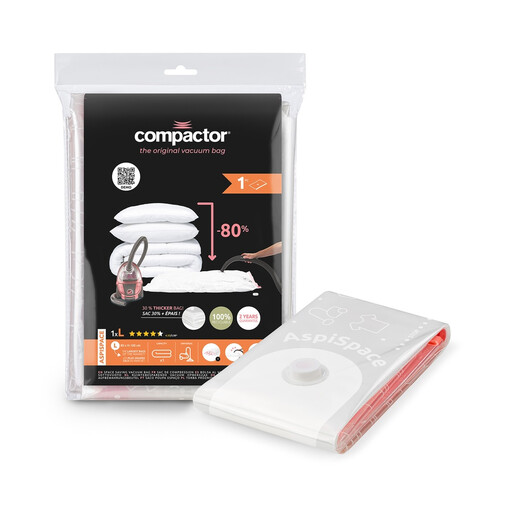
Why this choice suits this profile: With its 80 × 100 cm dimensions, this model is suitable for storing a double duvet, cushions or bulky winter clothing in a wardrobe or under a bed.
The size is clearly stated and the slider zip helps you control the closure – two things to check before compressing a bulky bedding item.
A leak-proof universal valve, nylon and polyethylene material, and a design intended for compression with a vacuum cleaner that has a flexible hose.
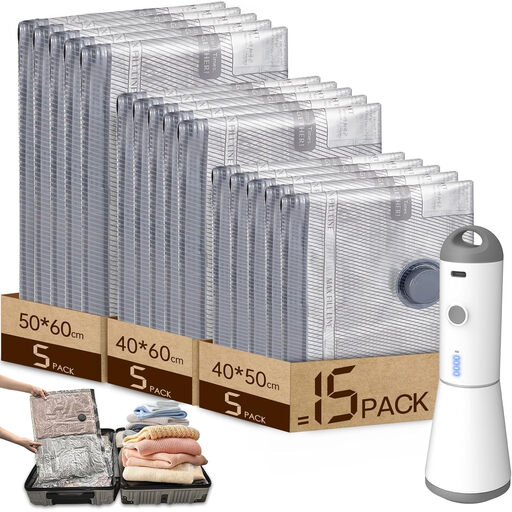
Why this choice suits this profile: This multi-size pack is aimed at families, people moving house and travellers who switch between clothes, bed linen and seasonal textiles. It includes a cordless pump and 15 bags in three sizes.
The three sizes prevent you from filling a large bag with a small amount of laundry. The double seal and dedicated valve do require a bit of care each time you use them.
A portable cordless pump, 5 bags of 50 × 60 cm, 5 of 40 × 60 cm and 5 of 40 × 50 cm; the set is advertised as reusable.
We’ve put together a comprehensive list, updated in real time, of products that meet these strict selection criteria and European safety regulations.
For even compression and to minimise air leaks:
A vacuum bag for household linen is not designed for storing food. Keep bags out of reach of children: a plastic cover can pose a suffocation risk. For models with a battery, keep the pump away from water and follow the charging and disposal instructions.
No. Check that the bag has a valve compatible with a flexible hose. Some models are designed for a manual or cordless pump. A poor connection can prevent air extraction and make it seem like the bag is leaking.
It depends on the quality of the material, the seal and the storage conditions. For seasonal storage, inspect the bag each time the seasons change. If its volume increases, check the zip and valve, then look for any punctures. Air the textiles before wearing them or storing them again.
An airtight seal can limit dust ingress and moisture exposure, depending on the product’s design. It doesn’t make the contents invulnerable: only place completely dry textiles in the bag and avoid cellars or very damp rooms. Don’t rely on these covers as a guarantee of protection against pests or as a medical device.