People who prepare portions for the week
If you cook in batches, bags can accommodate portions in different sizes. Also think about the space available in your fridge or freezer, and the packaging you plan to use regularly.


If you prepare portions in different sizes, a vacuum sealer that works with bags and rolls is worth considering. If you also package delicate or moist foods, check that the specific model has the settings you need. A pump with compatible containers is a better choice if you want to store meals in reusable containers, though they take up a fixed amount of storage space. Either way, vacuum sealing is no substitute for keeping food chilled or eating leftovers promptly.
If you cook in batches, bags can accommodate portions in different sizes. Also think about the space available in your fridge or freezer, and the packaging you plan to use regularly.
If your preparations aren’t always dry, check the settings on your chosen model and its guidance for delicate or moist foods. FoodSaver, for example, lists dry, moist and pulse settings on its VS3190X and VS2290X models. This doesn’t mean you can vacuum-seal every sauce directly in a bag.
If you want to store your meals in containers and find them easily, compare their capacities and the space they take up, then check that the pump, lids and containers are compatible. ZWILLING Fresh & Save and Guy Demarle Be Save systems use compatible accessories.
First decide whether you prefer flexible packaging or containers, then check that the system you’re considering suits your food and how you manage chilled storage. Moist and pulse settings are features to check on each sealer, not a separate storage solution.
Worth considering: for portions in different sizes that you want to store in flexible packaging; compatible models may let you cut rolls to the length you need.
Bear in mind: you’ll need suitable bags or rolls, and should clean the appliance after sealing messy preparations.
Worth considering: if you prefer to store prepared meals in reusable containers.
Bear in mind: containers take up a fixed amount of space and must be compatible with the pump and their lids.
Worth comparing: if your aim is to portion and store meals that you plan to eat soon.
Bear in mind: these containers don’t remove air in the way a vacuum-sealing system does.
| Factor | What to check before buying | Who is it for? |
|---|---|---|
| Keeping food chilled | Check how easy the system is to clean, and plan to put portions away in the fridge promptly. The Ministry of Agriculture recommends setting your fridge to +4 °C. | I prepare leftovers for later and want to package, refrigerate and eat them promptly, without relying on vacuum sealing to extend their shelf life. Around 33% of consumers might make chilled storage a priority. |
| Moist or delicate foods | Check the specific model’s dry, moist and pulse settings, along with its guidance on juices and sauces. | When my portions are delicate or more moist, I want to choose an appliance suited to what I actually prepare, without assuming that a moist setting works for every liquid. Food compatibility could be a priority for around 27% of consumers. |
| Space and reusability | Compare the space needed for the appliance with the dimensions of the containers; check that the containers, lids and pump are compatible. | I’m short on space or prefer to reuse containers for my meals, while keeping in mind how much room they take up when stored. This could be the top priority for around 20% of consumers. |
| Compatible accessories | Check the product codes and sizes of bags, rolls, containers or lids, then see whether you can buy them separately. | If I package portions often, I want to be able to find the packaging or accessories that fit my system. Around 20% of consumers might make this ongoing availability their main criterion. |
Vacuum sealing doesn’t remove the need to keep food chilled. The DGCCRF recommends putting leftovers in sealed packaging and eating them promptly.
Follow use-by dates and storage instructions on packaging; don’t set a new eat-by date based on a marketing claim.
Moist and pulse settings are only listed for some models. They don’t automatically make it possible to vacuum-seal every sauce or large quantities of liquid directly.
Think about whether you mainly prepare dry, moist or delicate portions, then check the settings and instructions for the specific model.
Bags, rolls, containers and lids aren’t necessarily interchangeable between FoodSaver, ZWILLING Fresh & Save and Be Save systems.
Check the compatible product codes and sizes you need for your portions before choosing a range.
Depending on the system, you may need to replace the packaging or add to your set of containers and lids.
Juices can make the sealing area messy, while portions intended for the fridge need to stay chilled. The Ministry of Agriculture recommends setting your fridge to +4 °C.
If you often package moist preparations, check which parts can be removed for cleaning, and put prepared portions away promptly.
FoodSaver offers external vacuum sealers, as well as bags, rolls and containers in its range.
The range pairs a compact pump with compatible storage bags and containers.
Guy Demarle’s system centres on a machine and compatible containers for storing prepared food.
These two products suit different needs: a sealer for packaging portions in bags, and a set of reusable containers for storing them. If removing air is essential, check that the container system you’re considering has this feature.
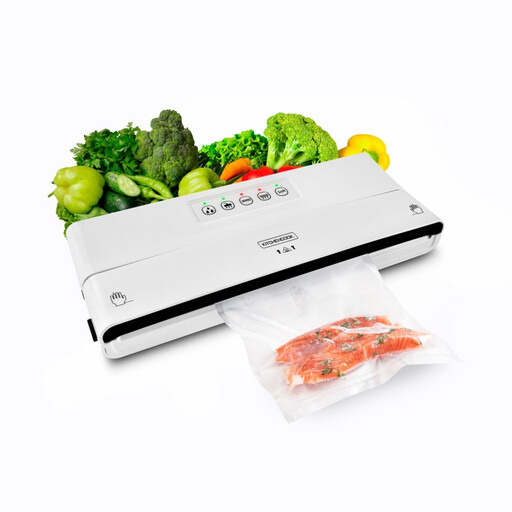 Image unavailable
Worth considering if you want to package portions in bags and adjust their length with a roll cutter.
For delicate foods or preparations containing a lot of liquid, check the model’s settings and instructions before buying.
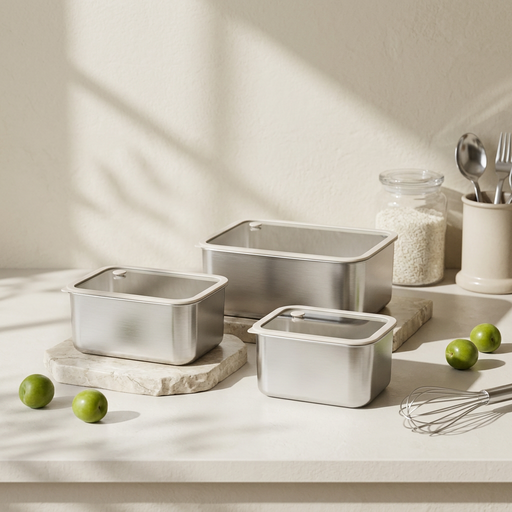 Image unavailable
Worth considering if you want to divide prepared meals between reusable containers in different sizes.
The set includes 1,000 ml, 1,800 ml and 3,000 ml containers, with glass lids and silicone seals.
If you want to remove the air, check that the containers and lids are compatible with a pump. Also check the instructions before reheating food in a container.
The Ministry of Agriculture recommends setting your fridge to +4 °C. ANSES advises keeping food between 0 and +4 °C in the coldest part of the fridge; also follow the guidance for the specific foods you’re storing.
It lets you control the suction on models that have this setting. FoodSaver lists pulse mode for delicate foods on its VS3190X and VS2290X models; check whether it’s available on the model you’re considering.
Don’t assume containers are interchangeable: check that the pump, valve and lid are compatible. ZWILLING lists compatibility with its Fresh & Save and UNLOCK products, while FoodSaver describes accessories designed for its zip bags and compatible containers.
Follow your appliance’s cleaning instructions, paying particular attention to areas where juices may collect. If you use it this way often, check which parts are removable: FoodSaver, for example, lists a removable drip tray on its VS3190X.