If you prepare several portions
You cook or buy several portions in advance and want to divide them between the fridge and freezer. A bag vacuum sealer is worth considering if you can find sizes that suit your portions and the machine.


If you regularly package solid portions, an external-suction vacuum sealer that uses compatible bags is worth considering. For moist or delicate foods, look instead at the sealing settings and suction control. If you want to avoid squashing certain leftovers, containers with valves may be suitable, provided the pump and lids are compatible. In all cases, vacuum sealing does not replace refrigeration for foods that need to be kept cold.
You cook or buy several portions in advance and want to divide them between the fridge and freezer. A bag vacuum sealer is worth considering if you can find sizes that suit your portions and the machine.
Your portions may sometimes have a little residual moisture, or certain foods may be easily crushed. Sealing settings, suction control and access to the drip tray for cleaning are all separate factors to consider.
You’d like to keep some leftovers in containers rather than bags. Check that the pump, valve, lid and container are all compatible: this depends on the system you choose.
Start with the foods you package most often, then check which consumables and accessories you’ll need. A moist-food setting, a pulse function and a container system meet different needs, and can also work well together.
| What matters to you | What to check | What consumers say |
|---|---|---|
| Regular portions of solid food | Check which types and widths of bags or rolls the machine accepts, and whether they’re available in sizes to suit your portions. | When I prepare several solid portions, I want bags that fit their size without making every packaging job more complicated; around 33% of consumers prioritise this regular use. |
| Delicate foods | Look for suction you can stop, or check whether a pump is compatible with containers that have valves. | For soft foods or biscuits, I want to limit compression during suction. This is the top priority for around 20% of consumers. |
| Moisture and cleaning | Check for a moist-food setting and access to any drip tray; consult the instructions for guidance on handling liquids. | If my food has a little moisture, I want to be able to package it without making cleaning a chore; nearly 27% of consumers prioritise this need. |
| Reusable containers | Confirm that the pump, valve, lid and container are compatible, and check how much space you’ll need to store the boxes or jars. | For some leftovers, I’d rather reuse a box or jar than prepare a bag. Around 20% of consumers put this type of container first. |
Vacuum packaging does not mean you can ignore the use-by date. For meat, fish and prepared meals, Anses highlights the importance of storing food in the coldest part of the fridge, at 4 °C, and maintaining the cold chain.
Choose packaging that suits the food, then make sure it’s kept cold when necessary. Date your portions so you can identify them.
With an external-suction machine, liquid can be drawn into the sealer and interfere with the seal. Le Parfait also advises cooling hot dishes before vacuum sealing them in a bag.
Follow your machine’s instructions for liquid preparations; Le Parfait, for example, recommends briefly freezing them first. Cool dishes hygienically and keep the edge of the bag clean before sealing.
If the seal fails, you’ll need to start again with a usable bag.
Bags for an external-suction machine and valve bags for a pump don’t necessarily serve the same purpose. Lids and containers may also be specific to a particular brand’s system.
Before buying, check which types and widths of bags or rolls the machine accepts, then confirm that the accessories you plan to use are explicitly listed as compatible.
Suction that’s difficult to control can deform some delicate products. For example, FoodSaver describes the Pulse function on its VS3190X as a way to control suction when packaging this type of food.
If you often package delicate foods, check for manual control or consider a compatible container with a valve.
The range includes machines for bags and rolls, as well as accessories. It may appeal if you want to start by packaging food in bags and then explore compatible containers.
This system combines a pump with bags, boxes and lids. It’s designed in particular for people who want to store some of their portions in containers.
The brand offers both a bag vacuum sealer and solutions that use valves. This distinction matters if you want to switch between bags and compatible jars.
This option is for packaging portions in bags and includes a roll cutter. If you often package moist or delicate foods, check the machine’s settings too before choosing.
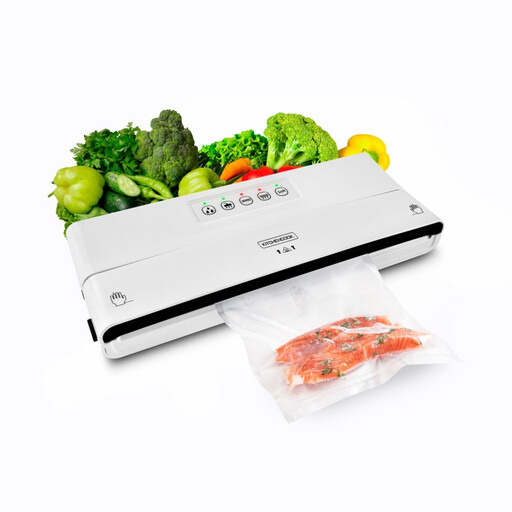 Image unavailable
Worth considering if you prepare portions in bags and would find a roll cutter useful. Check which bag and roll sizes are compatible; for delicate foods, check whether you can control the suction.
No. Anses says you must follow the use-by date. For meat, fish and prepared meals, vacuum sealing is no substitute for refrigeration or good food hygiene.
Cool the dish before packaging it in a bag: Le Parfait says a hot dish can cause the bag to swell and burst. Then make sure you follow the food hygiene and cold-chain requirements for that food.
Don’t vacuum liquid soup directly in this type of machine. For bag packaging with its system, Le Parfait recommends briefly freezing liquids until solid before vacuum sealing; follow your machine’s instructions. For a container, confirm that the pump and lid are compatible.
Not automatically. Some embossed bags are designed for external-suction machines, while valve bags, pumps and lids may be specific to a particular system. Check the bag type and width, as well as the stated compatibility of each accessory.
It can make cleaning easier if you package foods with residual moisture; FoodSaver lists one on the VS1290X. You’ll still need to keep the edge of the bag clean to get a good seal.