Who is this type of vacuum for?
The amount of carpet you have, how long you spend cleaning and how you prefer to maintain your vacuum will all help determine the right type.
Homes with a large floor area and different floor types
If you move between hard floors, rugs, fitted carpets and grooved wooden floors during the same cleaning session, check the suction performance on each surface. The reach and the brushes supplied with your chosen model are also important.
People who would rather handle less dust
A bagged cylinder vacuum is worth considering if you dislike emptying a dust container. UFC-Que Choisir says bagged models expose users to less dust; in return, check that compatible bags are readily available and find out how to maintain the filters.
Homes looking to keep floors clean between thorough cleans
A cordless stick vacuum can be handy for quick clean-ups, while a robot can take care of accessible areas. According to UFC-Que Choisir’s guides, you shouldn’t assume either will perform as well as a main vacuum on thick rugs, fitted carpets or difficult surfaces.
Which features should you check first?
First decide whether the vacuum needs to handle every cleaning session or just everyday upkeep. Then compare its performance on your floors, followed by how easy it is to move, store and maintain.
Cylinder vacuum for a thorough clean
Worth considering: for regular cleaning sessions in a large home with rugs and several floor types, in line with UFC-Que Choisir’s guide.
Bear in mind: you’ll need to move and store the appliance and its cord; if it’s bagged, you’ll also need to keep compatible bags in stock.
Stick vacuum for quick clean-ups
Worth considering: as a second vacuum if manoeuvrability and cordless convenience matter for smaller jobs.
Bear in mind: check the battery life at the setting you’ll use and how well it performs on rugs and fitted carpets; UFC-Que Choisir describes it mainly as a supplementary appliance.
Robot vacuum for accessible areas
Worth considering: to automate some everyday cleaning between sessions with your main vacuum.
Bear in mind: you’ll need to empty the dust container regularly, and performance varies by floor type, as UFC-Que Choisir points out.
| Priority |
What to check |
How it applies to my needs |
| Suction performance by floor type |
Compare test results for fitted carpets or rugs, hard floors and grooved wooden floors. Check the floorhead and included brushes rather than relying on motor wattage alone. UFC-Que Choisir’s testing, for example, distinguishes between dust embedded in a rug and dust caught in the gaps between floorboards. |
I need to clean both rugs and grooves in wooden flooring, so a result for just one floor type won’t tell me everything I need to know. |
| Full cleaning sessions |
Check the reach of a cylinder vacuum, the capacity of its bag or dust container, and how easy it is to move between rooms. For a stick vacuum, check the battery life at the setting needed for your floors. |
My home takes a while to clean, so I want to finish without having to keep changing sockets or stopping to recharge. |
| Bag and maintenance |
Compare handling a bag with emptying a dust container. Check the product codes for compatible consumables, as well as how easy it is to access the filters and brushes for maintenance. |
If I dislike emptying a dusty container, I’ll favour a bagged model, while making sure to budget for replacement bags. UFC-Que Choisir says this type exposes users to less dust. |
| Moving and storage |
Check the weight if you’ll need to carry the vacuum, then consider the wheels, tube and cord for moving it across the floor. Also measure the space you have available for storage. |
I need to move between rooms and sometimes tackle steps, so the vacuum needs to be easy to manoeuvre without being difficult to store. |
| Noise and repairability |
Where possible, compare noise levels in dB(A) under equivalent conditions. In France, the repairability index out of 10 for applicable vacuum cleaners provides information on factors including how easy the appliance is to dismantle and the availability of parts, according to the ministry responsible for ecological transition. |
For longer cleaning sessions, I want to take noise into account and check the maintenance requirements and parts before choosing, without assuming that a quieter vacuum will have better suction. |
Which models from well-known brands should you consider?
These models show the kinds of features to check on a specific product; a range name doesn’t guarantee that every variant has the same accessories or specifications.
Rowenta
The G-Force Silence RO6189EA bagged cylinder vacuum is a useful example for checking reach, bag capacity, accessories and overall size for a large home.
- Rowenta lists a 12 m operating radius, a 4.5 L bag, a parquet floorhead and a mini-turbo brush for this model.
- The 64 dB(A) noise level and 9.3/10 repairability index are specifications for this particular model, not evidence of its suction performance on your rugs.
Miele
The Complete C3 Special Flex shows why checking exactly what’s included in a pack matters when you have both rugs and wooden floors.
- Miele lists a Twister parquet floorhead, a mini-turbo brush, a universal floorhead and an AirClean HEPA filter for this variant.
- These accessories shouldn’t be assumed to come with every Complete C3; check the variant and what’s included before choosing.
Philips
The Performer Silent FC8780/09 bagged cylinder vacuum is worth considering if noise and floorhead design are important to you.
- Philips lists a noise level of 66 dB for the FC8780/09 and describes a floorhead designed to pick up dirt and fine dust.
- The manufacturer’s description doesn’t prove how well it performs on your rugs, fitted carpets or floorboard gaps; check test results and the accessories supplied with the specific model.
A Joybuy option for your main vacuum cleaner
This selection features a bagged cylinder vacuum to consider for full cleaning sessions in a large home. Its inclusion alone doesn’t tell you how well it performs on rugs and fitted carpets.
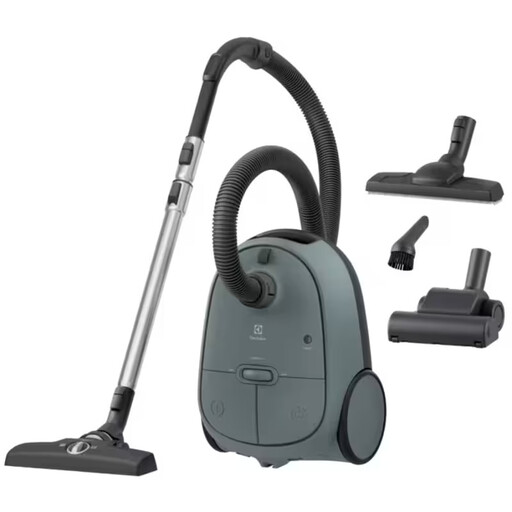 Image unavailable
Electrolux 600 EB61C4OG bagged cylinder vacuum cleaner
Its bagged cylinder design makes it a potential choice as your main vacuum for longer cleaning sessions. Before choosing it for rugs or fitted carpets, compare suction test results for the EB61C4OG. Also check the supplied brushes, reach, weight if you’ll need to carry it, and compatible bags.
View on Joybuy
Frequently asked questions
How can I assess suction on rugs, fitted carpets and grooved wooden floors?
Look for separate test results for these floor types rather than relying on a single motor power figure. UFC-Que Choisir’s testing assesses, among other things, dust embedded in a rug and dust caught in the gaps between floorboards. Then check that the brushes tested match the configuration being sold.
Can a cordless stick vacuum replace a cylinder vacuum in a large home?
Don’t assume it can if you’re planning long cleaning sessions on rugs and fitted carpets. UFC-Que Choisir describes stick vacuums mainly as supplementary appliances and reports an average battery life of around ten minutes at full power. If you plan to use one on its own, check the battery life at the setting you need and look for test results on your floors.
Should I choose a bagged or bagless cylinder vacuum?
A bagged model is worth considering if you want to handle less dust when emptying it: UFC-Que Choisir says bagged cylinder vacuums expose users to less dust and, in its guide, perform better than bagless models. A bagless model saves you from buying bags, but you’ll need to empty the dust container. Either way, compare the model’s performance on your floors and remember to maintain the filters and brushes.
Is a robot vacuum enough for rugs and different floor types?
Not necessarily. UFC-Que Choisir notes that robot vacuum performance varies by floor type and that the dust container needs emptying regularly. For a thorough clean, check test results for the specific robot on your rugs, in corners and along edges before deciding to go without another vacuum.
What should I check for maintenance after buying?
Check which bags or filters are compatible, how easy it is to access the brush and what maintenance the model requires. In France, the repairability index for applicable vacuum cleaners, as described by the ministry responsible for ecological transition, also gives an indication of factors such as ease of dismantling and parts availability. Check the score for the model you choose.


