What should you check before buying?
First, decide what you’ll be vacuuming and rule out any material that could pose a particular risk. Then compare debris clearance, wet-use features and overall size according to what matters most to you.
| Criteria |
What to check |
Who it matters to |
| Materials and safety |
Which dry materials and liquids the manual allows you to vacuum, and which filter is intended for your planned use. A “wet and dry” label does not mean the vacuum is approved for hazardous dust. |
After DIY work, I want to distinguish ordinary debris from dust that requires special precautions before cleaning; around 33% of consumers would put this check first. |
| Outdoor debris and reach |
The diameter of the tube and hose for leaves or small pieces of rubble, followed by the length of the cable and hose to reach the area you need to clean. |
When cleaning a patio or garage without constantly moving the machine, I need to reach into corners and clear the debris; this would be a priority for around 27% of consumers. |
| Water, tank and drainage |
Whether the vacuum is approved for the liquids you need to pick up, filter instructions, tank capacity and whether it has a drainage system. |
If I also need to collect water, I want to be able to empty the tank without making cleaning more complicated; around 20% of consumers would prioritise this use. |
| Storage and handling |
The dimensions, weight, handle, wheels and storage points provided for the hose, cable and accessories. |
When I put the vacuum away after every use, I’d rather be able to move it easily and find a place for it, even if that means choosing a smaller tank; this would be the priority for around 20% of consumers. |
Brands to consider
These ranges give you some useful points of comparison for DIY and outdoor cleaning. Check the specifications of the exact model rather than assuming they apply across an entire brand.
Bosch DIY
Wet and dry vacuums geared towards household DIY and utility cleaning.
- Bosch DIY lists a power tool adapter for the AdvancedVac 20 and PAS20-220P; according to its specifications, the PAS20-220P also has an Auto-Start socket.
- Check that the adapter fits your tool and that the tank and accessories are suitable for the materials you need to pick up.
Nilfisk
The Multi range includes vacuum cleaners for wet and dry cleaning in utility and outdoor areas.
- Nilfisk lists a 22 l tank, a blower function and a filter-cleaning indicator for the Multi II 22 Inox.
- These features don’t mean the model is suitable for all liquids or hazardous dust; check the manual for its intended use.
Einhell
Wet and dry models designed for uses including workshops, garages and household DIY.
- Einhell lists a 30 l tank, a 3 m hose, a blower function, a drain and a power take-off socket for the TE-VC 2230 SA.
- If these features appeal to you, remember to allow enough space to store the tank and accessories too.
A Joybuy model for utility cleaning
This wet and dry model with a blower function could be worth considering for utility cleaning in the garage and for ordinary debris. For leaves or small pieces of rubble, check the diameter of the clearance; for water, consult the model’s instructions for wet use.
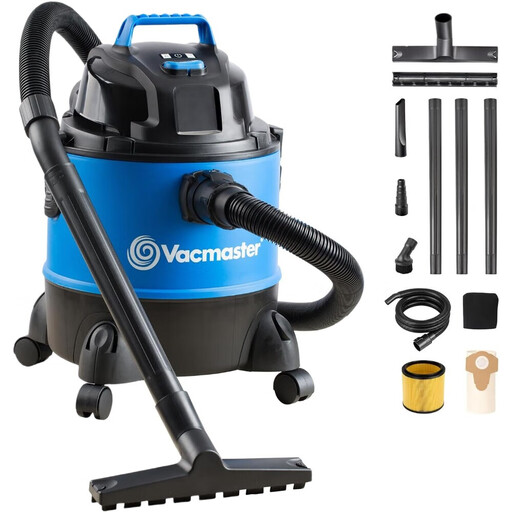 Image unavailable
Vacmaster VQ1220PF 3-in-1, 20 L, with blower function
Worth considering for switching between dry cleaning and ordinary wet use in a utility space, subject to the materials permitted by the manual.
The product name lists a 1,250 W motor, a stated suction power of 200 AW and a 20 L tank. Before using it for leaves or small pieces of rubble, check the diameter of the tube and hose; for liquids, check the filter instructions and which materials are permitted.
View on Joybuy
Frequently asked questions
Can a wet and dry vacuum always pick up water?
No. Choose a model that explicitly states it’s suitable for wet vacuuming, and follow the instructions in its manual, particularly those covering the filter and permitted liquids. The specifications for the Bosch AdvancedVac 20 and PAS20-220P, as well as the Nilfisk Multi II 22 Inox, mention wet and dry use, but that doesn’t mean they’re suitable for all liquids.
What should I check before vacuuming leaves or small pieces of rubble?
First, check the diameter of the tube and hose supplied. Que Choisir says a wider clearance makes it easier to pick up leaves and rubble; also check that the attachments are suitable for the surface you’re cleaning.
Can a vacuum’s blower function replace a garden blower?
Don’t assume they’ll perform equally well. The blower function listed on some Bosch, Nilfisk and Einhell models can help gather debris or clear a corner; check the model’s connection and accessories to see whether this feature suits your needs.
Can I use a domestic wet and dry vacuum to clean up potentially hazardous dust?
Don’t assume that you can. The INRS identifies Class H vacuum cleaners for dust that is hazardous to health. If the material may contain asbestos, crystalline silica or another hazardous substance, identify it and make sure the appropriate cleaning procedure has been established before you start.
Do I need to register my vacuum to get an extended warranty?
It depends on the brand’s offer. Bosch DIY offers an extension subject to registration; Einhell gives you 30 days after purchase to register an eligible product. Check the terms for the model in question: a voluntary extended warranty does not replace your applicable statutory rights.


