For occasional, light cleaning, your usual vacuum cleaner may be suitable if its manual expressly allows the type of debris you need to pick up. Consider a wet and dry vacuum for wood shavings, ordinary rubble or small amounts of water, provided the model you choose is designed to handle them. If you’re dealing with fine or unidentified dust, first find out what the material is and consider hiring suitable equipment rather than defaulting to a household vacuum.
Who is this guide for?
DIYer dealing with ordinary dry or wet debris
You need to pick up wood shavings, dust or small amounts of water after a DIY job at home. Check that the materials are suitable for the vacuum you’re considering, then compare its tank, filter and accessories. Bosch DIY and Kärcher describe these uses for some of their wet and dry models.
Anyone dealing with fine or unidentified dust
If you’re not sure exactly what material has come from sanding, drilling or cutting, don’t assume a household vacuum is suitable. Identify the material before choosing your equipment. Kiloutou, for example, lists specialist equipment for hire for certain types of fine dust.
Anyone looking for an appliance that will last
You want to be able to find the filters, bags, documentation and parts needed to maintain or repair your vacuum. In France, the repairability index described by the Ministry of the Economy is one factor to consider before buying, but you should still check which consumables are available for the model.
How do the options compare?
Cylinder vacuum cleaner
Consider it: for occasional, light dry pick-ups, but only if the manual allows the type of debris in question.
Limitation: having one at home doesn’t mean it can handle DIY debris or liquids, or connect to a power tool.
Upright vacuum cleaner
Consider it: for a small amount of approved debris on a dry floor after tidying up or rearranging a room.
Limitation: check that the bin capacity and battery life are sufficient for a quick clean-up.
Wet and dry vacuum cleaner
Consider it: for wood shavings, ordinary rubble or small amounts of water that the model is designed to handle, particularly if you do DIY regularly. Bosch DIY and Kärcher describe these uses for specific models.
Limitation: the words ‘wet and dry’ don’t mean it can pick up every type of DIY dust. Also consider how much space it will take up when stored between uses.
Hiring suitable equipment
Consider it: for a one-off job that requires equipment with the right capacity or filtration for fine dust, once you’ve identified the material. Kiloutou lists different classes of equipment for hire depending on the debris.
Limitation: confirm with the hire company that the equipment is suitable, and check which consumables you’ll need and how to transport it. Hiring equipment doesn’t remove the need to take the necessary precautions when dealing with hazardous materials.
| Criteria |
What to check |
Consumers with this concern |
| Approved debris |
Identify the material you’re dealing with, then check the uses permitted and any restrictions in the manual for the exact model. |
After drilling or sanding, I want to know if I can put the debris into the vacuum without going against the instructions. Around 25% of consumers say this compatibility is their top concern. |
| Capacity and uses |
Compare the tank capacity, approved wet or dry use and, if you’re connecting a tool, the socket or adaptor provided. |
If I do DIY regularly, I want to pick up approved everyday debris without constantly stopping to empty the vacuum. Capacity and versatility are the top priorities for around 34% of consumers. |
| Filtration or hiring |
For fine or unidentified dust, identify the material and ask the manufacturer or hire company which equipment and consumables are suitable. |
When faced with fine or unidentified dust, I’d rather find out what equipment I need before using a household vacuum. This is a top priority for around 33% of consumers. |
| Maintenance and repair |
Check the repairability index for the model sold in France, along with the reference numbers for the filters, bags and parts you’ll need. |
I plan to keep my vacuum and maintain it after several clean-ups. Repairability and access to consumables come first for around 8% of consumers. |
Mistakes to avoid
-
Assuming ‘wet and dry’ means ‘suitable for all DIY dust’
The uses listed by Bosch DIY and Kärcher apply to their specific models. Fine, hazardous or unidentified dust may require different equipment and additional precautions.
Identify the material and check the manual, filter and recommended consumables. If you’re not sure what the material is, ask for advice on a suitable solution before cleaning it up.
-
Choosing based on power alone
A wattage rating won’t tell you whether the vacuum can handle water, has a large enough tank or can connect to your tool.
Compare the approved uses, tank, filter and accessories for the model. If you want to vacuum near a power tool, check separately that it can be connected.
-
Forgetting about filters, bags and parts
Cleaning up after DIY jobs can put these consumables to the test. In France, the repairability index described by the Ministry of the Economy helps you assess whether a vacuum can be repaired, but it doesn’t guarantee that the filter you need for your debris will be available.
Note down the reference numbers for compatible consumables, and check the index and information about spare parts for the model you’re considering.
-
Buying specialist equipment for a one-off job
If you only need it once, hiring could save you from having to store and maintain an appliance you rarely use. You’ll still need to identify the debris and choose the right equipment.
Compare the cost of buying and hiring for the duration of your job, then confirm with the hire company which equipment, consumables and transport you’ll need.
If you buy, remember to allow enough space to store the appliance between uses.
Brands to know for this type of use
Bosch DIY
Bosch DIY describes the AdvancedVac 20 as a wet and dry vacuum for use in the workshop, including with dust, wood shavings and wet materials.
- For this model, the brand lists a drain valve, blower function and conical adaptor for tools.
- These features don’t mean the vacuum can be used to pick up materials excluded from or not mentioned in the manual.
Kärcher
Kärcher describes the WD 3 P V-19/4/20 as suitable for dust, ordinary rubble, small amounts of water and workshop jobs.
- For this model, the brand lists a 19 L tank, a wet and dry cartridge filter, a filter bag and a power tool socket.
- For the relevant category, Kärcher states that essential parts are available for six years after production ends. Check which parts are available and the terms that apply to the model you choose.
Nilfisk
Nilfisk offers wet and dry vacuum cleaners for the garage, workshop, outdoors and home, with capacity varying by model.
- The brand describes some models as suitable for spilled liquids and dry debris.
- Check the capacity, filtration and approved materials for the exact model, as the features of one model don’t apply to the whole range.
A wet and dry option on Joybuy
This model is a wet and dry vacuum option for use at home, in the garage or in the workshop. Before choosing it for your DIY jobs, check the debris you plan to pick up and the conditions for wet vacuuming against the instructions in the manual.
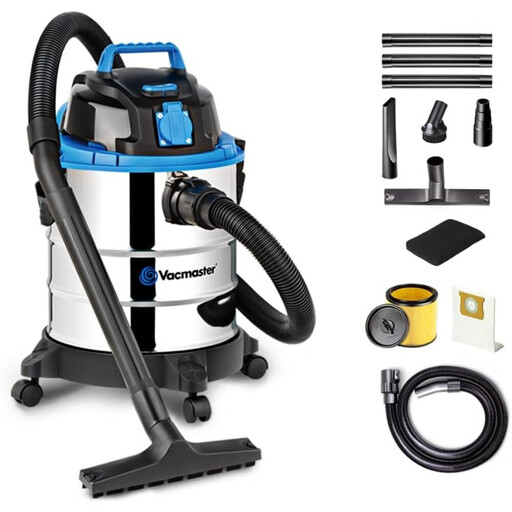 Image unavailable
Vacmaster VQ1220SC, 20 L wet and dry vacuum cleaner
Consider it for wet or dry household cleaning only if the manual allows the materials in question and sets out the conditions for use.
The product name specifies a 20 L stainless steel tank, a 1250 W motor, stated suction of 20 kPa, a 2430 W tool socket and a blower function.
The manufacturer excludes harmful dust, chemicals and flammable or explosive liquids, among other materials. Before cleaning up after DIY, check which debris the vacuum can handle, which filters are required and what instructions apply to liquids. If you plan to keep the appliance, also check its repairability index and compatible consumables.
View on Joybuy
Frequently asked questions
Can I use my usual vacuum to pick up dust and rubble after small DIY jobs?
Yes, but only if the manual for your model expressly allows the type of debris in question. The uses listed by Bosch DIY or Kärcher for some wet and dry vacuums don’t automatically apply to a different household vacuum or to materials not mentioned in its manual.
When should I consider hiring rather than buying?
Consider hiring for a one-off job that needs a level of capacity or filtration your own appliance can’t provide. Kiloutou offers equipment for different types of dust. Identify the material and ask the hire company to confirm which equipment and consumables are suitable.
Does a wet and dry vacuum use the same filter for both types of cleaning?
Some models do, but this isn’t the case for every vacuum. Kärcher states that the WD 3 P V-19/4/20 uses a cartridge filter for wet and dry dirt. Follow the manual for your chosen model for fitting the filter and checking which liquids are allowed.
Should I check the repairability index before buying a vacuum cleaner in France?
Yes, it’s useful if you want to keep and repair the appliance. The Ministry of the Economy states that the repairability index is compulsory for vacuum cleaners in France. It takes factors including documentation, disassembly and spare parts into account. Also check separately that the filters and bags are suitable for your needs.
Can I use a household vacuum if a material may contain asbestos?
No. Don’t assume a household vacuum is suitable for this clean-up. INRS highlights that asbestos requires strict prevention and protection measures. Have the material identified and contact qualified professionals rather than attempting to clean it up yourself.


