For cleaning up after small jobs around the home, choose a vacuum cleaner based on the non-hazardous waste you need to remove. If the floor is wet, pick a model explicitly designed to handle water; if collecting dry dust is your priority, choose one that can take a compatible dust bag. Also check the filter, whether small pieces of rubble can pass through the hose and how much storage space you have. If you only need it once, compare hiring with buying.
Who is this guide for?
DIYers dealing with dust and small pieces of rubble
After drilling, sawing or light sanding, you may need to clear non-hazardous debris from a floor, garage or workshop. The filter and hose diameter are just as important as the tank capacity. If you’re using a power tool, check that it can be connected to the vacuum cleaner too.
Anyone who also needs to clear up water
If your clean-up involves residual water as well as dry dirt, look for a model whose instructions explicitly say it can vacuum liquids. You should also consider how easy the tank is to empty.
Occasional users with limited storage space
If you’re tackling just one job around the home, hiring a drum-style vacuum cleaner may be more practical than buying one. Compare the equipment you need, how long you’ll use it and how you’ll transport it. Then think about where you would store it after the work is done.
What should you look for?
First, identify the type of debris you need to clear. Then decide whether you want to buy a machine to keep or hire one for a one-off job. If you need to deal with several types of dirt, check the instructions for each intended use of the model you’re considering.
| Criteria |
What to check |
Who it matters to |
| Dry dust |
Filter type and maintenance; the reference for a compatible dust bag if you want to use one. |
After light sanding, I want to collect the dust without having to stop frequently to clean the filter. Around 36% of consumers make this a priority. |
| Rubble and water |
Whether wet and dry use is permitted, whether debris can pass through the hose and how to empty the tank. |
If I need to clear small pieces of rubble and then residual water, I’m looking for a machine designed for both tasks. This is the top priority for around 29% of consumers. |
| Transport and storage |
Weight, dimensions, cable length and whether the hose and accessories can be stored away. |
When I need to move the machine between the house and garage, I don’t want it to be difficult to carry or store. Ease of handling is a priority for around 21% of consumers. |
| Occasional use |
Hire period, transport and the features of the equipment on offer, compared with storing a machine you’ve bought. |
For a one-off clean-up, I’d rather consider hiring than keep a bulky machine. Around 14% of consumers prioritise this occasional need. |
Mistakes to avoid
-
Treating all DIY dust as ordinary debris
The materials involved can change what equipment you need. The INRS states that work producing dust that may contain toxic or carcinogenic substances requires Class H machines. A standard domestic drum-style vacuum cleaner is not suitable for this type of work.
Identify the materials before cleaning. If you’re unsure whether dust is hazardous, don’t vacuum it with a standard domestic model. Find out which safety guidance and professional equipment are appropriate.
-
Choosing based on the power rating alone
A wattage figure won’t tell you whether a machine can vacuum water, pass small pieces of rubble through the hose or connect to your tool.
Check the permitted uses in the instructions, along with the filter, hose and accessories needed for the debris you’re dealing with.
-
Forgetting about replacement dust bags and filters
A compatible dust bag can make it easier to collect dry dust, but you need to be able to find the right reference when you need a replacement.
Before buying, check that consumables are compatible with the exact version of the vacuum cleaner and that they’re available.
-
Choosing a large tank without planning where to store it
A large-capacity tank can mean fewer trips to empty it, but you still need to be able to move and store the machine and its hose. Que Choisir points out that some drum-style vacuum cleaners can weigh close to 10 kg.
Measure the space you have and check the weight and how the hose can be stored. If it’s for a one-off job, compare hiring too.
Brands to know
These ranges offer useful points of comparison for small DIY jobs. Choose each model based on the type of debris you need to deal with.
Kärcher
The WD/KWD range includes wet and dry vacuum cleaners for the home and workshop. Kärcher France lists the WD 6 P S V-30/8/35/T with a 30 L tank, a 3,5 m hose and a power-tool socket.
- Kärcher says this model can vacuum dust, rubble and liquids, and features a filter-cleaning system.
- Its 30 L tank and mains-powered operation are worth bearing in mind if portability and storage are priorities.
Nilfisk
According to Nilfisk France, the Multi II 30 T has a 30 L tank, a 4 m hose, a dust bag included and a semi-automatic filter-cleaning system.
- Nilfisk recommends its Multi II 22/30 L bags for dusty dirt, including dirt containing cement.
- Replacement bags are separate consumables, so check the reference for your machine.
Bosch DIY
Bosch DIY describes the AdvancedVac 20 as suitable for wet and dry materials and for connecting to DIY power tools. Its tank is listed as 20 L.
- The manufacturer lists a drain valve, blower function and tool adapter.
- If you’re dealing with a large amount of debris, consider how often you’ll need to empty a 20 L tank.
Wet and dry vacuum cleaners on Joybuy
These two Vacmaster models are designed for wet and dry cleaning around the home or in the garage. The VQ1220PF is worth considering if you’re comparing models with a blower function; the VQ1220SC also has a power-tool socket. Before using either for fine dust or small pieces of rubble from DIY work, check with the manufacturer which uses are permitted, and confirm the filter and accessories supplied.
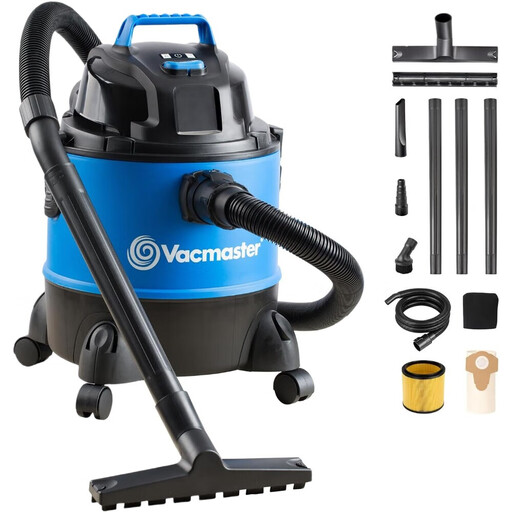 Image unavailable
Vacmaster VQ1220PF 3-in-1 wet and dry vacuum cleaner, 20 L
Worth considering for wet or dry cleaning around the home or in the garage. This model is listed with a 20 L tank, a 1 250 W motor and a blower function.
If collecting dry dust with a bag is your priority, check which bag is compatible and which accessories are included. Also check the instructions to confirm which types of dust and small debris can be vacuumed.
View on Joybuy
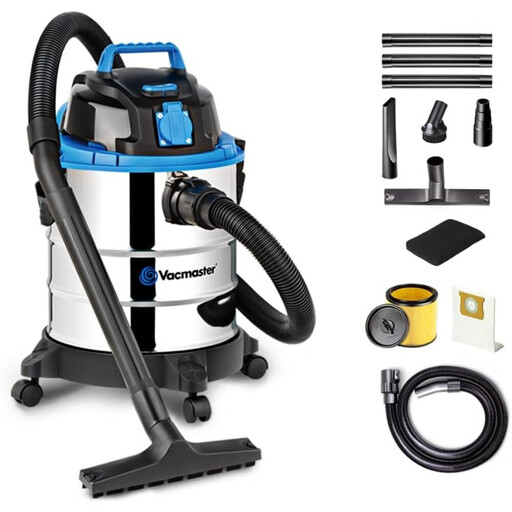 Image unavailable
Vacmaster VQ1220SC wet and dry vacuum cleaner, 20 L
Worth considering if you want to connect a power tool while carrying out DIY work. This model is listed with a 20 L tank, a 1 250 W motor, a power-tool socket rated at 2 430 W and a blower function.
Check that your tool and its connector are compatible, then check the guidance on fine dust and small pieces of rubble. If you need to move or store the machine, also check its weight, dimensions and hose width.
View on Joybuy
Frequently asked questions
Can I vacuum up water after DIY work with any vacuum cleaner?
No. Choose a model whose instructions explicitly say it can vacuum liquids. Kärcher France and Bosch DIY list this use for the WD 6 P S V-30/8/35/T and AdvancedVac 20 respectively. Always follow the guidance for the exact version you’re using.
Is a dust bag useful for plaster or cement dust?
A compatible dust bag can make it easier to collect dry dust that your machine is approved to handle. Nilfisk France recommends its Multi II 22/30 L bags for dusty dirt, including dirt containing cement. However, a dust bag doesn’t make a domestic vacuum cleaner suitable for hazardous dust.
Is a domestic drum-style vacuum cleaner suitable for silica or asbestos dust?
No. Don’t use a standard domestic drum-style vacuum cleaner for hazardous materials. The INRS states that work producing dust that may contain toxic or carcinogenic substances requires Class H machines. Have the risk assessed and follow the appropriate safety guidance before starting any work.
Is it worth hiring a vacuum cleaner for a one-off post-DIY clean-up?
Hiring is worth comparing with buying if you’re short on space or only need the machine for one job. First, choose equipment suited to the debris, then compare how long you’ll need it, transport and the hire terms. A single break-even point wouldn’t apply to every project.


