
Livraison le jour même ou le lendemain

Qualité garantie

Débloquez vos offres de bienvenue: Livraison GRATUITE | Jusqu'à -80 % | 30 jours d'essai gratuits à JoyPlus
Téléchargez l'application
Protecting yourself from the sun is no longer just a holiday habit; it's an everyday concern. In this context, the UV umbrella has established itself as an essential ally for both city commutes and travel. The problem? With an explosion of options on the market, it's hard to distinguish between marketing promises and real-world performance. One model might promise maximum protection but break at the first gust of wind, while another, sold as "compact," turns out to be more cumbersome than useful.
To ensure you don't regret your purchase, let's break down the three most common pitfalls that can turn a good idea into a useless accessory:
To avoid these disappointments, it's best to rely on objective technical criteria. These are the true arbiters for assessing the quality and utility of a UV umbrella.
The UPF (Ultraviolet Protection Factor) rating is the benchmark standard: it quantifies a fabric's ability to filter ultraviolet rays. For maximum protection, aim for a UPF 50+ certification. In practical terms, this means the fabric blocks at least 98% of UV rays. Some manufacturers go even further with technical coatings, like the L.R.C (Light-blocking & Radiative Cooling) Black Coating, which not only stops UV rays but also helps lower the perceived temperature under the canopy.
A travel umbrella or a pocket parasol must be practical for daily use. Two points should be scrutinised closely:
A compact UV umbrella shouldn't mean fragile. Its ability to withstand bad weather dramatically increases its versatility. To assess it, take a close look at:
To illustrate these criteria in practice, here is our selection of models suited for different profiles.
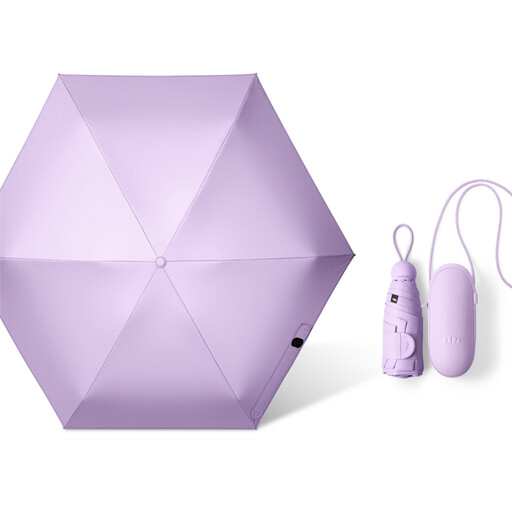
The Verdict: Perfect for daily commutes. At just 19 cm when folded and with its capsule-style hard case, it slips into a bag or glove box without risk. Its light weight makes it the ideal discreet companion for sun protection between meetings or during a lunch break.
It avoids the "deceptive portability" pitfall. Its 5-fold design and patented capsule case guarantee true compactness, a far cry from mere marketing claims.
UPF 50+ protection with L.R.C coating, 6-rib reinforced frame for sun/rain versatility.
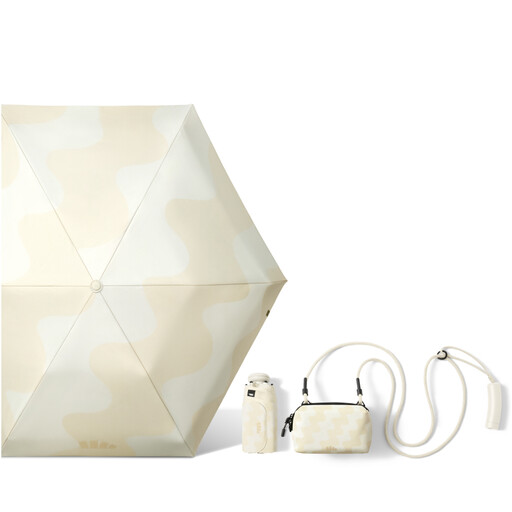
The Verdict: Designed for those who travel light but accept no compromises on protection. Its feather-light weight of 255 g and its expandable storage pouch with a shoulder strap make it an ultra-practical travel accessory. It can be carried by hand or over the shoulder, leaving your hands free.
It avoids the "illusory protection" pitfall. The manufacturer claims a record-breaking sun protection of UPF 2000+, capable of blocking over 99% of UV rays across the entire spectrum.
Ultra-lightweight design, 6-fold mechanism for maximum compactness, and an innovative storage pouch with a strap.
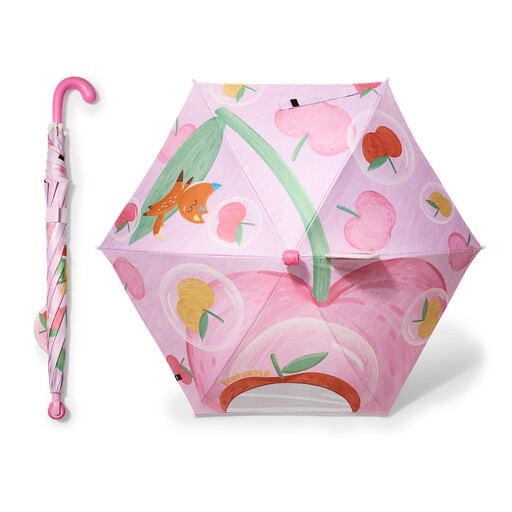
The Verdict: Because protecting children's skin is non-negotiable. This model combines UPF 50+ protection with safety features specifically designed for young ones: anti-injury rounded tips and top, and a structure that reduces the risk of pinching fingers.
It avoids the dual pitfalls of fragility and lack of safety. Its fibreglass frame is robust, while thoughtful details like the visibility window and rounded corners make it perfectly suited for children.
Child-centric safety design, UPF 50+ protection, and a fun design to ensure they'll use it without a fuss.
Discover our full selection of products that meet our demanding selection criteria and current standards.
The fundamental difference lies in the canopy. A UV umbrella uses a very tightly woven fabric, often with a special coating (black or silver), to block a very high percentage of UVA and UVB rays. This effectiveness is validated by a UPF 50+ certification. In contrast, a classic parasol provides shade but offers no certified guarantee of protection against UV rays.
Absolutely. Good models are designed to be versatile. Their canopy has a water-repellent treatment that causes water droplets to bead up and ensures quick drying. As for their frame, often made of an aluminium and fibreglass alloy, it's designed to make it a wind-resistant umbrella, rendering it just as reliable during a downpour.
It's quite simple. After a downpour, always let it dry completely in the open position to prevent mould and rust. Once dry, store it in its sleeve to protect the canopy from friction. For cleaning, a damp sponge and a little soapy water are sufficient. Most importantly, avoid harsh detergents that could damage the UV-protective coating.