
Livraison le jour même ou le lendemain

Qualité garantie

Débloquez vos offres de bienvenue: Livraison GRATUITE | Jusqu'à -80 % | 30 jours d'essai gratuits à JoyPlus
Téléchargez l'application
A smartphone dying on the train, a tablet nearly flat before a lecture, or a laptop you can't use on the go – a USB-C power bank can save you from plenty of headaches. But you need to pick a model that's genuinely suited to your devices. The advertised capacity isn't everything: power, ports, cables and airline regulations all need to be taken into account.
A 10,000 mAh or 20,000 mAh power bank won't necessarily deliver all that energy to your phone. Some is lost during voltage conversion and recharging. The actual battery life you get also depends on your device's capacity, the temperature, and whether you're using it while charging.
For a smartphone and earphones, 10,000 mAh is generally enough for daily use. A 20,000 mAh power bank gives you more reserve to last several days, charge a tablet, or power multiple devices. With its 25,000 mAh, a power bank is better suited to long trips and certain laptops, though it often comes with a heavier weight.
Fast charging depends on the power delivered, but also on the protocol your device supports and the cable you use. A power bank with a high power rating won't automatically deliver that power to an iPhone, a Samsung, or a laptop.
Look for compatibility with USB Power Delivery, usually marked "PD", and check the power output of the USB-C port. For a phone, power between 20 and 35 W already covers most needs. For a USB-C laptop charger, compare the power your computer requires with what the power bank provides. A PD3.1 model rated at 100 W or more may suit some compatible laptops, provided you use a cable that can handle that power.
A single port can quickly become limiting if you're charging a smartphone, a watch and earphones at the same time. A multi-port power bank offers more flexibility, but bear in mind that the total power is sometimes shared between the different outputs.
A power bank with a built-in USB-C cable lets you travel with fewer accessories. However, check the cable's length, durability, and compatibility with your devices. For an iPhone with a USB-C connector, a suitable USB-C cable is essential. Depending on your device's generation or the accessory you're using, an adapter may still be necessary.
The capacity in mAh isn't always enough to compare two models. When the information is available, also look at the energy expressed in Wh. On a plane, lithium batteries must generally travel in your cabin bag, with rules that can vary from one airline to another. The 100 Wh threshold is a common reference, but always check your carrier's guidelines before you travel. A "flight-safe" commercial label doesn't replace this check.
PD fast charging is particularly useful with USB-C devices. Look at each of these separately:
A power bank for iPhone or a power bank for Samsung can work with many USB-C devices, but the actual charging speed depends on the phone and the protocol it supports. For a smartwatch, especially an Apple Watch, a built-in wireless charger can be more convenient than a simple USB-C port.
Choose a product that is properly documented, with instructions and the contact details of the manufacturer or the responsible party established in the European Union where this information is required. Usage warnings must also be clearly stated. Never use a battery that is swelling, giving off an unusual smell, or overheating excessively.
Do not pierce, crush or dismantle a lithium-ion battery. Keep it away from moisture, high heat and sources of flame. At the end of its life, dispose of it at a suitable collection point for electrical and electronic equipment, rather than in your household waste.
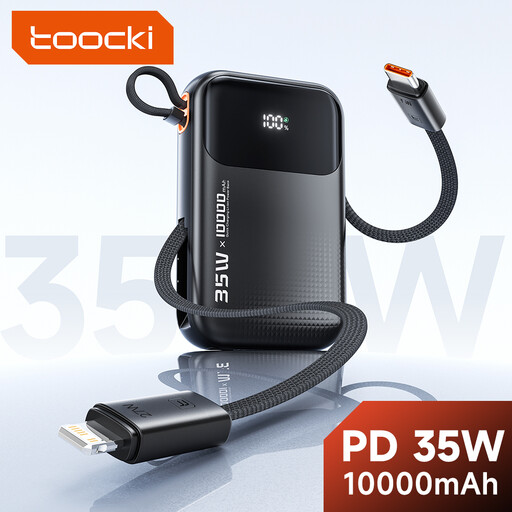
Why this choice suits this profile: With its 10,000 mAh and stated 35 W power, this model is ideal for users who mainly need to charge a phone, earphones or a lightweight tablet.
The capacity and USB-C output are clearly stated. This makes it easier to check they match your needs than relying on the "fast charging" label alone.
USB-C input and output, stated PD3.0 power of 35 W and a design made for travel.
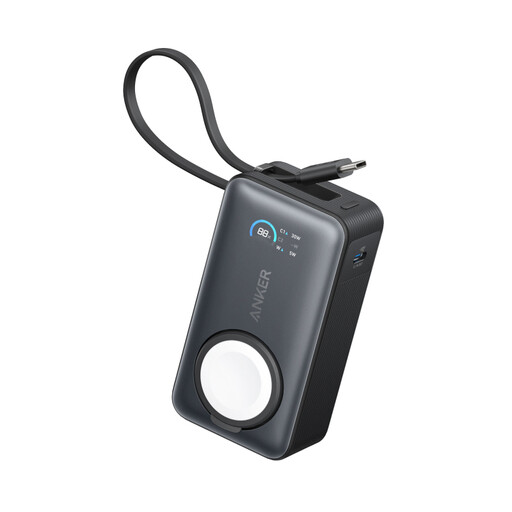
Why this choice suits this profile: This model combines a built-in USB-C cable and an adjustable wireless charger for Apple Watch, with a USB-C output that can reach 35 W.
The built-in cable and dedicated watch charging reduce the number of accessories you need to carry.
10,000 mAh capacity, wireless Apple Watch charging stated at up to 5 W and power bank recharging in 1 hour 30 minutes thanks to a 30 W input.
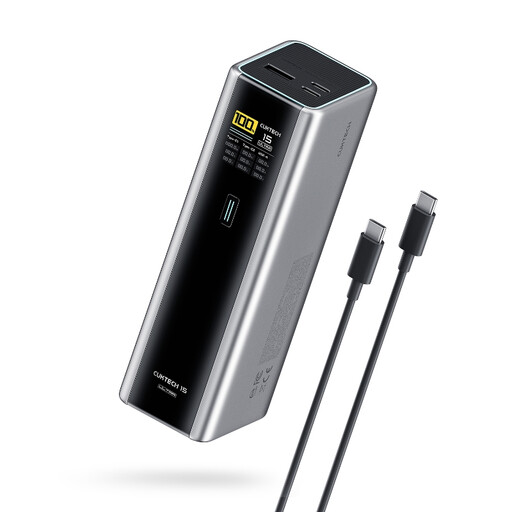
Why this choice suits this profile: Its three USB-C ports and total stated power of 140 W meet the needs of those who charge a laptop, tablet and phone simultaneously.
The power, PD3.1 protocol and port configuration are documented. You can therefore check its compatibility with a USB-C laptop.
20,000 mAh capacity, three USB-C ports and a maximum stated power of 140 W with PD3.1 support.
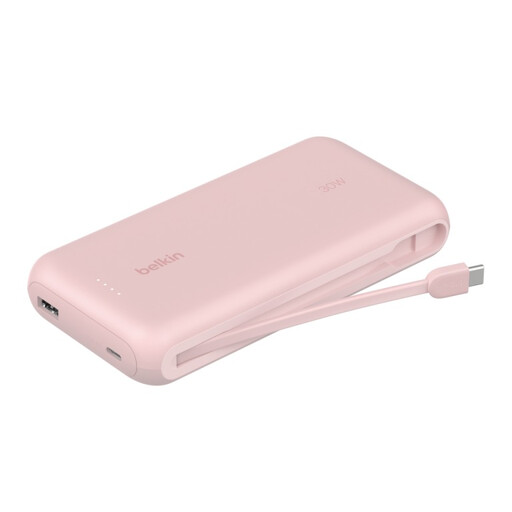
Why this choice suits this profile: Its built-in USB-C cable, three outputs and simultaneous charging make it a practical companion for commutes, remote work and air travel.
The ports, shared power and weight of 395 g are all specified. This makes it easier to weigh up battery life against portability.
Built-in USB-C cable stated at 30 W PD with PPS, 30 W USB-C port, 18 W USB-A port and a level indicator.
We've put together a full, real-time updated selection of products that meet these demanding criteria and European safety regulations.
A 10,000 mAh power bank is a common size to keep a smartphone going throughout the day. If you also charge a tablet, earphones and a watch, or if you're going away for several days without access to a plug socket, a 20,000 mAh capacity will give you a more comfortable reserve.
Yes, provided the laptop accepts charging via USB-C and the power bank delivers enough power through PD. Compare the power your original charger requires with what the power bank provides. The USB-C cable must also be compatible with that power.
Its lifespan depends mainly on the number of charge cycles, heat, and storage and charging conditions. To preserve it, avoid high temperatures, knocks and prolonged discharges. If the casing swells, heats up abnormally or shows signs of damage, stop using it immediately and take it to a suitable recycling point.