
Livraison le jour même ou le lendemain

Qualité garantie

Débloquez vos offres de bienvenue: Livraison GRATUITE | Jusqu'à -80 % | 30 jours d'essai gratuits à JoyPlus
Téléchargez l'application
The red battery icon flashing at the worst possible moment... it's an all-too-familiar sight. Whether you're on a business trip, a weekend getaway, or simply far from an outlet, a dead battery can strike at any time. But with the jungle of available models, hunting down the USB-C power bank that truly fits your needs can be a real headache.
This guide is here to decode the technical jargon, introduce you to the best models on the market, and help you choose the portable charger you'll never want to leave behind.
Before diving straight in, let's review the key criteria that will make all the difference.
Capacity, measured in milliamp-hours (mAh), determines how many times your power bank can bring your devices back to life.
Power, expressed in watts (W), dictates the charging speed. To take advantage of fast charging, make sure the power bank is compatible with your devices' protocols (like Power Delivery or PD). A substantial power output (45W or more) is essential for charging a laptop with a power bank.
While USB-C has become the standard, some extra features can be a real game-changer:
Naturally, a larger capacity often means a bigger and heavier power bank. It's all about finding the right trade-off. For daily use, opt for a lightweight and compact model. For long trips where every percentage point counts, a beefier, more resilient model will be your best friend.
Here are our hand-picked gems, selected for their performance and designed to meet a variety of needs.
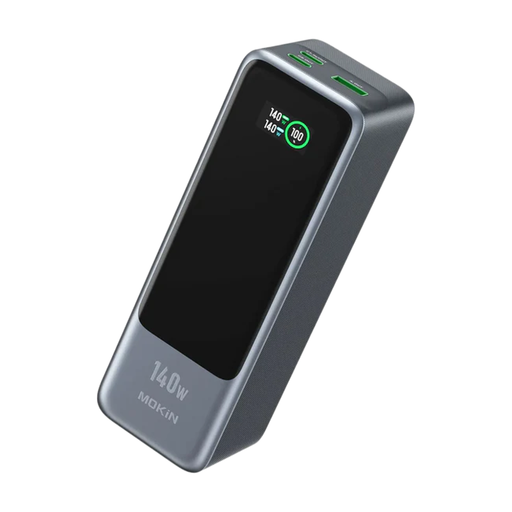
Key Feature: This power bank is a true powerhouse of capacity and performance. With a primary USB-C output reaching up to 140W thanks to the PD 3.1 protocol, it can rapidly charge the most power-hungry devices, including the latest MacBook Pros. Its LCD screen is a real bonus, displaying real-time power output and remaining battery life for perfect control.
Highlights:
Who is it for? Digital nomads, content creators, and anyone who needs to power a laptop, tablet, and smartphone simultaneously without compromising on charging speed.
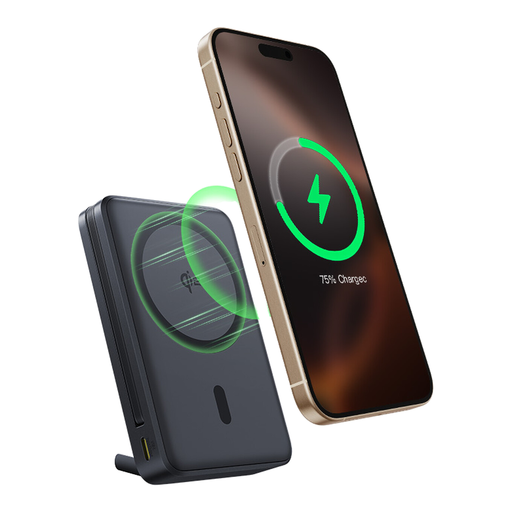
Key Feature: This model is the Swiss Army knife of charging, all in a compact form factor. It features a 15W Qi2 wireless charger with magnetic attachment, a built-in USB-C cable that delivers up to 45W, and even a fold-out kickstand. In short, it's the ultimate all-in-one solution for traveling light.
Highlights:
Who is it for? Owners of recent smartphones (MagSafe/Qi2 compatible) who want the convenience of wireless charging and an ultra-versatile portable charger for daily use, without the clutter of extra cables.
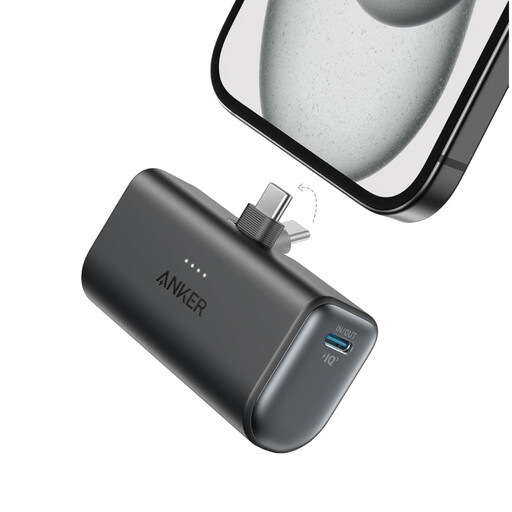
Key Feature: This mini power bank is the champion of portability. Its ace up its sleeve: a built-in, foldable USB-C connector that plugs directly into your smartphone. No more cables! Despite its tiny size, it delivers 22.5W of power for a quick and effective boost.
Highlights:
Who is it for? Anyone for whom lightness and discretion are non-negotiable. It's the ideal backup battery for a night out, a quick trip, or simply for peace of mind without weighing down your pockets.
Our selection is just a glimpse of what's available. The portable charger market is filled with models for every need. If you haven't found your perfect match or are simply curious, feel free to explore our full catalog.
Discover Our Entire USB Type-C Power Bank Category
It all depends on your usage. For an emergency top-up, 5,000 mAh is enough. For worry-free daily use, aim for 10,000 mAh. For long trips or to power demanding devices (laptops, etc.), a capacity of 20,000 mAh or more is recommended.
Yes, but it must be in your carry-on luggage. International air travel regulations limit lithium batteries to 100 Wh (watt-hours) without special approval. The conversion formula is: (mAh / 1000) x V = Wh. Rest assured, most power banks on the market, including the 24,000 mAh (86.4 Wh) model in our selection, are well below this limit.
Yes, as long as it's powerful enough. Check the wattage (W) required by your laptop (it's written on its original charger). You'll need a power bank with a USB-C Power Delivery (PD) port of at least 45W or 65W. The 24,000 mAh model in our selection, with its 140W output, is obviously perfect for this task.
By the Joybuy Product Recommendation Officer