
Livraison le jour même ou le lendemain

Qualité garantie

Débloquez vos offres de bienvenue: Livraison GRATUITE | Jusqu'à -80 % | 30 jours d'essai gratuits à JoyPlus
Téléchargez l'application
USB-C has established itself as the standard, and for good reason: a single cable to charge your laptop, smartphone, and headphones. However, choosing the right USB-C fast charger has become a real headache. Between the advertised wattages, obscure technical standards, and marketing promises, it's easy to make a mistake and invest in an inefficient or flimsy product.
As the Head of Product Recommendations at Joybuy, my role is to help you see things more clearly. Let's forget the unnecessary technical jargon and get straight to the point: here are the concrete pitfalls to avoid to make the right choice.
To avoid these pitfalls, you just need to check three essential points. These are what determine the speed, safety, and versatility of your future USB-C power adapter.
The power, expressed in watts (W), must match the needs of your most power-hungry devices.
But raw power isn't everything. The charging protocol is just as crucial. The Power Delivery (PD) standard is essential today. It allows the charger and the device to "talk" to each other to adjust the delivered power. The result: a fast, and above all, perfectly safe charge. For some devices, especially recent Samsung smartphones, support for the PPS (Programmable Power Supply) standard is a real plus for even more precise and optimized charging.
If you see the term GaN charger, it's an excellent indicator of modernity. Gallium nitride (GaN) is a semiconductor material that replaces traditional silicon. In practical terms, this allows for the production of chargers that are:
A GaN charger is therefore an excellent choice, especially if you travel a lot or want to free up space on your power strip.
A multi-port charger is convenient, provided that the power is distributed intelligently. Always check the technical specifications to understand how power is distributed when multiple ports are in use. A good charger will clearly detail the different charging scenarios (e.g., 65?W on a single USB-C port, or 45?W + 20?W if two ports are used).
Rather than a long list, we've chosen to match products from our catalog to typical user profiles. Each of these chargers has been selected for its performance, reliability, and safety.
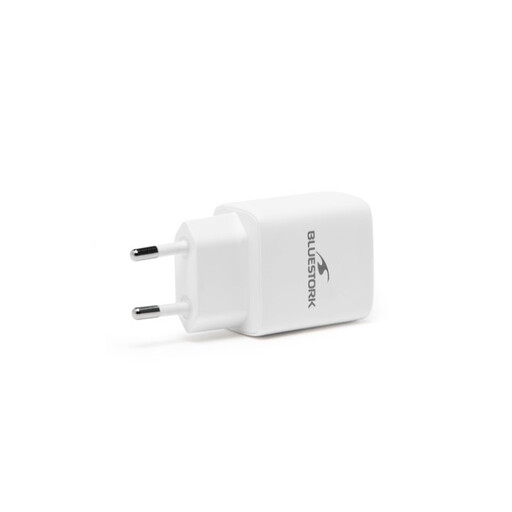
Why we chose it: It's the simple and effective solution for fast-charging your smartphone. With its 20 W output and Power Delivery compatibility, it's the perfect companion for an iPhone or any other compatible mobile device.
This charger does one thing, but it does it perfectly. There's no confusion about power distribution: it delivers 20 W through its single port, allowing it to avoid the trap of underperforming multi-port chargers.
Simplicity and efficiency. Compliant with the Power Delivery standard, it ensures a fast and safe charge for compatible devices, all in a compact and affordable package.
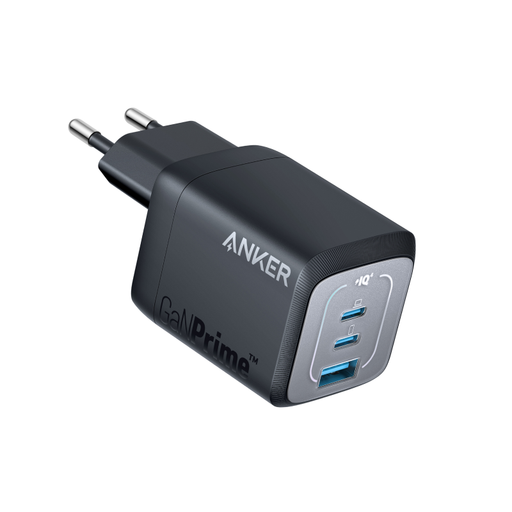
Why we chose it: The perfect solution for those who juggle a laptop, smartphone, and tablet. Its 67 W can power a MacBook Air or Dell XPS while charging other devices, all in an ultra-compact form factor thanks to GaN technology.
It leverages GaN technology to stay compact and efficient, even at full power. Most importantly, its power distribution is clearly detailed (up to 65 W across two ports), which prevents unpleasant surprises when you plug in multiple devices.
Versatility and power. With its two USB-C ports and one USB-A port, it replaces three chargers on its own. Its 67 W output makes it a true charging hub, equally at home on a desk or in a travel bag.
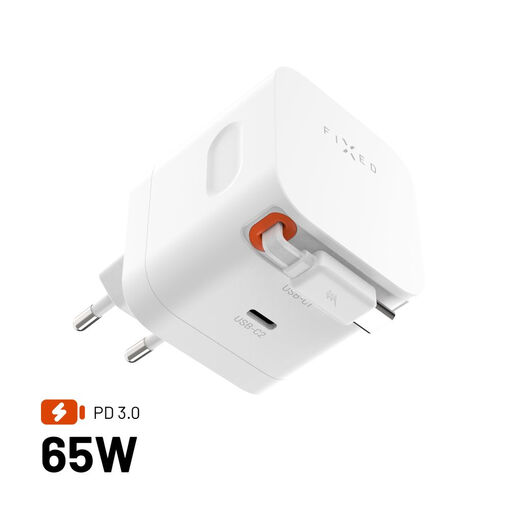
Why we chose it: For anyone who wants to travel light, without the traditional tangled mess of cables. This powerful charger integrates its own retractable USB-C cable, a brilliant solution for a consistently tidy bag. Its two USB-C ports even allow you to charge another device in parallel.
It directly tackles the "hidden cost" pitfall by integrating a high-quality cable. No more hunting for a compatible cable that can handle 65 W. Here, everything is included and designed for travel.
The all-in-one concept. The combination of GaN technology, 65 W of power, and a retractable cable makes it the ultimate travel solution for anyone looking to minimize clutter.
We have curated a complete selection of products that meet our strict selection criteria and European safety standards.
No, absolutely not. Thanks to the Power Delivery (PD) protocol, the charger and your device "communicate." The charger will only deliver the maximum power that your phone can safely accept (20?W in this example). Using an overpowered charger is therefore not dangerous at all.
At the same wattage, a GaN charger will be much more compact and will generate less heat than a traditional silicon-based charger. This efficiency gain makes it more pleasant to use daily and much easier to carry.
Yes, and this is an absolutely crucial point. To harness the full power of a 65?W or 100?W charger, you need a USB-C cable certified to handle such power. A basic cable will throttle the charging speed, regardless of your charger's power. Always check that the cable is up to the task for your USB-C power adapter.