
Livraison le jour même ou le lendemain

Qualité garantie

Débloquez vos offres de bienvenue: Livraison GRATUITE | Jusqu'à -80 % | 30 jours d'essai gratuits à JoyPlus
Téléchargez l'application
By the Joybuy Editorial Team, July 5, 2026
The charger has disappeared from the box of our smartphones, tablets, and laptops. This trend, started by a few, has now been adopted by nearly every manufacturer. The result: between the underpowered old adapters lying in our drawers and the empty space in the box, many of us are on the hunt for the ideal charger. But the market is a jungle of acronyms—USB-C PD, GaN, PPS—making it easy to get lost.
Our mission today is to help you decode this jargon and choose the model that’s truly right for you, without getting bogged down in marketing hype. Follow our guide to find the power adapter that will re-energise your devices, quickly and efficiently.
Before you grab the first model you see, let's review the key criteria that make all the difference.
Power, measured in watts (W), is the crucial factor. A 45W charger or a 65W charger will deliver charging speeds that are worlds apart from an old 5W or 10W adapter.
The acronym GaN stands for gallium nitride. A GaN charger uses this advanced semiconductor instead of traditional silicon. The advantages are immediate:
This technology is a key advantage for a travel charger, where every gram and square centimetre counts.
The number and type of ports determine the charger's versatility. A dual USB-C charger allows you to charge two devices at the same time by intelligently distributing the power.
But ports aren't everything; charging protocols are just as crucial. The USB Power Delivery (PD) standard has become the near-universal norm, ensuring fast charging for most devices, including being the basis for an iPhone fast charger. For certain Android devices, especially Samsung's flagships, the PPS (Programmable Power Supply) protocol is a significant advantage. It dynamically adjusts voltage and current to optimise charging speed while preserving battery health. For Galaxy owners, a Samsung 45W charger that is also a PPS charger is therefore the logical choice.
Let's get practical with a selection of models that caught our eye, each tailored to a specific need.
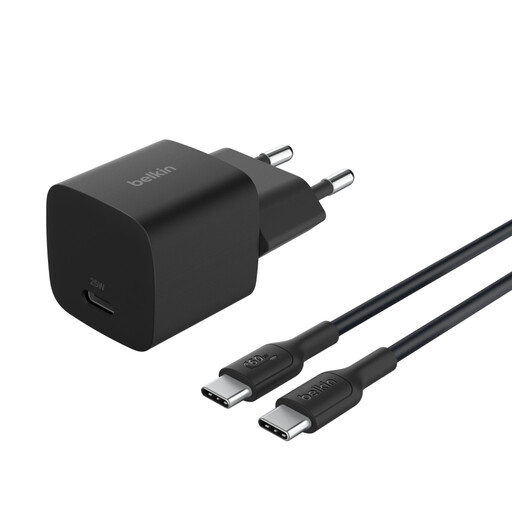
Why we love it: The Belkin BoostCharge 45W checks all the boxes for the ideal modern charger. It combines GaN technology for compactness, two USB-C ports for versatility, and includes a quality cable, making it ready to use right out of the box.
Key Strengths:
Who is it for? For those looking for a single, high-performance charger for home, the office, and travel. Its ability to quickly charge a smartphone and an accessory (earbuds, watch) or even two phones makes it a highly practical daily companion.
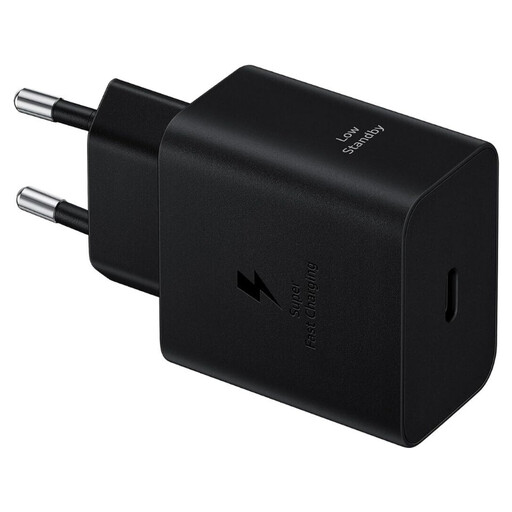
Why we love it: Who better than Samsung to optimise charging for its own devices? This official charger is designed to leverage the "Super Fast Charging 2.0" technology of Galaxy devices, ensuring perfect communication for a charge that is as fast as it is safe.
Key Strengths:
Who is it for? For owners of high-end Samsung Galaxy smartphones (S series, Z Fold, Z Flip) who want to take full advantage of the charging speed promised by the manufacturer. It's the trusted choice for the Samsung ecosystem.
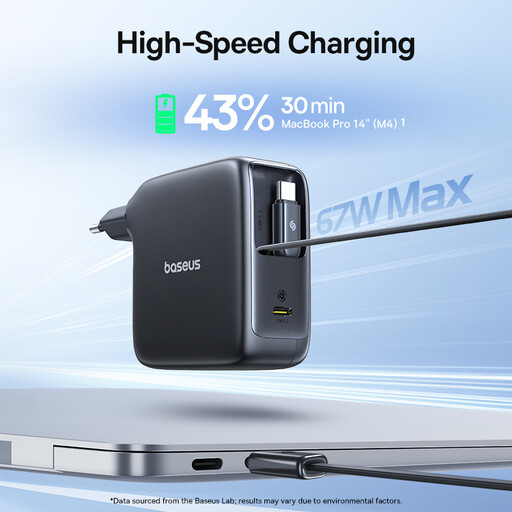
Why we love it: The Baseus EnerCore CJ21 completely rethinks the concept of a travel charger. With its two integrated retractable cables (one USB-C and one Lightning) and an additional USB-C port, it makes carrying multiple cables and adapters obsolete.
Key Strengths:
Who is it for? For the professional on the go, the frequent traveller, and anyone who hates the tangled mess of cables. It's the most integrated and convenient solution for keeping all your devices charged, wherever you are.
Our selection covers the most common use cases, but the perfect charger for you might be something else. Perhaps you're looking for a model with more ports, a different power output, or simply a replacement cable that can keep up with your new charger.
To explore a wider range of chargers and accessories, feel free to browse our dedicated category.
? See all our USB-C charging cables
1. Can I use a 65W charger on a smartphone that only accepts 25W? Yes, absolutely. Modern chargers communicate with devices to negotiate the optimal charging power. The charger will only supply the maximum power that the smartphone can safely accept. Using an overpowered charger therefore poses no risk to your battery.
2. Is GaN technology essential? No, not essential, but highly recommended, especially for power outputs above 30W. A GaN charger will be smaller, lighter, and run cooler than a non-GaN charger of the same wattage. The improvement in comfort and portability is undeniable, particularly when travelling.
3. Is a USB-C fast charger compatible with an iPhone? Yes. Since the iPhone 8, all models have been compatible with fast charging via the USB-C Power Delivery (PD) protocol. For models released before the iPhone 15, you will need a USB-C to Lightning cable. Starting with the iPhone 15 series, a simple USB-C to USB-C cable does the job. In short, an iPhone fast charger is simply a USB-C PD charger of at least 20W.