
Livraison le jour même ou le lendemain

Qualité garantie

Débloquez vos offres de bienvenue: Livraison GRATUITE | Jusqu'à -80 % | 30 jours d'essai gratuits à JoyPlus
Téléchargez l'application
The promise of a single USB-C fast charger to power everything from your smartphone to your laptop and tablet is certainly appealing. Yet, the market is a veritable jungle of models with often opaque spec sheets. Between the advertised wattage, charging standards, and marketing claims, the risk of making the wrong choice is very real. And an unsuitable charger doesn't just slow down charging? it can also prematurely wear out the batteries of your precious devices.
Before you buy, it's crucial to know how to avoid the most common pitfalls to invest in a USB-C power adapter that is powerful, durable, and perfectly safe.
To navigate the charger jungle, you just need to focus on a few key technical points. Mastering them is your guarantee of choosing a product perfectly suited to your needs.
Power, expressed in watts (W), determines the charging speed. But be careful, this raw power is useless if the charger and the device don't "talk" to each other correctly. This is precisely the role of the Power Delivery (PD) protocol.
Always check that "Power Delivery" or "PD" is mentioned. This guarantees that the charger will intelligently adjust the power delivered to preserve your battery's health in the long run.
Gallium nitride (GaN) is a semiconductor that is replacing aging silicon in modern chargers. A GaN charger offers very real advantages:
If you're juggling multiple devices, a multi-port charger is the obvious solution to declutter your desk or bag. Two points to keep a close eye on:
Rather than an endless list, we've selected three models that meet very specific needs, all validated against our criteria for performance, safety, and common sense.
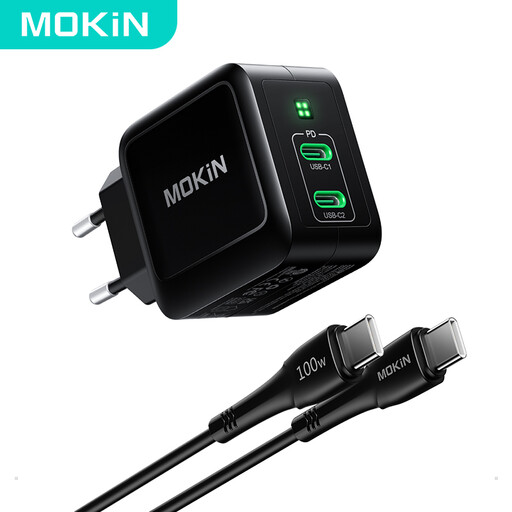
Why it's the right choice: Perfect for those who travel with a laptop and a smartphone. Its GaN technology makes it ultra-compact for its power, and its two USB-C ports allow you to charge a MacBook Air and an iPhone at the same time. No more cluttering your bag with two adapters!
It avoids the shared power trap by guaranteeing up to 67W on a single port, enough to power a laptop with peace of mind. In dual-port mode, the power is intelligently distributed to maintain a fast and efficient charge on both devices.
GaN II technology for a mini form factor and controlled heat. 1.2m USB-C to USB-C cable included, a ready-to-use bundle.
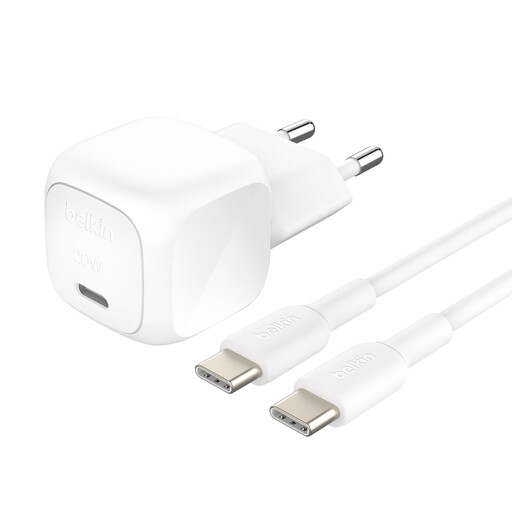
Why it's the right choice: Ideal for the user who wants a simple and reliable solution to quickly charge their smartphone. Its 20W is perfectly optimised for the latest iPhones and many Android models, offering significant time savings compared to standard 5W chargers.
This charger removes any doubt about compatibility thanks to its USB-C PD 3.1 certification. It guarantees a perfect dialogue with the device for a fast and safe charge, without any risk of overheating or speed throttling.
USB-C PD 3.1 certification for a fast and secure charge. 1m USB-C to USB-C cable included, an excellent value for money.
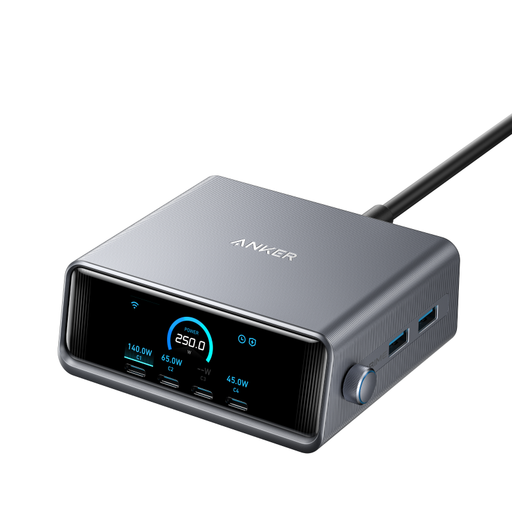
Why it's the right choice: The ultimate solution for heavy users who juggle an arsenal of devices (two laptops, smartphone, tablet...). With its 250W of total power and 6 ports, this charging station can power an entire ecosystem from a single wall outlet.
This powerhouse solves the shared power puzzle in the most elegant way: an LCD screen. It displays the power delivered to each port in real-time, allowing you to know exactly what is charging and how, and to optimise your connections.
Colossal 250W power to charge multiple laptops simultaneously. LCD screen for total control over charging. 6 ports (4x USB-C, 2x USB-A) for absolute versatility.
Discover our full selection of chargers that meet our selection criteria and the strictest European safety standards.
Absolutely no risk. Thanks to the USB Power Delivery (PD) protocol, the charger and your device "negotiate" the right amount of power to deliver. The charger will never supply more than what your phone can safely accept, which is 20W in this example. Using an overpowered charger won't speed up the charge, but it will never damage the device.
Yes, and this is a crucial point. The cable is a critical link in the chain. To take advantage of truly fast charging, especially above 60W, you need a USB-C cable certified to handle that level of power. A basic cable will throttle the charging speed and may overheat. Look for cables that explicitly state their capacity (60W, 100W, etc.) to match your charger.
It all depends on its build quality and thermal management. A good, certified, and well-designed charger can work flawlessly for years. Conversely, entry-level models tend to get very hot, which degrades their internal components and significantly reduces their life expectancy.