
Livraison le jour même ou le lendemain

Qualité garantie

Débloquez vos offres de bienvenue: Livraison GRATUITE | Jusqu'à -80 % | 30 jours d'essai gratuits à JoyPlus
Téléchargez l'application
The promise of USB-C was simple: a single charger for all our devices. Yet, the reality is often a drawer overflowing with slow, bulky, or incompatible chargers. Choosing a new USB-C fast charger can quickly become a headache, caught between technical jargon and vague marketing claims.
As the Head of Product Curation at Joybuy, I'm here to guide you. Together, we'll break down the common pitfalls and focus on the criteria that truly matter. The goal: to help you make an informed decision that fits your needs, without overspending.
The market is saturated, but not all options are created equal. Here are the most common mistakes that lead to buyer's remorse.
To avoid these traps, focus on a few key technical specifications. These are the true measures of a charger's performance and reliability.
Power, measured in watts (W), determines charging speed. However, raw wattage isn't everything. The standard to demand is Power Delivery (PD). It's an intelligent charging protocol that allows the charger and the device to "talk" to each other, adjusting the power output to the device's precise needs.
You'll often see the term GaN charger. Gallium nitride is a semiconductor material that replaces traditional silicon. Its advantages are very real for the user:
A multi-port charging station is a practical solution to declutter your cables and power bricks. Before buying, always check the technical specifications to understand how the power is distributed. A reputable manufacturer will always detail the maximum power per port and the different possible combinations (e.g., 65W on a single USB-C port, or 45W + 20W if two ports are used).
Rather than an endless list, we've selected a few models tailored to specific user profiles. The idea is to help you find the perfect fit.
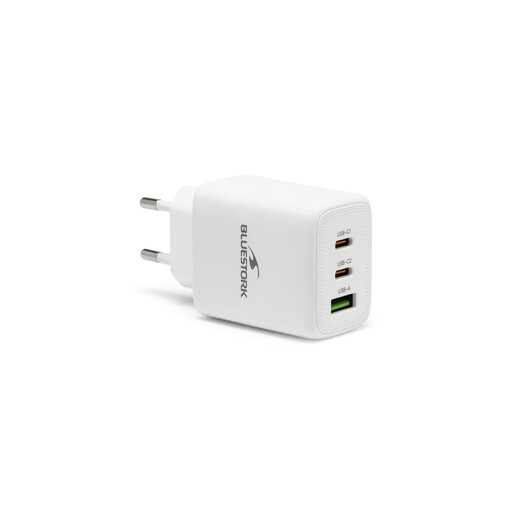
Why it's a great fit: For nomads, this charger is the ultimate all-in-one solution. Its 65W output is more than enough for an ultraportable laptop charger and a smartphone. The included cable and its international voltage compatibility (100-240V) make it ready to go wherever you do.
It sidesteps the incompatibility trap by supporting both Power Delivery 3.0 and QC 3.0 protocols. The result: guaranteed fast charging for a vast ecosystem of devices (Apple, Samsung, etc.).
A ready-to-use kit, cable included. Its dual ports (USB-C and USB-A) offer maximum versatility.
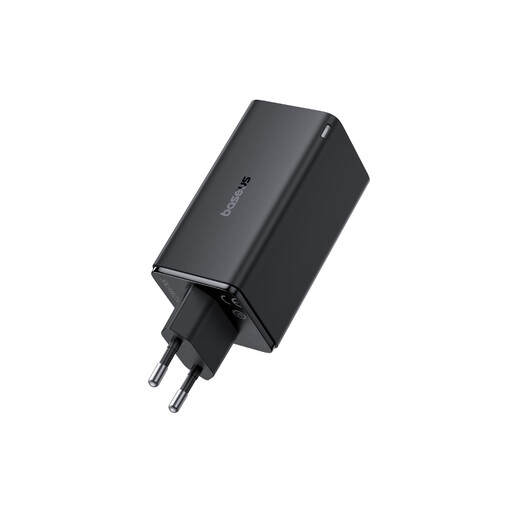
Why it's a great fit: The professional who constantly juggles their MacBook charger, smartphone, and earbuds needs power and versatility. This 100W GaN charger offers four ports in a compact form factor, allowing you to power everything with a single block, whether at the office, at home, or on the go.
No more guesswork with shared power. With 100W and intelligent distribution technology, it adjusts the current to each device to optimize charging without the risk of overload.
GaN technology for a pocket-sized format. Its four ports (2x USB-C, 2x USB-A) make it the Swiss Army knife of charging.
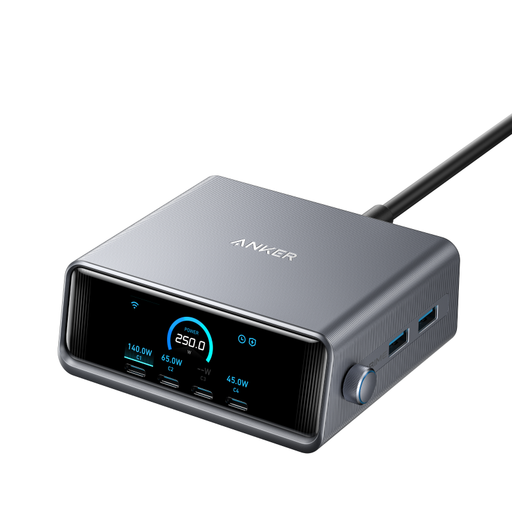
Why it's a great fit: This is THE ultimate multi-port charging station for a well-organized desk. With 250W of total power and 6 ports, it can simultaneously power two laptops, a smartphone, a tablet, and other peripherals. It's the radical solution to end the cable jungle on your desk.
It shatters the pitfall of unclear power distribution with its LCD screen, which displays the real-time power output for each port. No more guessing—you know exactly what each device is drawing.
A colossal 250W of power. The LCD screen for total control. 6 ports to power an entire setup.
Discover our full selection of products that meet our demanding selection criteria and European safety standards.
1. Will a 100W charger damage my phone that only needs 20W?
Absolutely not. A modern charger that complies with the Power Delivery (PD) standard is "smart." It communicates with your device to provide only the power it needs. You can safely plug your smartphone into a 100W charger; it will only "draw" the maximum power it can accept (e.g., 20W).
2. What's the difference between a GaN charger and a regular charger?
The main difference lies in the semiconductor material. A GaN charger (gallium nitride) offers much better energy efficiency than a traditional silicon-based charger. In practical terms, for the same wattage, it is much more compact, heats up less, and is therefore a perfect travel charger.
3. Do I need a special cable for fast charging?
Yes, and this is a crucial point. The cable is just as important as the charger. To take advantage of fast charging, especially above 60W, you absolutely need a USB-C cable capable of handling that level of power. A basic cable will throttle the charging speed and, in the worst-case scenario, could overheat. Make sure your cable is certified for the intended wattage (e.g., a 100W-rated cable).