
Livraison le jour même ou le lendemain

Qualité garantie
Téléchargez l'application
Catégories
In an age where our lives are governed by a multitude of electronic devices—from smartphones and tablets to laptops—managing chargers has become a real headache. Drawers are overflowing, travel bags are getting heavier, and finding the right plug at the right time can be a challenge. In light of this, adopting a single, high-performance USB-C fast charger is a practical solution.
As a Product Recommendation Manager at Joybuy, my role is to help you navigate the available options, based on objective criteria for an informed and lasting purchase.
Before we present our top picks, here are a few key points to consider to make the right choice.
Power, measured in Watts (W), is the main criterion. A 20W charger will be sufficient for a smartphone, but a USB-C laptop charger will require between 65W and 100W for efficient charging. The goal isn't to aim for the highest wattage, but for the one that matches your most power-hungry device. Most modern chargers intelligently distribute the available power when multiple devices are plugged in.
A good multi-port wall charger should match your device ecosystem. Count the number of devices you charge simultaneously. A common configuration includes:
The acronym GaN stands for gallium nitride. It's a semiconductor material that is replacing silicon in modern chargers. Its advantages are tangible: it allows for the production of chargers that are more compact, lighter, and generate less heat, all while delivering high power. A GaN charger is often a smart choice for travellers or anyone looking to minimize bulk.
Ensure the charger has the CE mark. This certification indicates that the product complies with the health and safety standards in force within the European Union. It's an essential guarantee of reliability to protect your devices and prevent any electrical hazards.
Keeping these criteria in mind, we have identified a few models that stand out for their design and suitability for specific needs.
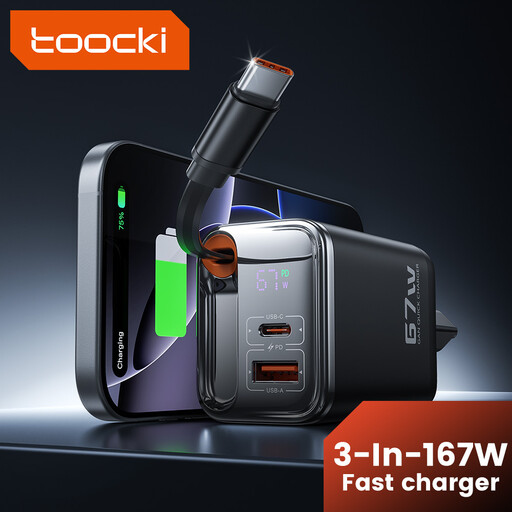
Why We Recommend It
This model from toocki directly tackles the problem of cable clutter with its built-in retractable USB-C cable. No more tangled cables at the bottom of your bag. With 67W of power, it can charge a wide range of devices, including laptops like the MacBook Air, while also offering extra ports for other gadgets.
Pros
Who Is This Product For? Ideal for frequent travellers, students, and mobile professionals looking for an all-in-one solution to reduce clutter and charge multiple devices at once.
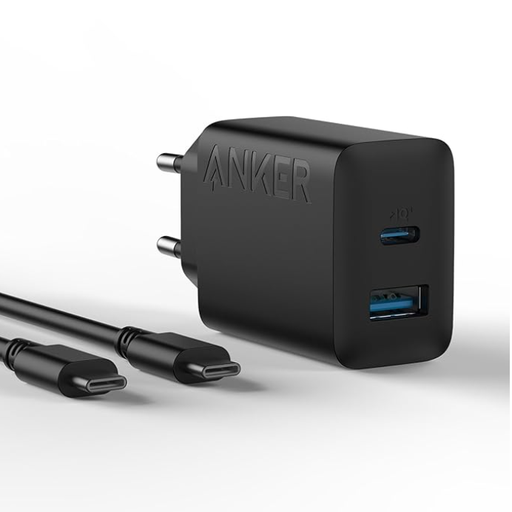
Why We Recommend It
Anker is a brand renowned for its reliable accessories. This 20W fast charging block is a simple and effective option. Its power is optimized for fast-charging modern smartphones, especially iPhones. Its compact design and the inclusion of a 1.5m USB-C cable make it a very convenient, ready-to-use solution.
Pros
Who Is This Product For? Perfect for smartphone users (as a fast charger for iPhone, for example) who need a reliable and compact primary or secondary charger for home, the office, or light travel.
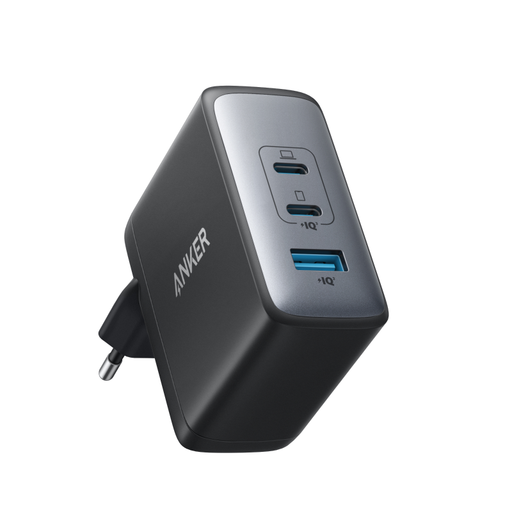
Why We Recommend It
This model is a high-performance solution. Thanks to GaN technology, it delivers a massive 100W of power in a surprisingly compact form factor. It can simultaneously charge a demanding laptop, a smartphone, and headphones without slowing down. The two USB-C ports and one USB-A port provide comprehensive connectivity for the most well-equipped users.
Pros
Who Is This Product For? Aimed at professionals, creatives, and "power users" with a power-hungry laptop (e.g., MacBook Pro, Dell XPS) who want a single charger for their fixed or mobile workstation.
Our selection highlights products that cater to specific use cases. However, the market offers a wide variety of power ratings, designs, and port configurations. If your needs are different, we invite you to explore our full range of wall chargers to find the model that's right for you.
The right wattage depends on your devices. Here are some guidelines:
Yes, absolutely. Modern chargers and devices equipped with the USB Power Delivery (PD) standard communicate with each other to negotiate the optimal charging speed. A 100W charger will only deliver the maximum power your smartphone can accept (e.g., 25W), without any risk of damage.
GaN (gallium nitride) technology allows for the creation of chargers that are smaller, lighter, and more energy-efficient than their silicon-based counterparts. It's not essential, but it is a significant advantage if compactness and portability are important criteria for you, especially for chargers over 60W.