
Livraison le jour même ou le lendemain

Qualité garantie

Débloquez vos offres de bienvenue: Livraison GRATUITE | Jusqu'à -80 % | 30 jours d'essai gratuits à JoyPlus
Téléchargez l'application
GPS, music, calls... In the car, your smartphone is indispensable. But to ensure it lasts the journey, you need the right charger. The problem? The cigarette lighter adapter market is a minefield of models with often-broken promises. Making the wrong choice means, at best, a desperately slow charge, and at worst, a very real risk to your multi-hundred-dollar devices.
Before you buy, here are the 3 classic pitfalls to avoid so you won't regret your purchase?:
To make the right choice, a few technical specifications are simply non-negotiable. They are the guarantee of performance and longevity for your USB-C cigarette lighter adapter.
Power, expressed in watts (W), is the name of the game for express charging. Here are a few benchmarks to make sense of it all?:
powerful car charger.It is imperative to check that the charger is compatible with the Power Delivery (PD) protocol. It's the universal standard for fast charging via USB-C, adopted by Apple, Google, and a myriad of other manufacturers. For some Android devices, compatibility with Qualcomm Quick Charge (QC) can also be a plus.
A multi-port cigarette lighter charger has become virtually standard. The most versatile configuration combines?:
Pay close attention to power distribution. A good charger will allocate dedicated power to each port or will unambiguously state the power available when multiple ports are used simultaneously.
To save you from drowning in spec sheets, we have selected three models that meet clear and specific needs.
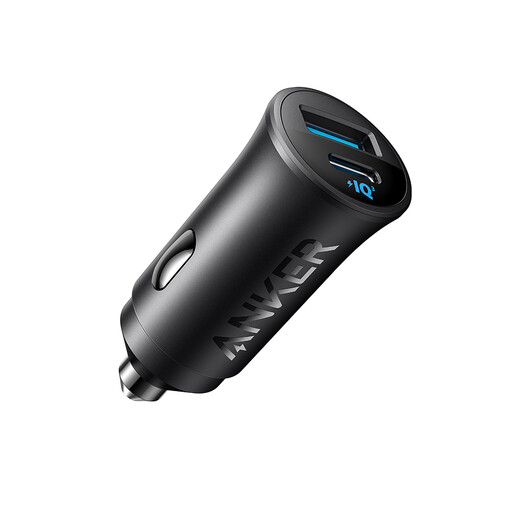
Who is it for? For those looking for a simple and reliable solution for daily commutes. Its ultra-compact design blends in seamlessly with the dashboard, and its 30W USB-C port ensures a fast charge for a smartphone, even on short trips.
It offers 30W dedicated to the USB-C port, guaranteeing a true fast charge for one device, not a vague promise of shared power. On the safety front, Anker's MultiProtect technology provides comprehensive protection.
Ultra-discreet design. 30W Power Delivery USB-C port. Additional USB-A port for dual charging.
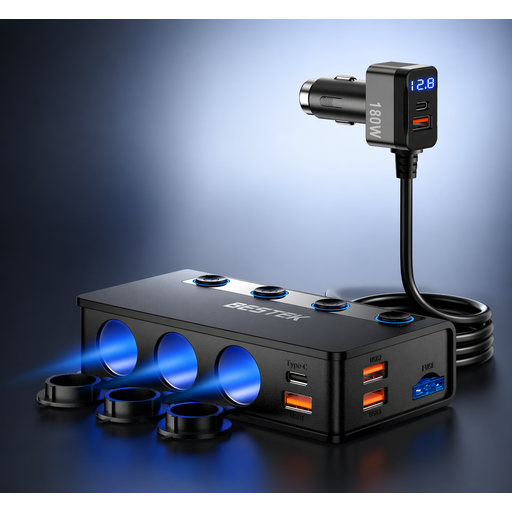
Who is it for? This is much more than a charger; it's a true mobile power station. With 6 charging ports (including one 65W PD) and 3 cigarette lighter sockets, it powers smartphones, tablets, GPS, dashcams, and even a laptop. Ideal for long family road trips or professionals (ride-share drivers, delivery personnel).
It doesn't just boast a high total wattage; it distributes it intelligently, with a dedicated 65W PD USB-C port that delivers on its promise. The independent switches enhance safety and power management.
Massive charging hub (up to 9 devices). True 65W PD port for laptops. Individual switches and integrated voltmeter.
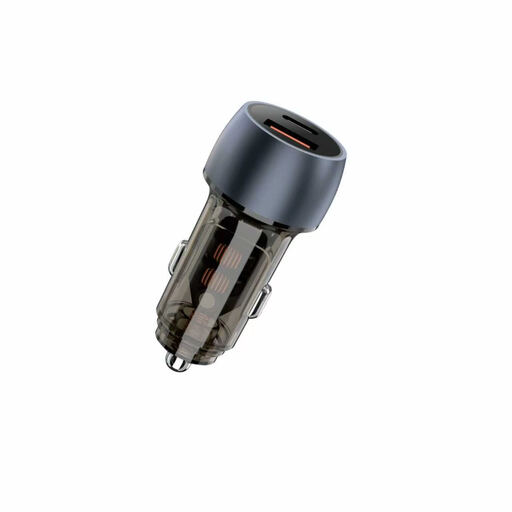
Who is it for? For those who demand maximum power in a still-compact form factor. With one USB-C port reaching up to 100W and a second 20W PD port, it can charge a MacBook Pro at full speed while simultaneously powering up an iPhone 15.
There's no smoke and mirrors here: the promise of a `powerful car charger` is kept with a colossal 100W of power on a dedicated port. The distribution is clear, and the performance is there for the most demanding users.
Very high power output (up to 100W). Perfect for powerful laptops and simultaneous fast-charging of a smartphone.
Explore our full selection of tested and approved chargers, all of which meet our criteria for performance and safety.
It all depends on your devices. For a single smartphone, 20 to 30W is sufficient for an effective fast charge. If you plan to charge a tablet or a laptop, aim for at least 45W on a PD-compatible USB-C port. To power multiple power-hungry devices at the same time, a total output of 60W or more is highly recommended.
Absolutely. A poor-quality charger is a risk not worth taking. Models without protection against overheating, overvoltage, or short circuits can not only prematurely degrade your device's battery but, in the worst-case scenario, also blow a fuse in your vehicle. Always opt for reputable brands that explicitly mention their safety certifications.
No, and this is a very common misconception. The USB-C port is just a physical connector. The charging speed depends on the power (in W) and the protocols (like Power Delivery) it supports. A low-end USB-C charger might only deliver 5W, resulting in an excruciatingly slow charge. Therefore, always check the wattage and look for the mention of "Power Delivery" or "PD".