If you want more space for frozen food, choose an upright freezer if you often take out portions and want to organise them in drawers. Consider a chest freezer if capacity and storing bulky items matter most, and you have enough floor space. An under-counter model is better suited to a modest top-up, while a large fridge freezer is worth considering if you’re replacing your fridge as well. Whichever you choose, check the usable freezer capacity, dimensions and the permitted room temperature range.
Who is each format best for?
Households stocking up
If you buy in bulk or regularly freeze home-cooked meals, compare the usable capacity with the space you have available. If power cuts are a concern for your stock, also check the stated storage time in the event of a power failure.
Households dipping into their stock every day
To find portions and ready meals quickly, look at how easy it is to access the drawers in an upright freezer or the baskets in a chest freezer. Make sure they’ll still be easy to open once the appliance is in place.
Households with a garage or cellar
An unheated room can fall below the temperature range permitted for some appliances. Check its minimum and maximum temperatures, then consult the manufacturer’s guidance for the model you’re considering.
What should you check before choosing?
Start with what you need to store and how often you’ll take food out, then check each format against the available space and operating conditions.
| What to consider | What to check | What I need |
|---|
| Capacity and format |
Compare usable freezer capacity in litres and the appliance’s dimensions. According to Que Choisir, chest freezers can hold up to 600 L, while upright models generally offer around 200 L, rising to 400 L for larger models. With a fridge freezer, distinguish the freezer capacity from the total capacity. |
I want to store my food stock without choosing an appliance that won’t fit through the doors or into the space available. If I’m replacing my fridge too, I’ll check the fridge freezer’s freezer capacity separately. |
| Access to food |
Check how much clearance you need to open the drawers of an upright freezer or the lid of a chest freezer. Consider how the compartments or baskets will help you organise the food you use most often. |
For daily use, I’d rather be able to see and reach my portions without moving the whole stock. If I’ll access it less often, I can organise a chest freezer by category. |
| Storage time and maintenance |
Compare the stated storage time in hours in the event of a power cut and the defrosting method. Que Choisir recommends setting the freezer to -18 °C and says that frost build-up of more than 3 mm can increase energy consumption. |
If power cuts are a risk where I live, storage time matters for the food I keep in the freezer. I also want to make an informed choice between regular defrosting and a No Frost model. |
| Energy and noise |
Check the stated annual energy consumption in kWh, energy rating, usable capacity and noise level, rather than looking at the rating letter alone. ADEME points out that the energy label also includes a noise rating. |
I’ll compare the energy consumption of models that meet my capacity needs. In an online Que Choisir survey published in 2014, 41% of the nearly 1,500 respondents said the energy rating had played a decisive part in their choice. |
| Room temperature |
Check that the climate class, or any explicitly stated suitability for low temperatures, covers the conditions where the appliance will be kept. Beko France says that climate class SN-T corresponds to an ambient temperature of 10 to 43 °C, so on its own it isn’t enough for a room that falls below 10 °C. |
For a cellar or garage, I’ll check the room temperature before choosing a model. In the online Que Choisir survey published in 2014, 77% of the nearly 1,500 respondents said they didn’t know that climate classes existed. |
What mistakes should you avoid?
-
Choosing capacity before measuring the space
A chest freezer takes up floor space, while a large upright model may need more depth and clearance for its drawers. Capacity is no use if the appliance won’t fit through the door or is difficult to open.
Measure the space, the delivery route and the clearance needed for the lid or drawers. Follow the ventilation clearances given in the model’s instructions.
-
Assuming any freezer will work in any cellar or garage
Beko France says the climate class defines the ambient temperature range an appliance is designed for. Even an SN-T rating, specified for 10 to 43 °C, doesn’t automatically cover a room where the temperature drops below freezing.
Check the room temperature and confirm that the exact model is suitable. For example, Whirlpool France says its W3RHS19DW chest freezer features Freezer Guard down to -15 °C. This doesn’t apply to all chest freezers.
-
Comparing energy ratings by letter alone
Two appliances with different capacities won’t necessarily meet the same storage needs. The rating alone doesn’t replace checking annual energy consumption and the features that matter for installation.
Compare the stated energy consumption in kWh per year with the usable capacity, then check the noise level, storage time and permitted ambient temperature.
-
Forgetting about delivery and installation
A bulky appliance needs to be brought into the room where it will be installed. Delivery to the room, unpacking and installation are separate services, so check what’s included.
Before ordering, check the access route, the services actually on offer and the arrangements for taking away your old appliance if you’re replacing one.
A guide to the brands
Liebherr
The range includes large-capacity upright freezers and fridge freezers.
- Liebherr France lists a capacity of 363 L, NoFrost and a noise level of 37 dB for the FNd 7227 upright freezer.
- The FNd 7227 measures 185.5 × 69.7 × 76 cm. Check the access route, available depth and door clearance before choosing it.
Whirlpool
The W3RHS19DW chest freezer is an example of extra storage for a room that meets the conditions specified for the model.
- Whirlpool France lists a capacity of 198 L, two baskets, 41 h of storage time and Freezer Guard down to -15 °C for this model.
- Compare its 198 L capacity with the size of the stock you want to store. Don’t assume its suitability for low temperatures applies to other models.
Bosch
The models featured here illustrate two different options: a large upright freezer and an under-counter model.
- Bosch Électroménager France lists a capacity of 366 L, No Frost and adjustable drawers for the GSN58AWEV upright freezer.
- Bosch lists 83 L of usable capacity for the under-counter GTV15NWEB. It’s suitable for a modest top-up, but not as the sole freezer for a large family’s food stock.
Options available on Joybuy
These options include chest freezers, an upright freezer and a fridge freezer to suit different household storage needs. Compare their freezer capacity and format with your available space. If the appliance will be kept in an unheated room, check the permitted temperature range for your chosen model.
 Image unavailable
AUCMA, 291 L convertible chest freezer
This 291 L chest freezer is an option for stocking up on frozen food if you have enough space to open its top-hinged lid. Its product title lists fridge and freezer modes, a removable basket, LED lighting and an energy rating of E. If you plan to keep it in an unheated room, check the permitted ambient temperature range and storage time in the event of a power cut.
View on Joybuy
 Image unavailable
Candy CFQQ5T817EPS, 4-door fridge freezer, 467 L
This fridge freezer is worth considering if you’re replacing your fridge as well. The 467 L stated in the product title is for the whole appliance, so check the freezer compartment’s capacity separately to see how much extra space you’ll have for frozen food. The title also mentions Total No Frost and an energy rating of E. Be sure to check the dimensions and installation requirements too.
View on Joybuy
 Image unavailable
Heinrich´s, 161 L No Frost upright freezer
This 161 L upright freezer is suited to households that want to organise their frozen food in easily accessible compartments rather than in a chest freezer. Its product title mentions No Frost, drawers, a reversible door and an energy rating of C. Compare its 161 L capacity with the amount you plan to store, and check the dimensions, climate class and storage time before choosing where to put it.
View on Joybuy
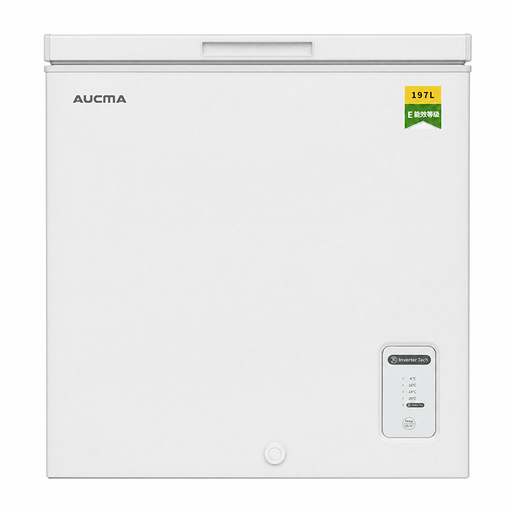 Image unavailable
AUCMA, 197 L convertible chest freezer
This 197 L chest freezer is worth considering for extra storage, rather than automatically opting for the largest capacity available. Its product title lists fridge and freezer modes, a removable basket and an energy rating of E. Check that its capacity, permitted ambient temperature range and storage time suit your needs, especially if you plan to keep it in a cellar or garage.
View on Joybuy
Frequently asked questions
What climate class do I need for a cellar or garage?
Choose a model whose permitted ambient temperature range covers the temperatures the room actually reaches. Beko France says that climate class SN-T covers 10 to 43 °C, so if your cellar or garage falls below 10 °C, this class alone isn’t enough. Check that the exact model is specifically stated to work at lower temperatures.
Do I need a chest freezer to store a lot of frozen food?
No. Your choice also depends on how easy it is to access your food and how much space you have. Que Choisir says chest freezers can hold up to 600 L, while large upright models can offer up to 400 L. A chest freezer is worth considering for a large stock, while an upright model may be more convenient if you regularly take food out of the drawers.
What temperature should I set my home freezer to?
Que Choisir recommends setting it to -18 °C. The consumer association says that lowering the temperature further uses an extra 2 to 3% of energy per degree for a freezer, so check your appliance’s setting regularly.
Does defrosting matter when choosing a model?
Yes. If you’d like to keep manual maintenance to a minimum, compare the defrosting methods of the models you’re considering. Que Choisir says that frost build-up of more than 3 mm can increase energy consumption by up to 30%. A model without No Frost therefore needs particular attention to prevent frost from building up.


