
Livraison le jour même ou le lendemain

Qualité garantie

Débloquez vos offres de bienvenue: Livraison GRATUITE | Jusqu'à -80 % | 30 jours d'essai gratuits à JoyPlus
Téléchargez l'application
A coffee stain on the new sofa, muddy paw prints on the living room rug, or car seats that have seen better days… It's a familiar scenario for many families, pet owners, and car enthusiasts. When faced with these everyday mishaps, an upholstery and carpet cleaner—also known as a spot cleaner—emerges as the secret weapon to bring your fabrics back to life. The problem is, the market is flooded with models making tempting promises, and it's easy to be misled.
As the Head of Product Recommendations at Joybuy, my mission is to help you see things more clearly. Let's cut through the marketing jargon and get straight to the point, so you can make an informed choice with no unpleasant surprises.
Before you even start comparing spec sheets, it's crucial to be aware of the common traps that can turn a promising purchase into a real disappointment.
To avoid making a mistake, focus on these few objective characteristics. They are what determine the true performance of a spot cleaner.
These two values are inseparable. The motor power (in Watts) gives an idea of the overall energy consumption, while the suction power (in kilopascals, kPa) specifically measures the force with which the machine extracts water and dirt from the fibres. For a domestic fabric spot cleaner, a suction power between 12?kPa and 17?kPa is an excellent performance benchmark. This balance ensures a deep clean and fast drying, whether it's for your sofa cleaner or your car seat cleaner.
This is a non-negotiable feature for hygienic cleaning. A good machine must have two separate tanks: one for clean water (and the cleaning solution) and another for the collected dirty water. This separation is the only way to ensure you're not just spreading dirt around and are always cleaning with a fresh solution. Also, check their capacity: tanks of at least 1 litre each will save you constant trips to the sink, especially if you plan to clean a large rug or an entire bench seat.
If your budget allows, a model with a hot water or steam mode is a real game-changer.
Rather than an endless list, here are a few models that meet specific needs, all evaluated based on the performance and practicality criteria we've just discussed.
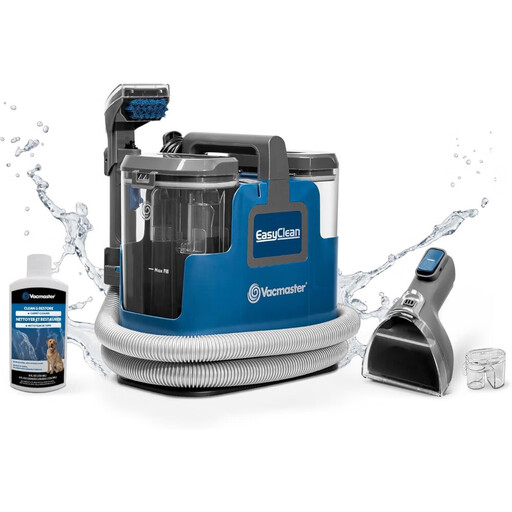
Why it's right for you: Ideal for anyone looking for a simple and effective solution for everyday accidents. Its compact size makes it easy to store and pull out for a drink spill or food stain, without the hassle of a complex machine.
This model doesn't fall into the trap of inflated marketing numbers. It offers balanced performance, and its simple design makes rinsing the tanks much easier, avoiding the maintenance headache.
Dual-tank system (1.6 L / 0.95 L) for good runtime on targeted jobs. Very compact and lightweight (3.4 kg) for optimal manoeuvrability.
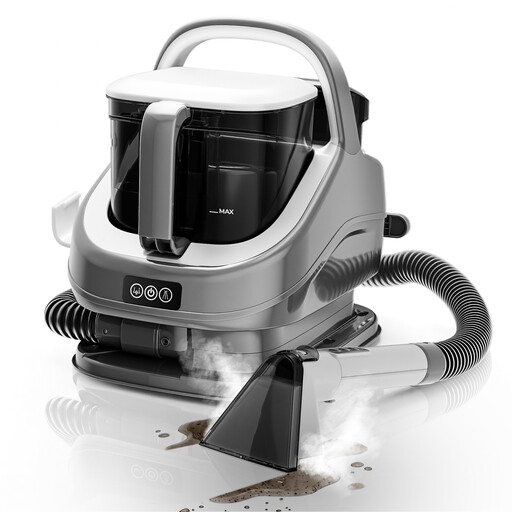
Why it's right for you: When dealing with a variety of stains (food, mud, pet accidents…), versatility is key. Its three cleaning modes (cold water, hot water, steam) allow you to tailor the cleaning power to each situation for a flawless result.
It stands out from models with empty promises by offering true hot water and steam modes, not just lukewarm water. Its 13 kPa suction is perfectly calibrated to extract moisture from deep within the fibres.
3 distinct cleaning modes for maximum versatility. 1300 W of power and large tanks (1.4 L / 1.2 L) suitable for larger cleaning jobs.
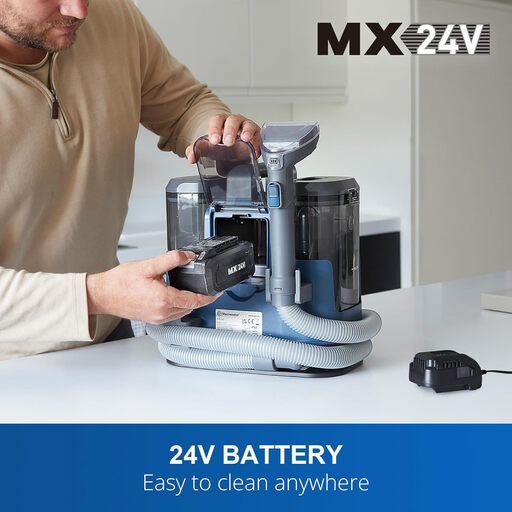
Why it's right for you: Perfect for hard-to-reach areas like a car interior, stairs, a camper van, or a boat. The freedom of cordless allows you to tackle stains anywhere, without being tied to a power outlet.
It sidesteps the trap of underpowered cordless models by delivering a remarkable suction power of 15 kPa, which rivals many corded models and ensures truly effective extraction.
Powerful 15 kPa suction for a cordless model. Up to 57 minutes of runtime, more than enough for most jobs. Large 1.6 L clean water tank.
We have put together a complete and up-to-date selection of products that meet our demanding selection criteria and current safety standards.
In everyday language, these terms often refer to the same type of device. "Upholstery cleaner" or "injector-extractor" is the technical term describing how it works: the machine injects water (with a detergent) and then extracts it. "Carpet shampooer" is a widely used name, while "spot cleaner" or "fabric spot cleaner" usually refers to more compact, portable models.
It is essential to use a detergent specifically formulated for upholstery and carpet cleaners. These products are "low-foaming." Using a standard detergent could create an excessive amount of foam, which might overflow from the dirty water tank and damage the machine's motor.
Drying time depends on three factors: your machine's suction power, the type of fabric, and the room's ventilation. A good upholstery cleaner will leave the surface just damp to the touch, not soaked. Under normal conditions, complete drying usually takes between 2 and 6 hours. Remember to ventilate the room well to speed up the process.