If reducing fat is your priority, don’t confuse almonds with no added salt with reduced-fat almonds: the products checked at E.Leclerc, Auchan and Monoprix contain around 51 to 52 g of fat per 100 g. If you’d like to keep almonds as a snack, compare the ingredients and nutritional information on the specific pack. For a snack at school, first check the school’s rules and any applicable individual care plan (PAI).
Who is this choice for ?
Parents looking for lower-fat options
You want a verifiable reduction, not simply no added salt. The almonds checked at E.Leclerc, Auchan and Monoprix contain around 51 to 52 g of fat per 100 g. If lower fat is essential, consider a different snack category too.
Parents who want to keep almonds as a snack
For a snack outside school, you can compare products made with just almonds with those containing added oil or salt. Read the ingredients list and nutritional information for the product you choose: a simple recipe doesn’t necessarily mean it’s lower in fat.
Families preparing a snack for school
If a food allergy or school rule relates to tree nuts, choosing the right recipe isn’t enough. Check which foods are allowed on site and, where applicable, follow the individual care plan (PAI) for the child concerned.
What should you check ?
When choosing a snack for a child, first decide whether your priority is to reduce fat, avoid added ingredients or follow the rules at the place where the snack will be eaten.
| Criteria |
What to check |
Who it’s for |
| Fat |
Compare the “fat” figure per 100 g across similar products. The products checked at E.Leclerc, Auchan and Monoprix contain around 51 to 52 g per 100 g. |
When choosing a snack, my main priority is a measurable reduction in fat; around 40 % of consumers put this need first. |
| Added ingredients |
Read the ingredients list, then check the salt content per 100 g: “no added salt” doesn’t mean “reduced fat”. |
I want to keep almonds, but avoid a recipe with added oil and salt. This is the top priority for around 40 % of consumers. |
| Allergens and setting |
Check the allergens and any “may contain traces” statements on the packaging, as well as the school’s rules and any applicable PAI. |
If the snack is for school or a group of children affected by an allergy, checking whether tree nuts are allowed takes priority over choosing a recipe; around 20 % of consumers put this check first. |
What should you avoid confusing ?
-
Assuming “no added salt” means “lower in fat”
The claim relates to salt. The almonds with no added salt checked at E.Leclerc, Auchan and Monoprix still contain around 51 to 52 g of fat per 100 g.
If reducing fat is your priority, compare the per-100 g figures for the specific product. If almonds don’t meet this criterion, consider a different snack category.
-
Assuming all roasted almonds have the same recipe
The TOKAPI roasted and salted product listed by E.Leclerc contains sunflower oil and salt, unlike the products checked whose ingredients list contains only almonds.
To avoid these additions, check the ingredients list rather than relying on the word “roasted” alone.
-
Assuming almonds are allowed at every school snack time
Almonds are tree nuts. The French Ministry of National Education says that an individual care plan (PAI) can include a special diet for a pupil with a food allergy.
Ask about the school’s rules before buying. If tree nuts need to be avoided, choose a different snack category that complies with the relevant rules.
Brands and products to know
E.Leclerc / Couleurs Vives
The E.Leclerc listing features roasted blanched almonds with no added salt, in a 250 g pack.
- Ingredients listed: blanched almonds. Figures per 100 g: 51,8 g of fat and 0,0 g of salt.
- No added salt doesn’t confirm that the product is lower in fat.
Auchan
The Auchan product checked is made with roasted almonds and no added salt; its 400 g product listing gives figures per 100 g.
- The listing states 52 g of fat and less than 0,1 g of salt per 100 g.
- It warns that the product may contain traces of peanuts, other tree nuts, gluten, soya, sesame and sulphites. If allergen avoidance is required, check the packaging of the pack you choose.
ALDI / Trader Joe's
ALDI lists Trader Joe's blanched almonds with no added salt in a 200 g pack.
- The product description helps you identify an unsalted option.
- To check the fat content and other ingredients, consult the information on the specific pack.
Monoprix / Daco Bello
The Monoprix listing features Daco Bello roasted blanched almonds with no added salt, in a 250 g pack.
- It lists roasted blanched almonds, with around 51 g of fat and 0,03 g of salt per 100 g.
- This product’s composition doesn’t mean it can be described as reduced-fat.
Another snack category on Joybuy
This selection features a fruit pouch to consider if you’re looking for a snack in a different category from almonds. Before choosing it for a child, check the age guidance on the packaging and any allergen information.
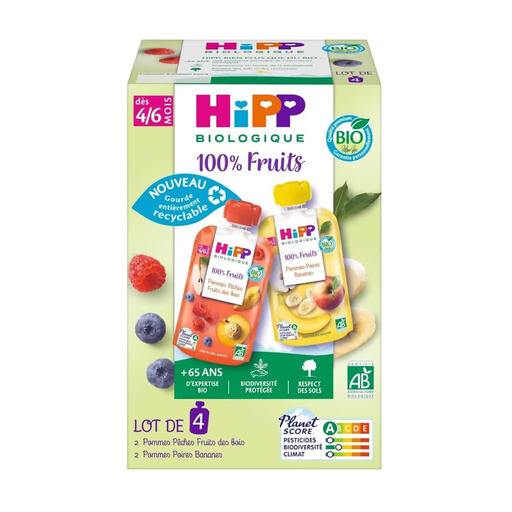 Image unavailable
HIPP Organic Fruit Baby Pouch, 4 × 90 g
A fruit pouch format to consider if you’d prefer not to serve almonds as a snack. The pack contains four 90 g pouches. The age guidance differs between the product title and description, so check the packaging, ingredients and any “may contain traces” statements before buying.
View on Joybuy
Frequently asked questions
Are almonds with no added salt reduced in fat ?
Not simply because they have no added salt. The products checked at E.Leclerc, Auchan and Monoprix contain around 51 to 52 g of fat per 100 g. If reducing fat is your buying criterion, compare the figures on the specific pack with those of a similar product.
Can you take almonds to school for a snack ?
First check the school’s rules and consider the needs of the children concerned. According to the French Ministry of National Education, an individual care plan can include a special diet for a pupil with a food allergy, so don’t assume almonds are allowed as a school snack.
What should you read on a pack of almonds before buying ?
Read the ingredients list, allergen information and any “may contain traces” statements, then check the fat and salt per 100 g. EU labelling rules include allergen information and a nutrition declaration for pre-packed foods.
How should you store almonds after opening ?
Follow the instructions on the pack you buy. For one of its roasted almonds with no added salt, Auchan recommends storing the product in a cool, dry place away from light, resealing the pack securely and eating the almonds within 15 days of opening.


