What should you check before buying?
For lunch at university, first decide whether glass is essential. Then consider the bottle size, your journey and whether you’ll be able to store the drink after opening.
| Criteria |
What to check |
Who it suits |
| Glass container |
Check that the specific product is listed as being in glass, then look at its size. |
I want glass for my lunch and am happy to protect the bottle in my bag. Around 36% of consumers would put this container type at the top of their list of criteria. |
| Getting around between lectures |
Consider the size and closure, and how much space you’ll need to carry the bottle safely. |
If I often move between rooms, I want a drink that’s easy to carry without risking a broken container. Almost 29% of consumers would prioritise ease of transport. |
| Product description and sugars |
Read the product description, ingredients list and sugars per 100 mL, then consider how much you’ll drink. |
Before choosing, I want to know whether I’m buying juice or nectar and understand how much sugar I’ll be drinking. This would be the main deciding factor for around 21% of consumers. |
| Size and leftovers |
Choose a size that matches how much you expect to drink, and read the storage instructions for after opening. |
When I’m having lunch on my own, I’d rather not open a large bottle unless I can store the rest as directed. Around 14% of consumers would prioritise finishing the whole container. |
A glass-bottle option on Joybuy
This 1 L pineapple nectar in a glass bottle could work for a shared lunch or if you can store the rest after opening. Check the product description: this is nectar, not fruit juice.
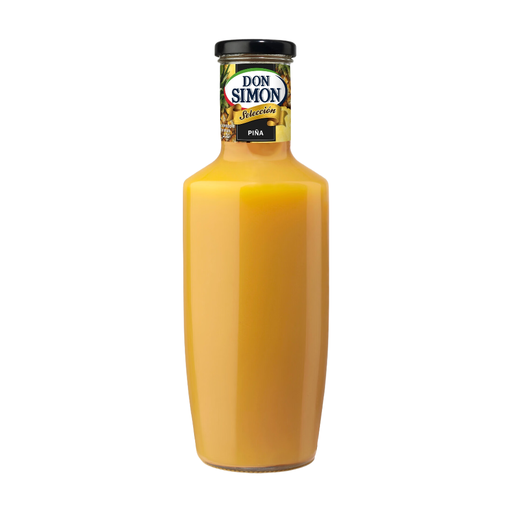 Image unavailable
Don Simon pineapple nectar in glass, 1 L
Worth considering if you want a glass bottle for a shared lunch or more than one serving. This is 1 L of pineapple nectar: if you’re looking for fruit juice, check the product description before buying. Protect the bottle on your journey and follow the storage instructions after opening.
View on Joybuy
Frequently asked questions
Is pure juice always sugar-free?
No. Juice can contain sugars that occur naturally in fruit, even if no sugars have been added. As an example for this specific product, Courses U states that its Tropicana Pure Premium Smooth Orange in a glass bottle contains 8.6 g of sugars per 100 mL.
How can I tell fruit juice and nectar apart?
Read the product description: ‘fruit juice’ and ‘nectar’ are distinct categories, as the DGCCRF points out. To find out what’s in the bottle you’re considering, check its ingredients list and nutritional information too.
Can I keep a large bottle of juice in my bag after opening it?
Don’t assume that a glass bottle means you can ignore the storage instructions on the label. For the 1 L Tropicana Pure Premium Smooth Orange, Courses U says to keep the opened bottle at 7 °C or below and consume it within five days. You should also protect it from knocks while travelling.
Is single-use glass necessarily better than other containers?
No. The material alone isn’t enough to make a general comparison. A glass bottle may suit your presentation preference, but you’ll need to protect it on your journey. If portability matters more than the container, consider the other sizes and types available too.
Can juice replace water at lunch?
No, water is still the drink to prioritise. Manger Bouger recommends limiting fruit juice as much as possible and, in any case, having no more than one glass a day. If you have juice at lunch, bear in mind how much you actually drink.


