
Livraison le jour même ou le lendemain

Qualité garantie

Débloquez vos offres de bienvenue: Livraison GRATUITE | Jusqu'à -80 % | 30 jours d'essai gratuits à JoyPlus
Téléchargez l'application
Whether you're on a business trip or a globetrotting holiday, one thing is constant: our entourage of electronic devices comes with us. Laptops, smartphones, tablets, headphones... The challenge? Keeping everything powered up without lugging around a myriad of chargers and incompatible plugs. This is where a high-performance universal USB-C travel adapter comes in: the ideal solution for travelling with a light bag and a clear mind.
This guide breaks down the essential criteria—power, versatility, safety—to help you find the model that perfectly suits your needs. To illustrate our points, we will then present a selection of products that have caught our attention.
Before you check out, let's review the technical features that will make all the difference once you're on the road.
For today's traveller, power is a non-negotiable criterion. A travel laptop charger typically requires at least 60-65W for efficient charging. Opting for a 65W adapter ensures you can power your computer and also fast-charge your other devices at full speed.
The other revolution is GaN (Gallium Nitride) technology. Chargers incorporating it are significantly more compact, lighter, and generate less heat than their traditional silicon counterparts at the same power level. A 65W GaN travel charger therefore offers an unbeatable power-to-size ratio—a decisive advantage when packing your suitcase.
The core purpose of a travel adapter is, of course, its ability to plug into any electrical outlet in the world. A good model must include the most common plugs: EU (Europe), UK (United Kingdom), US (North America, Japan), and AU (Australia, China).
But beyond the wall socket, the number and type of output ports are just as crucial. A multi-port power adapter that combines several USB-C ports (for fast charging and modern devices) and USB-A ports (for backward compatibility) is a true Swiss Army knife. It allows you to charge your entire array of devices simultaneously with a single unit. This is the very definition of a modern universal travel plug.
When juggling different countries' electrical standards, caution is key. Ensure the adapter has essential safety certifications, such as the CE mark in Europe. Protections against overvoltage, overheating, and the presence of a replaceable fuse are all safeguards that will guarantee the security of your precious electronic devices.
Here are a few options that meet different traveller needs, taking into account the criteria discussed.
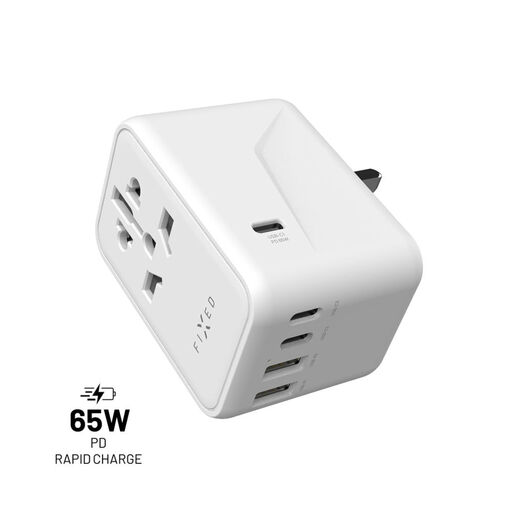
Why It Stands Out: This model is the perfect answer for the hyper-connected traveller. It checks all the boxes: 65W of power driven by GaN technology, a rich selection of ports with 3 USB-C and 2 USB-A, and retractable prongs for near-universal compatibility. It's a true global plug adapter capable of powering a laptop and several other devices simultaneously.
Advantages:
Who is it for? Ideal for the digital nomad, the business professional, or simply the discerning traveller looking for a single, powerful, and compact solution to power their entire electronic ecosystem, including a laptop.
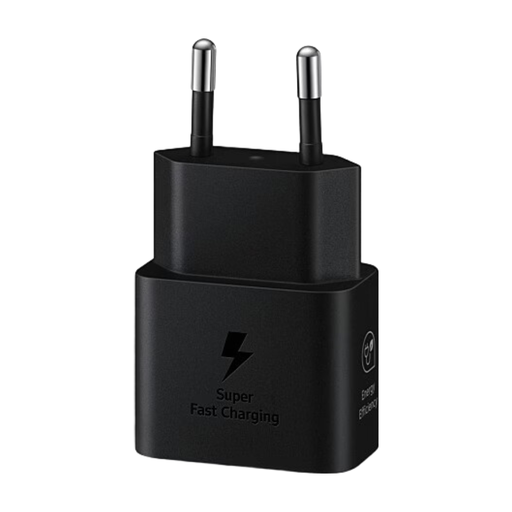
Why It Stands Out: Note that this is not a universal adapter in the strictest sense, but this Samsung wall charger is a highly relevant alternative due to its compactness and efficiency. With 25W, it provides very fast charging for most recent smartphones and tablets. Its feather-light design makes it an excellent companion for short trips or as a supplement to a main charger.
Advantages:
Who is it for? For the traveller who makes lightness an absolute priority and whose main need is to quickly charge their smartphone and tablet. Be aware that you will need to pair it with a simple plug adapter to use it in countries that do not use the European standard.
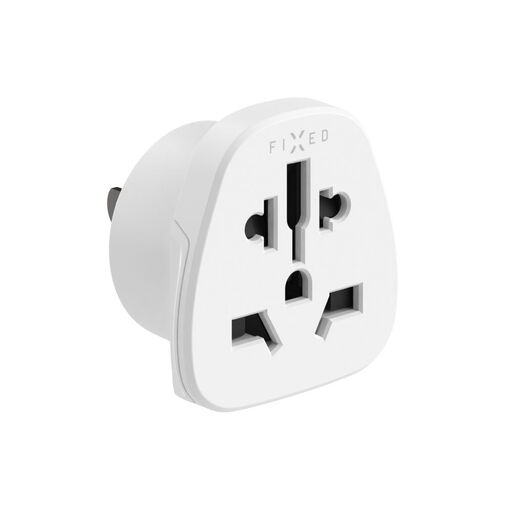
Why It Stands Out: Sometimes, simplicity is best. This adapter gets straight to the point: it does not convert voltage and has no integrated USB ports. Its one and only function is to allow a device with a European, British, or Australian plug to be connected to an American (Type B) wall socket. It is the quintessential budget-friendly and reliable solution for a very specific task.
Advantages:
Who is it for? For the occasional traveller heading to a country that uses Type B outlets (USA, Canada, Japan, etc.) who already has their own chargers.
Our selection covers the most common scenarios, but every traveller has unique needs. If you're looking for a different power rating, another port configuration, or an adapter for a specific region, feel free to explore our full range.
Explore Our Full Collection of AC Power Adapters
Yes, absolutely and completely risk-free. Modern chargers and compatible devices (thanks to standards like USB Power Delivery) communicate to adjust the power supplied in real time. A 65W charger will only deliver the maximum power your smartphone can accept (e.g., 20W or 25W). Your devices are therefore not at risk of overcharging.
This is a critical distinction for the safety of your devices. A travel adapter simply changes the physical shape of the plug so it fits into the wall socket of the country you're visiting. It does not change the electrical voltage (e.g., 230V in France vs. 120V in the United States). A voltage converter, on the other hand, transforms this voltage. Fortunately, nearly all modern electronic device chargers (for laptops, smartphones, etc.) are now multi-voltage (100-240V compatible) and therefore only need a simple adapter. The rule of thumb: always check the small label on your original charger.
No, far from it. It's a genuine technological breakthrough. Gallium Nitride (GaN) is a semiconductor material that is much more efficient than the traditionally used silicon. It allows more power to be transmitted through a much smaller volume while generating less heat. For the user, the benefit is immediate: chargers that are radically smaller, lighter, and more energy-efficient.