
Livraison le jour même ou le lendemain

Qualité garantie

Débloquez vos offres de bienvenue: Livraison GRATUITE | Jusqu'à -80 % | 30 jours d'essai gratuits à JoyPlus
Téléchargez l'application
The excitement of planning a trip can quickly turn into a technical headache: plugging in our electronic devices. Faced with an unfamiliar wall socket, the simplest charger becomes a paperweight. The universal travel adapter presents itself as the perfect solution, but the market is flooded with models whose promises often fall short.
Before making your choice, it's best to know the common pitfalls that can render an adapter useless at best, and dangerous at worst.
To avoid making a mistake, you need to look beyond the marketing spiel and focus on a few key technical points.
A true universal travel adapter must be compatible with the four major international plug standards:
The robustness of the selection mechanism is just as crucial. A quality system ensures a stable and reliable connection, trip after trip. A good international plug adapter should fit snugly into the socket, without any wobble.
What distinguishes a simple adapter from a modern universal travel charger are its charging capabilities. For today's travelers, one or more integrated USB ports have become indispensable.
The crucial feature to look for is a USB-C Power Delivery (PD) port. This technology provides fast, intelligent charging for compatible devices. A universal USB-C adapter with at least 30W is an excellent all-round choice. It can quickly charge a smartphone, a tablet, and even some ultrabooks. Standard USB-A ports remain useful for older devices or accessories.
Never compromise on safety. A universal power adapter worthy of the name must display the CE mark, a guarantee of its compliance with European safety standards.
Another essential safety feature is the built-in fuse. It acts as a shield in the event of a power surge, "sacrificing" itself to protect the circuits of your computer or smartphone. Ideally, the adapter even comes with a spare fuse.
To help you see more clearly, here is our selection of models that suit different traveler profiles, all evaluated on strict criteria for performance and reliability.
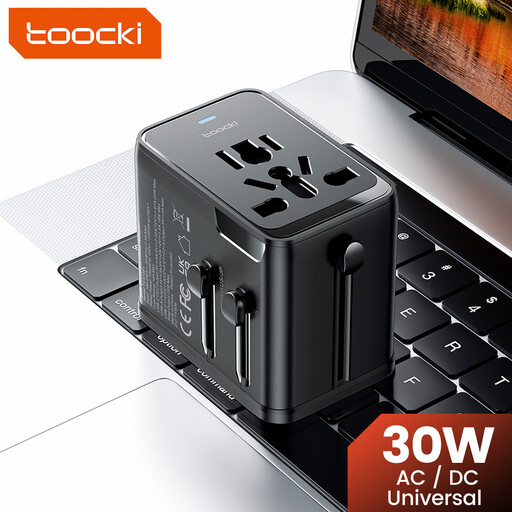
The Verdict: Ideal for those who juggle multiple devices (laptop, tablet, smartphone). This all-in-one solution charges up to three devices simultaneously, including one via its fast-charging USB-C PD port. It's enough to let you leave your other chargers at home.
It solves the problem of underpowered USB ports with its 30W USB-C PD port, powerful enough to efficiently charge modern devices.
Worldwide compatibility (EU, UK, US, AUS) and a trio of ports (2x USB-C, 1x USB-A) in a compact form factor.
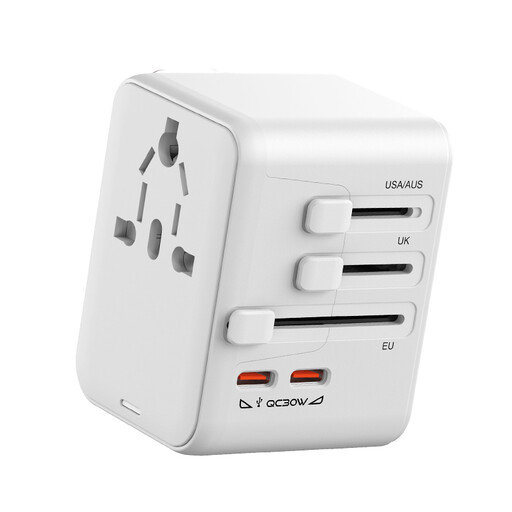
The Verdict: Perfect for the occasional traveler who just wants to plug in their usual chargers (phone, camera) anywhere in the world, without any fuss. A simple, compact, and reliable solution.
It avoids the "fake universal" trap by focusing on the essentials: broad compatibility and a simple but functional slider mechanism.
Covers over 150 countries (Europe, UK, US, Japan, Australia). Ultra-compact design, easy to slip into any bag.
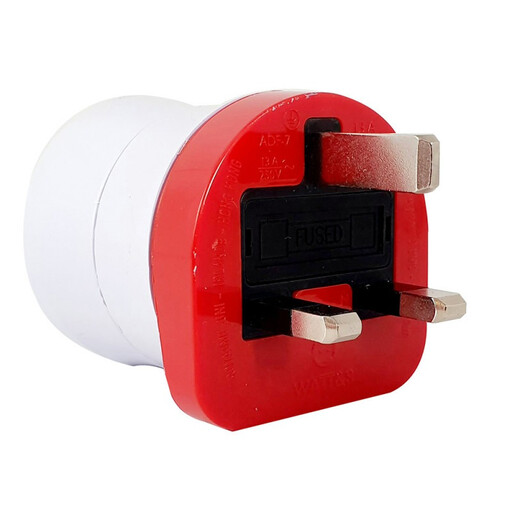
The Verdict: For frequent visitors to the UK (and countries using the Type G plug). A dedicated adapter is often more robust and compact than a multi-function universal model.
It bypasses the issue of sometimes-fragile universal mechanisms by opting for an ultra-sturdy, single-piece construction. It does one job, but with rock-solid reliability.
Grounded connection for maximum safety. Supports high power (up to 3200W), is CE certified, and comes with a lifetime warranty.
We've curated a full selection of products that meet our selection criteria and current safety standards.
No, and this is a common and potentially dangerous misconception. An adapter only changes the physical shape of the plug. It never converts the electrical voltage (e.g., from 230V in Europe to 110V in the US). Fortunately, most modern chargers (for laptops, smartphones) are now dual-voltage (look for "INPUT: 100-240V" on the label). It's a crucial habit to check this before plugging anything in.
If you're choosing a model with USB ports, a USB-C port of at least 30W is the standard to aim for today. It's the ideal compromise for quickly charging most devices, including tablets and ultrabooks. For a more power-hungry laptop, a 65W port (or higher) would be more comfortable, but 30W provides a very versatile baseline.
This is technically possible, but strongly discouraged. This kind of "daisy-chaining" significantly increases the risk of overheating and overload, especially with a low-end adapter. Every adapter is designed for a maximum power rating (in watts or amps) that should never be exceeded. A power strip loaded with several devices will quickly surpass this limit. To safely plug in multiple devices, opt for an adapter that has multiple USB ports built-in.