
Livraison le jour même ou le lendemain

Qualité garantie

Débloquez vos offres de bienvenue: Livraison GRATUITE | Jusqu'à -80 % | 30 jours d'essai gratuits à JoyPlus
Téléchargez l'application
Packing your suitcase is the start of the journey. Making sure your devices don't run out of power on the other side of the world is another challenge entirely. A dead battery during a Zoom meeting, or a smartphone dying while you're desperately searching for your hotel in an unfamiliar city... It's a nightmare scenario that's easy to avoid. Yet, the travel adapter market is a jungle, filled with gadgets that can turn the promise of a miracle solution into a useless—or even dangerous—purchase. As a product expert at Joybuy, my mission is to guide you in making the right choice.
Before you buy, let's review the hidden flaws that make so many models ineffective, or even hazardous, after just a few trips.
To avoid falling into these traps, here are the technical specifications on which you should never compromise.
Power, measured in watts (W), is the crucial factor: it determines charging speed. Here are a few benchmarks:
Opt for a model with at least one USB-C port that supports Power Delivery (PD). This smart charging protocol adjusts the power output in real time to ensure a charge that is both fast and safe. For today's traveller, a multi-port USB-C charger is a major asset.
The acronym GaN stands for Gallium Nitride. Without getting into a physics lesson, here's the key takeaway: a GaN charger is smaller, lighter, and generates far less heat than a traditional charger with the same power output. For a travel charger, where every gram and square centimetre in your luggage counts, GaN technology is a game-changer.
A true world power adapter worthy of the name must cover at least the four major plug standards: EU (Type C/F), UK (Type G), US (Type A/B), and Australia/New Zealand (Type I). Ensure the prong selection mechanism is sturdy and includes a safety feature that prevents multiple plug types from being deployed at the same time. This is a crucial safety point. Finally, always check for the CE mark, which certifies its compliance with European safety standards.
Instead of an endless list, we've selected targeted solutions for different types of travellers, chosen for their relevance and excellent design.
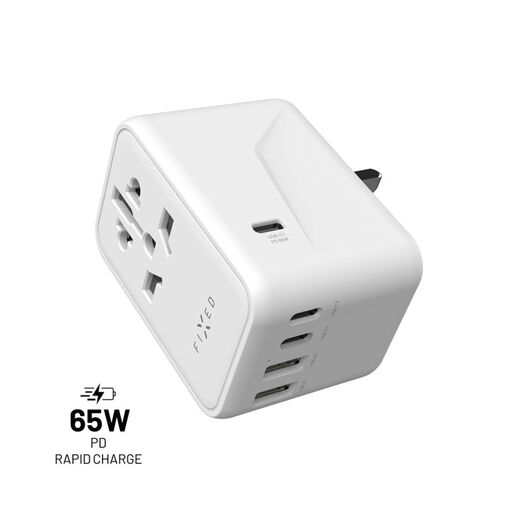
Why we recommend it: This is the ultimate all-in-one solution for those who travel with a full tech arsenal. Laptop, tablet, smartphone, smartwatch... it can power everything at once thanks to its ample power and generous port selection.
Its 65W power output and GaN technology eliminate the problem of slow charging. Its robust and secure plug selection mechanism puts an end to the nightmare of fragile adapters.
5 ports (3x USB-C, 2x USB-A) and a front-facing AC outlet that remains available. Worldwide compatibility (EU, UK, US, AU). A true travel charging station.
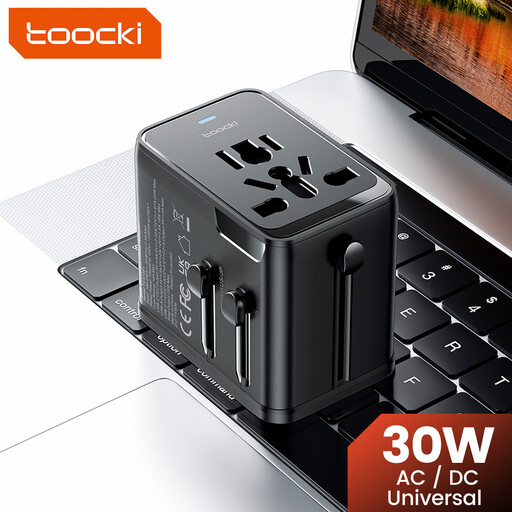
Why we recommend it: Ideal for those who travel light with a smartphone and perhaps a tablet. It gets straight to the point: worldwide compatibility, fast charging, and multiple ports, all in a compact form factor at a very accessible price.
With its 30W output and USB-C PD port, it leaves basic adapters in the dust by providing a fast charge for everyday devices. It also includes all the essential safety protections.
The perfect balance of performance, versatility (3 ports, including 2 USB-C), and compactness. It meets the needs of most travellers with no unnecessary frills.
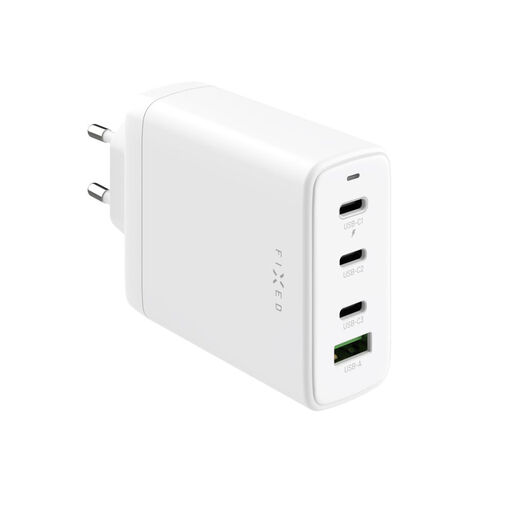
Why we recommend it: Designed for professionals whose laptop is their primary work tool. This charger bets everything on raw power to fuel the most demanding machines, without forgetting ports for secondary devices.
It obliterates the anemic power problem. With 120W total and a USB-C port capable of delivering up to 100W, it recharges a laptop as fast as its original charger. Period.
Serious firepower in a compact form factor, thanks to GaN technology. It's a universal charger in terms of voltage (100-240V) and power, designed to be paired with a simple plug adapter for the specific country.
Explore our complete, up-to-date selection of products that meet our strict selection criteria and safety standards.
No, and this is a common and dangerous misconception. An adapter only changes the shape of the prongs to fit a foreign wall socket. It does not convert the electrical voltage (e.g., from 230V in Europe to 120V in the US). Fortunately, nearly all modern device chargers (for laptops, smartphones, etc.) are now dual-voltage: they accept a voltage range from 100V to 240V. Always check for this information, which is usually printed in small text on your original charger.
The short answer: no. High-power appliances like hairdryers, straighteners, or kettles almost always exceed the maximum power rating of a travel adapter (typically limited to 10A, or about 2300W in Europe). Attempting to plug them in can cause the adapter to melt, create a short circuit, and poses a very real fire hazard. Reserve your adapter for your electronic devices only.
A quality model with a solid mechanism and certified components can accompany you on dozens of trips over many years. In contrast, low-end models with fragile moving parts often fail after just one or two trips. Investing in a well-designed product gives you peace of mind and a durable travel companion.