Who are these options for?

Anyone replacing a built-in appliance

If you already have a space under your worktop, measure it and check the plinth and front-panel type before choosing a new model. Que Choisir points out that a built-in appliance is designed for a space specifically made to accommodate it.

Households that want visible controls

A semi-integrated model keeps the control panel visible, unlike a fully integrated one. This may matter if you want to see the controls while the door is closed.

Shoppers mindful of noise and energy use

Once you’ve identified compatible models, the energy label helps you compare capacity, electricity and water use, and noise levels, as the ADEME explains.

What should you consider before choosing?

Semi-integrated

Consider this if: your space can accommodate this type of appliance and you want a visible control panel.

Bear in mind: the control panel remains visible alongside your cabinets; the front panel and plinth must be suitable for the exact model.

Fully integrated

Consider this if: you prefer a front panel that blends in with your cabinets and have a suitable space.

Bear in mind: the controls are less immediately visible than on a model with an exposed panel; the cabinet door must be compatible.

Freestanding

Consider this if: your kitchen layout allows you to install a freestanding appliance without requiring a decorative front panel.

Bear in mind: the appliance won’t blend in with your cabinets in the same way; installation under a worktop must be permitted for your chosen model.

FactorWhat to checkWho it matters to
Space compatibility Measure the height, width and depth, then compare them with the installation diagram for the exact model, including its plinth and front-panel requirements. I’m replacing an under-counter appliance and want to avoid finding that a difference in dimensions prevents installation. Around 36% of consumers put compatibility at the top of their list.
Controls and front panel Choose between an exposed control panel and a fully integrated front; check the requirements for a decorative door on the model you’re considering. I want to see the controls without opening the door, or, conversely, keep a uniform kitchen frontage. This is the main consideration for around 22% of consumers.
Capacity and loading Compare the place settings and basket layout with the dishes and glasses you use. If I have bulky crockery, I need to be able to fit the items I use regularly, not just meet a certain place-setting capacity. Around 21% of consumers prioritise capacity and loading.
Energy and water use, and noise On the energy label, compare kWh per 100 cycles, litres per Eco cycle and noise levels in dB on a like-for-like basis. If my kitchen opens onto a living area or I use the appliance often, noise and energy and water use weigh more heavily in my decision. These are top priorities for around 21% of consumers.

Mistakes to avoid before ordering

  • Relying on the “60 cm” measurement alone

    This nominal width doesn’t tell you whether the height, depth, plinth or door will fit. The appliance and space dimensions listed by Bosch and Whirlpool for their respective models show why each measurement needs to be checked separately.

    Measure the space, then compare every measurement with the installation diagram for the model you’ve chosen.

  • Confusing built-in and freestanding models

    A semi-integrated model keeps its control panel visible, while a fully integrated one is designed to be concealed behind a front panel. According to Que Choisir, a built-in appliance shouldn’t simply be placed on the floor like a freestanding model.

    Decide on the look you want and check that the appliance type suits the space available.

  • Comparing energy ratings alone

    Two appliances that fit your kitchen can have different water and electricity consumption figures, as well as different noise levels. The energy rating letter alone doesn’t tell you everything you need to know.

    Compare the figures on the energy labels on a like-for-like basis, and take your usage habits and tolerance for noise into account.

  • Assuming the place-setting capacity tells you how much will fit

    The stated capacity alone doesn’t show how well large dishes, glasses or cutlery will fit. The interior layout varies between models.

    Look at the baskets and check that their layout suits the crockery you wash regularly.

Brands to consider by appliance type

Bosch

Bosch offers semi-integrated and fully integrated options among its 60 cm built-in models.

  • According to Bosch Électroménager France, the semi-integrated SMI4HCB07E measures 815 × 598 × 573 mm, while the fully integrated SMV4EVX36F measures 815 × 598 × 550 mm.
  • These dimensions apply to these specific models: check the required space and front panel before choosing either one.

Whirlpool

The semi-integrated W3PFD636W and W3PFD636B models may suit households looking for a visible control panel and a stated capacity of 14 place settings.

  • Whirlpool France lists a required space of 82/90 × 60 × 56 cm for the W3PFD636B, along with energy use of 85 kWh per 100 Eco cycles, water use of 11,5 l per Eco cycle and a noise level of 46 dB.
  • The space requirements and consumption figures listed for the W3PFD636B shouldn’t be applied to any other Whirlpool model.

Miele

Miele France’s range of fully integrated dishwashers is worth considering if a discreet front is more important to you than visible controls.

  • Miele France features fully integrated models measuring 45 cm, among others.
  • Choose a model based on the actual dimensions of your space and its specific features, not simply because it belongs to the range.

Freestanding models available on Joybuy

These two freestanding dishwashers are options for placing an appliance under a worktop, provided the model’s instruction manual and the dimensions of the space allow for it. They aren’t a substitute for choosing a semi-integrated model if your kitchen requires a built-in front with a visible control panel.
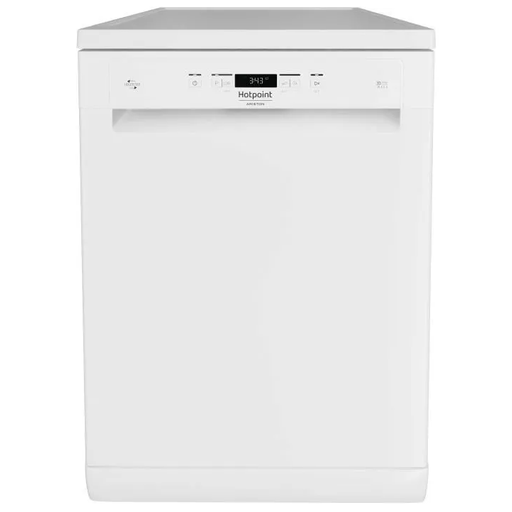
White Hotpoint H4FD641A freestanding dishwasher

Hotpoint H4FD641A freestanding dishwasher, 14 place settings, white

Consider this for an under-counter space only if the instruction manual allows this installation and the dimensions of your space are suitable.

Stated width: 60 cm. Stated noise level: 41 dB. Stated energy rating: C. Check the energy label to compare electricity use too.

View on Joybuy
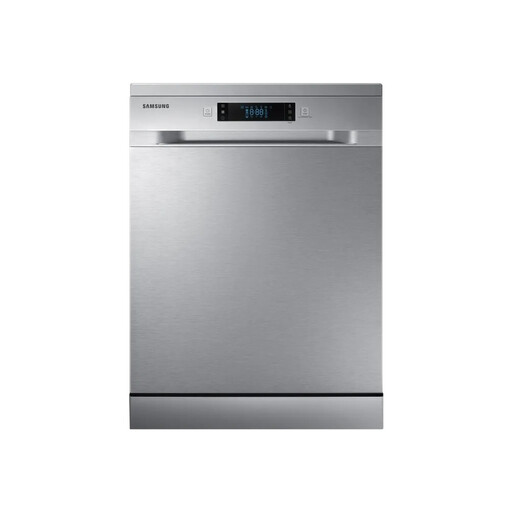
Grey Samsung DW60M6050FS freestanding dishwasher

Samsung DW60M6050FS freestanding dishwasher, 14 place settings, grey

A freestanding option to consider if you want to place the appliance under a worktop: check the instruction manual for the required dimensions, clearances and installation conditions.

This model is listed with 7 programmes. Check that its interior layout suits the crockery you use.

View on Joybuy

Frequently asked questions

What’s the difference between a semi-integrated and a fully integrated dishwasher?

A semi-integrated model keeps its control panel visible, while a fully integrated one is designed to blend in with your kitchen cabinets. In either case, check the installation diagram and door requirements for the exact model.

Can you install a built-in dishwasher like a freestanding model?

No, a built-in dishwasher isn’t designed to simply stand on the floor. Que Choisir explains that built-in appliances must be installed in the space made for them; if you need a freestanding installation, look for a model designed for that purpose.

What should you measure before ordering?

Measure the height, width and depth of the space, then compare them with the installation diagram for the model you’re considering. Also check the clearances and plinth, and, for a built-in appliance, make sure the door or front panel is compatible. “60 cm” alone isn’t enough.

What should you compare on a dishwasher’s energy label?

Compare the kWh per 100 cycles, litres per Eco cycle and noise level in dB, after confirming the appliances will fit your space. The ADEME explains that the energy label gives information about energy and water use and noise; these figures are more useful for comparing models than the rating letter alone.