
Livraison le jour même ou le lendemain

Qualité garantie

Débloquez vos offres de bienvenue: Livraison GRATUITE | Jusqu'à -80 % | 30 jours d'essai gratuits à JoyPlus
Téléchargez l'application
After sterilisation, adult cats often live exclusively indoors and get less exercise. Their diet therefore deserves a little more attention: ingredients, serving size, bag size and palatability all need to be considered together.
Ultima cat food for sterilised cats is available in several recipes, flavours and pack sizes. But attractive packaging alone is not enough to determine whether a product is genuinely suitable for your companion’s lifestyle.
Claims such as “weight control”, “sensitive digestion” or “urinary health” primarily indicate the recipe’s intended purpose. They do not provide a diagnosis and do not replace veterinary advice. A formula designed for sterilised adult cats is not automatically suitable for an animal with a diagnosed urinary, kidney or digestive problem.
Even relatively low-fat food for sterilised cats can lead to weight gain if portions are too generous. Treats, small table scraps and wet food for sterilised cats must also be included when calculating daily intake.
Ultima 12 kg bags can be a practical choice for households with several cats. However, once opened, a large pack may gradually lose its freshness and palatability. For a single cat, the 1.5 kg Ultima pack allows you to replace the food more frequently. Whatever the pack size, store it in a dry, cool place away from light, ideally in an airtight container.
Start by checking the regulated product description on the packaging. The products featured here are labelled as complete food for sterilised adult cats or for sterilised adult cats living indoors. They are designed to meet daily nutritional needs, provided that the manufacturer’s feeding guidelines are followed.
These products are not intended for kittens or pregnant or nursing cats. If your cat has specific nutritional needs, ask your vet for advice before changing its diet.
Depending on the product, the selected Ultima dry recipes generally contain around 35 % crude protein and 12 % to 12.5 % fat. Their crude fibre content is typically between 3 % and 4 %. These figures provide an objective basis for comparing labels.
The ingredients list can then help identify the highlighted protein source:
The presence of plant proteins, cereals or dehydrated animal proteins should not be judged in isolation. To compare two products properly, consider the ingredients as a whole, the nutritional analysis and how well your cat tolerates the recipe.
For several recipes, the recommended amounts range from 25 to 40 g per day for a 2 to 3 kg cat, then increase as the cat’s weight rises. Treat these figures as a starting point: they should be adjusted according to the cat’s age, activity level and body condition.
Always make sure your cat has clean, fresh water available. Wet food can be combined with dry food, but you will need to reduce the quantities accordingly to avoid excess calories. When changing food, allow for a gradual transition over 7 to 10 days.
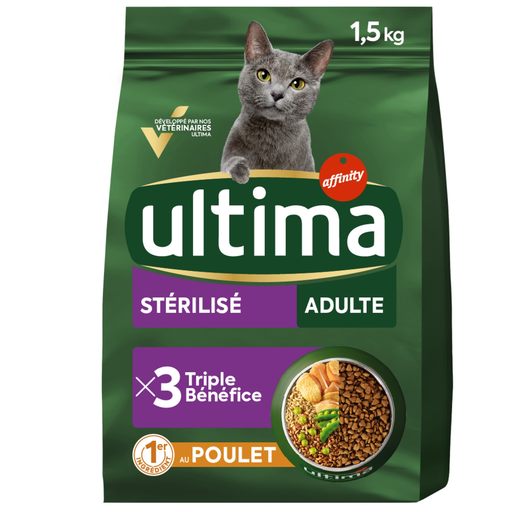
Why this choice suits this profile: The 1.5 kg bag lets you try a chicken recipe without committing to a large budget or filling your cupboard with a big pack.
It avoids buying too much before checking whether your cat enjoys the recipe and digests it properly.
Chicken listed at 17 %, 35 % crude protein and 12 % fat according to the product information.
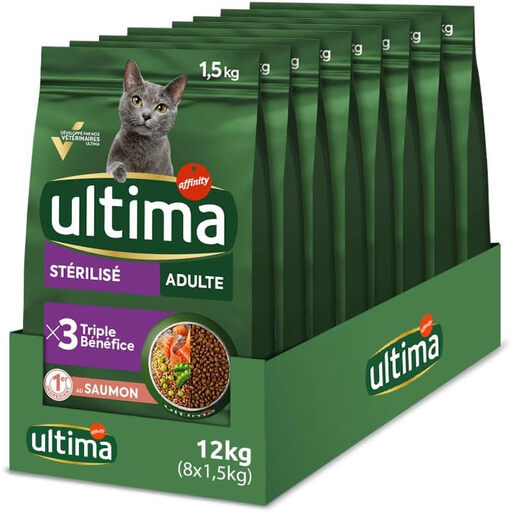
Why this choice suits this profile: This eight-bag pack is ideal for households that want to stock up on salmon food for sterilised cats.
The 1.5 kg bags limit the storage time after opening, unlike one very large bag.
Salmon listed at 15 %, 35 % crude protein and 12 % fat according to the product information.
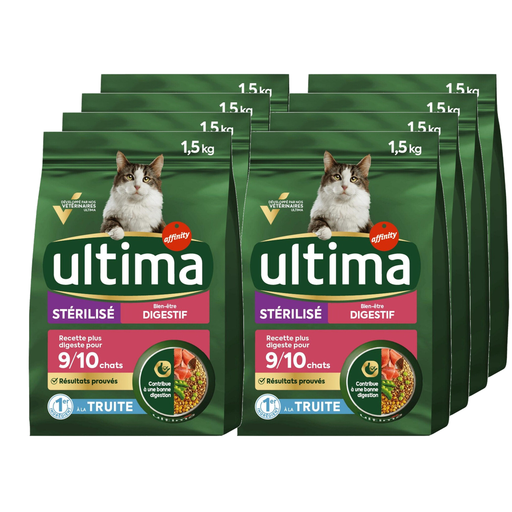
Why this choice suits this profile: The 12 kg bag is aimed at families with several cats or those serving this recipe over a longer period.
It encourages you to focus on the ingredients and nutritional analysis rather than simply relying on a promise of easier digestion.
Trout listed at 16 %, 35 % crude protein, 12.5 % fat and 3 % crude fibre.
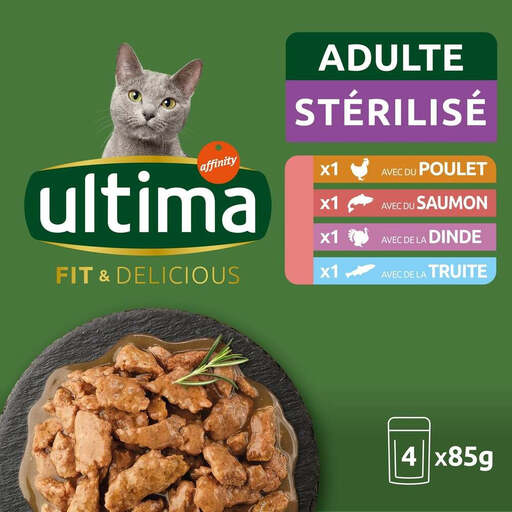
Why this choice suits this profile: This wet food multipack includes four varieties in convenient 85 g portions, ideal for occasionally varying mealtimes and complementing a dry-food diet.
Individual portions make it easier to control quantities and avoid leaving a large opened tin around.
Complete food for sterilised adult cats, four recipes and 82 % analytical moisture according to the product information.
We have brought together a complete, real-time updated selection of products that meet these demanding criteria as well as European safety regulations.
The information sheets for the selected recipes generally recommend 25 to 40 g for a 2 to 3 kg cat, and up to 70 to 80 g for a 6 to 7 kg cat. Use these figures as a starting point, then adjust the portion according to activity, age, body shape and any supplementary foods. A simple kitchen scale can help you avoid serving portions “by eye”.
Some products are specially designed for sterilised adult cats living indoors, including the turkey recipe. According to its product information, it contains plant fibres, inulin and beet pulp, among other ingredients. This does not guarantee that it will suit every sensitivity: monitor your cat’s appetite, stools and weight over time. If a problem persists, it is best to seek advice from a vet.
This is perfectly possible, provided that the wet food is included in the daily ration. It provides a different texture and plenty of water, while dry food is easy to measure and store. Introduce each new food gradually and always keep fresh water available.