People who put fat content first
You compare the amounts per 100 ml before choosing a soya drink for breakfast or cooking. Auchan and E.Leclerc product pages let you compare several plain varieties on this basis.


If limiting fat is your priority, start by comparing plain soya drinks per 100 ml. Auchan and E.Leclerc product pages list 1.8–1.9 g for plain Sojasun, Auchan Bio and Bio Village varieties, compared with 2.8 g for the Alpro high-protein drink featured by Auchan. A version with added calcium or more protein may suit a different priority, but check the sugars and ingredients too. The word “filtered” alone doesn’t tell you how much fat a drink contains. Find out what it means for the product you’re considering and compare its nutritional information.
You compare the amounts per 100 ml before choosing a soya drink for breakfast or cooking. Auchan and E.Leclerc product pages let you compare several plain varieties on this basis.
You want a soya drink whose label specifically lists calcium, rather than assuming every recipe contains the same amount. Auchan’s product page for an enriched version lets you assess this separately from its fat content.
You choose a drink for smoothies, snacks or recipes and want to compare protein without losing sight of fat content. Auchan’s product page for the Alpro high-protein drink lists both values.
When choosing a soya drink and fat content matters, start by comparing the values per 100 ml. Then weigh up the recipes against your priorities for sugar, calcium or protein.
| Criteria | What to check | Who it’s for |
|---|---|---|
| Fat | The “fat” value per 100 ml and the portion you plan to drink. | When I have a soya drink at breakfast, fat content matters more to me than extra protein; around 36% of consumers would put fat first. |
| Sugars and ingredients | The ingredients list and the “of which sugars” value per 100 ml. | For my cereal or recipes, I want to tell a plain drink apart from a recipe containing sugar or flavourings; around 29% of consumers would prioritise this first. |
| Calcium | The amount of calcium listed and the fat content of the same product. | If calcium is my main consideration for a drink I have regularly, I want it listed on the label rather than assume it’s there; around 21% of consumers would make it their priority. |
| Protein | Protein and fat per 100 ml, compared on the same basis. | For my smoothies or pancakes, I prioritise protein while also comparing fat content; around 14% of consumers would put protein first. |
According to Auchan’s product pages, the Alpro high-protein drink contains 5 g of protein and 2.8 g of fat per 100 ml. The plain Sojasun and Auchan Bio varieties contain 1.8 g and 1.9 g of fat per 100 ml respectively.
If fat content is your main priority, compare this value first and then decide whether the difference in protein meets your needs.
Auchan’s product page for its soya drink with added calcium lists 2.5 g of sugars per 100 ml. A mention of calcium alone doesn’t tell you what else is in the recipe.
Check the ingredients list and the “of which sugars” value for the specific product you’re considering.
On its own, this term doesn’t tell you how much fat the drink contains or what it’s made from.
Check which process it refers to on the packaging or product page, then compare the nutritional values per 100 ml.
Soya must be identified as an allergen on the labels of relevant foods, as explained by the French Ministry of the Economy. Bio Village’s product page also states that its drink is not a substitute for breast milk or infant formula for babies under one year old.
Check the label if you need to avoid soya, and don’t choose an everyday soya drink as a substitute for infant nutrition.
Auchan’s product page features a 1 L carton of plain UHT soya drink that can be enjoyed as a drink or used in cooking.
Auchan describes its 1 L carton of plain organic UHT soya drink as containing organic soya juice sourced from France.
E.Leclerc offers a 1 L carton of plain organic UHT soya drink under its Bio Village brand.
Auchan’s product page features a 1 L carton of high-protein soya drink for breakfast and certain recipes.
This Barista-style soya drink is worth considering for drinks and recipes. If you’re looking for a long-life product or a particular fat content, check these details for the specific product before choosing.
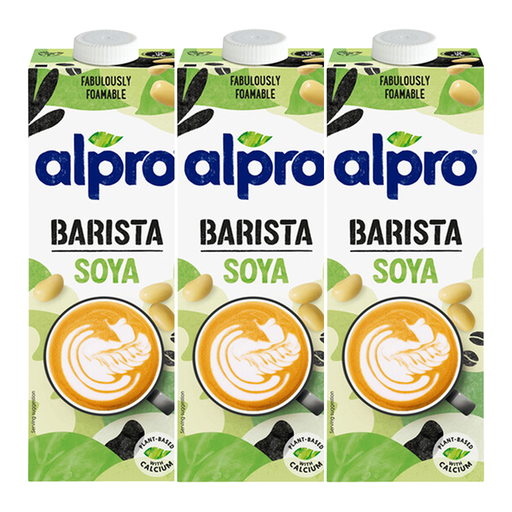 Image unavailable
Worth considering if you’re looking for a Barista-style soya drink for your drinks or recipes.
Pack size: 3 × 1 L cartons. Compare the fat and sugar content on the packaging. Check that it’s UHT and follow the storage instructions if you need a long-life product.
Compare the “fat” value per 100 ml, then look at the other criteria that matter to you. Auchan’s product pages list 1.8 g for Sojasun Nature, 1.9 g for Auchan Bio Nature and 2.8 g for Alpro high-protein; E.Leclerc lists 1.8 g for Bio Village Nature.
Follow the instructions on the carton you buy. Auchan’s product pages for Sojasun, Auchan Bio, its enriched drink and Alpro say to refrigerate after opening and consume within five days.
No. E.Leclerc’s Bio Village product page states that this drink isn’t suitable as a replacement for breast milk or infant formula for babies under one year old. Don’t choose an everyday soya drink for this purpose.
Check the ingredients list, allergens and nutritional information to compare the recipe and fat content. The French Ministry of the Economy states that allergens must be highlighted on the labels of relevant foods. Also check the product’s storage instructions.