
Livraison le jour même ou le lendemain

Qualité garantie

Débloquez vos offres de bienvenue: Livraison GRATUITE | Jusqu'à -80 % | 30 jours d'essai gratuits à JoyPlus
Téléchargez l'application
To charge a Tesla, Audi, BMW, Mercedes, Volkswagen, Hyundai or Kia at a public charging point, a Type 2 electric car charging cable is often essential. However, choosing the wrong model can limit the available power, make connection more difficult or become awkward to handle every day.
Before buying, three common pitfalls are worth bearing in mind:
A 7 kW electric vehicle charging cable generally operates single-phase up to 32 A, while a 22 kW charging cable operates three-phase up to 32 A. However, the actual power delivered depends on three factors:
A vehicle equipped with a 6 to 7.68 kW OBC can make use of a 7 kW cable. A model with a 22 kW three-phase charger can take advantage of a 22 kW cable, provided the charging point and electrical installation support it. Check this information in the vehicle’s manual or technical specifications before ordering.
For a plug-in hybrid, a 7 kW charging cable is often sufficient, as the onboard charger is generally more limited. A higher-powered cable can still be used in certain situations, but it will not charge the vehicle beyond its own limit.
The format you will generally need is a Type 2 to Type 2 cable, with a male plug for the charging point and a female plug for the car socket. This standard complies with the European IEC 62196-2 standard for alternating-current charging.
A vehicle fitted with a CCS2 combined socket will usually have a Type 2 section at the top for alternating-current charging. However, this cable should not be confused with a CCS cable designed for rapid direct-current charging. J1772, CCS1 and CHAdeMO connectors are not compatible with the models featured here.
The length should suit your parking arrangement:
An IP54 rating means that the product is protected against dust and water splashes. It does not mean that it can be submerged or left in a puddle for an extended period. For outdoor use, also look for a flexible cable, a durable sheath and protective caps.
The products below feature a TPU sheath, PA66 and TPU connectors, and a claimed resistance of more than 20,000 bends. The product listing also mentions TÜV Rheinland certification and compliance with several standards, including CE, UKCA, RoHS, ISO and IEC. Keep this information with the instructions and check it on the packaging when your order arrives.
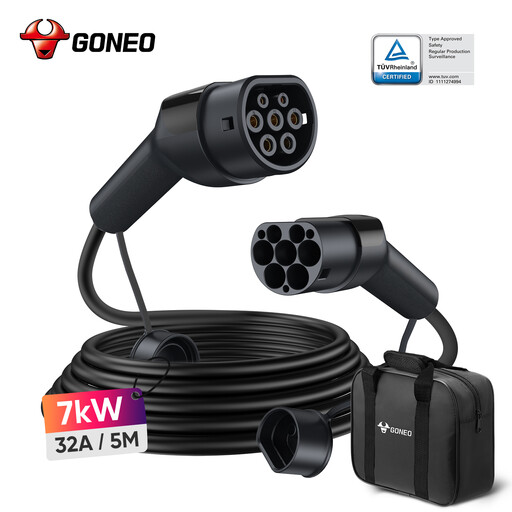
Why this choice suits this profile : its 5 m length and single-phase power of up to 7 kW make it ideal for first-time use at home or at a nearby charging point.
The stated power rating comes with clear specifications: 32 A, single-phase and 5 m. This makes it easier to compare with your car’s OBC capacity.
Stated IP54 protection, TPU sheath, carry bag and TÜV Rheinland certification mentioned in the product listing.
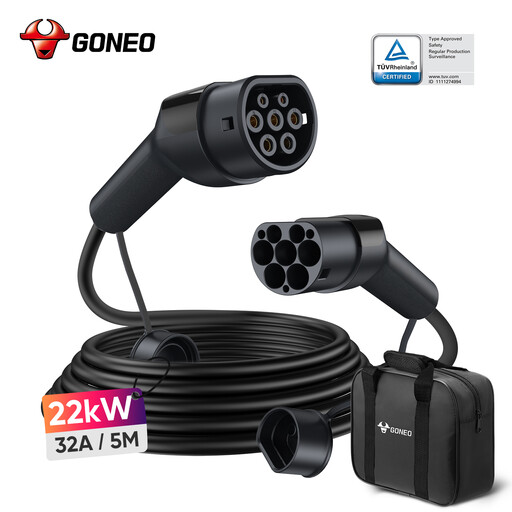
Why this choice suits this profile : this 5 m three-phase Type 2 cable is designed for drivers whose vehicle and charging point support charging at up to 22 kW.
The 22 kW rating should not be taken as a guaranteed charging speed: it is mainly useful for choosing a cable that matches a compatible three-phase OBC.
32 A three-phase, TPU sheath, silver-plated contacts and storage bag, according to the product listing.
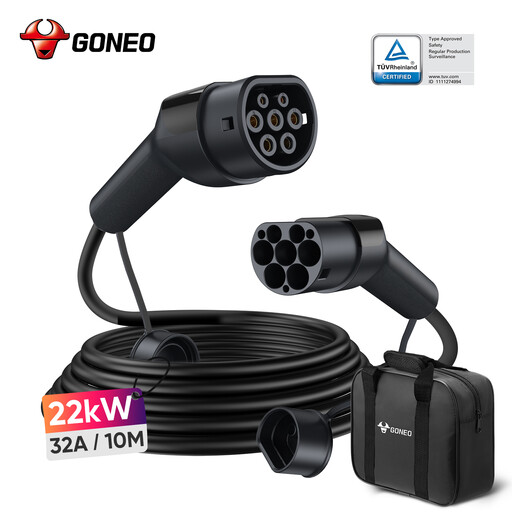
Why this choice suits this profile : its 10 m length makes connecting easier when the charging point is further away, positioned to the side or difficult to line up with the car.
This length lets you work around parking constraints without putting the cable under tension. However, avoid excessively tight bends and running it underneath the wheels.
22 kW configuration, 32 A three-phase, stated IP54 rating and a claimed resistance of more than 20,000 bends.
We have put together a comprehensive, real-time updated list of products that fully meet these strict selection criteria and European safety regulations.
No. Charging speed depends on whichever limit is lowest among the charging point, cable and onboard charger. With a vehicle limited to 7 kW, a 22 kW cable will not increase the charging power. It may nevertheless be a sensible choice if you change vehicle or regularly use three-phase charging points.
Measure the distance between the charging point socket and the vehicle socket, allowing some extra length to prevent tension. A 5 m Type 2 cable is suitable for direct connections. The 7 m model offers greater flexibility in public parking spaces. The 10 m version is ideal when the charging point is further away, but it will generally be heavier to carry.
Put it back in its bag after each use, keep the contacts clean and dry, and replace the supplied cap. Avoid sharp bends, pulling on the connectors and repeatedly running the cable underneath the wheels. An IP54 rating protects against splashes, but you should still store the cable away from standing water.